Huey Long Quotes
So, we have in America today, my friends, a condition by which about 10 men dominate the means of activity in at least 85 percent of the activities that you own. They either own directly everything or they have got some kind of mortgage on it, with a very small percentage to be excepted. They own the banks, they own the steel mills, they own the railroads, they own the bonds, they own the mortgages, they own the stores, and they have chained the country from one end to the other
Huey P. Long, 1893-1935, Louisiana Governor, U.S. Senator (Democrat, LA), Speech, “Every Man a King,” February 23, 1934
Sourced by: Eigen's Political and Historical Quotations


The National City Company was formed expressly as an attempt to dominate and monopolize the United States economy. It was a holding company that included Standard Oil, National City Bank, 16 other banks, and the Union Pacific and Southern Pacific railroads among others, all controlled by the same 3 men--William Rockefeller, .James Stillman, and Frank Vanderlip.


The last sentence echoes a quotation of Napoleon. See {630664} .


The Rockefeller Trust was Standard Oil and its many subsidiaries and other related companies. Note the firmness with which the President announced the prosecution of this huge trust. In modern times, Presidents have rarely been so definitive about their intention to prosecute a corporation.

FDR even admitted that very wealthy men and corporations controlled most U. S. governments including the administration of his own political party. Roosevelt did a great deal to improve the situation but by the latter years of the 20th century, private financial entities gained back much of the influence and control. The result was the Meltdown of 2008 and the Great Recession, where another set of regulations and laws (Dodd-Frank) was made law by the Obama Administration. However, the financial corporations still had enormous political influence as a result of unlimited campaign contributions to politicians and unlimited lobbying.


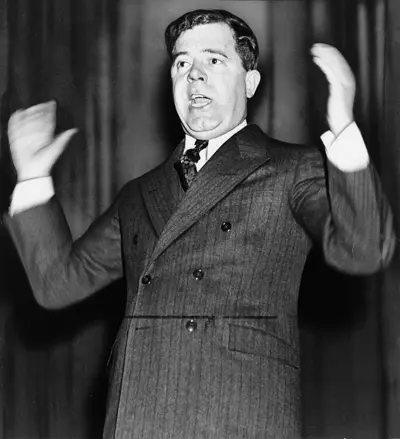
Huey Pierce Long Jr., byname "The Kingfish", was an American politician who served as the 40th governor of Louisiana from 1928 to 1932 and as a member of the United States Senate from 1932 until his assassination in 1935. He was a populist member of the Democratic Party and rose to national prominence during the Great Depression for his vocal criticism of President Franklin D. Roosevelt and his New Deal, which Long deemed not radical enough. As the political leader of Louisiana, he commanded wide networks of supporters and often took forceful action. A controversial figure, Long is celebrated as a populist champion of the poor or, conversely, denounced as a fascistic demagogue.
