Stephen J. Field Quotes
If exclusive privileges of this character [monopolies] can be granted to a corporation of seventeen persons, they may, in the discretion of the legislature, be equally granted to a single individual. If they may be granted for twenty-give years they may be equally granted for a century, and in perpetuity. If they may be granted for landing and keeping of animals intended for sale or slaughter they may be equally granted for the landing and storing of grain and other products of the earth, or for any article of commerce. If they may be granted for structures in which animal food is prepared for market they may be equally granted for structures in which farinaceous or vegetable food is prepared. They may be granted for any of the pursuits of human industry, even in its most simple and common forms. Indeed, upon the theory on which the exclusive privileges granted by the act in question are sustained, there is no monopoly, in the most odious form, which may not be upheld.
Stephen J. Field, 1816-1899, U. S. Supreme Court Justice, Dissent, Slaughter-House Cases, 1873
Sourced by: Eigen's Political and Historical Quotations

to grant a state monopoly for maintaining slaughterhouses


The “rebate agony” referred to a corrupt practice of the Railroads and the Large Monopolies. The railroads charged a very high rate for the transportation of important products like beef and oil. However, secretly they gave back a large percentage of the transportation rate charged to the trusts. They in turn could cut their prices and undersell all the smaller competitors who were paying “full freight” and could not afford to match the lower price. As soon as the smaller competitors were driven out of business in an area, the trust raised its rates even higher than they charged originally. The Railroad had made a small but reasonable profit on the freight of the trusts but they were guaranteed all their business. They also made huge profits on the higher rates that the small companies paid until those companies were driven out of business. Journalists like Ray Baker and Ida Tarbell had uncovered the rebate scheme which enabled the trusts to steal high amounts from the general public through unreasonably high prices. President Theodore Roosevelt was committed to try and regulate the railroads and not allow rebates but charge the same public rate to all with no rebates. Socialists like Sinclair, thought that this attempt would be hopeless—that the damage had already been done, and the trusts now had so much money that they could buy state legislatures and many in Congress to preserve their dominance.


He was not able to maintain this position. Even Communist and Socialist states have had to cope with problems triggered by markets.


If there would be free competition in banking as opposed to monopolies in each area, This is the first major history of banks written in the United States. At the time, there was hardly any competition amongst banks. Each bank had a do facto or official monopoly in its area. In many communities of America, this is still true, but competition in banking has reached almost all high density areas of the country.


To the modern reader utterances such as this from a Conservative Prime Minister seem astounding. However, the Great Depression existed in Canada as well as the United States, and Franklin Delano Roosevelt was not the only world leader who would reach the conclusion that business and capitalism must be profoundly regulated and the system changed if it was to be saved.


By the middle of the 20th century, the banks were no longer allowed to control the railroads and seemed less powerful, but by the beginning of the 21st century, the few largest banks, without the railroads or any other industrial holdings, were so big that the controlled credit, fraudulently manipulated rates and mortgage foreclosures and after losing huge amounts speculating in 2008, the government had to bail them out with taxpayer money while the bank executives who caused the failures tool million dollar bonuses. Never were banks so powerful in any country that they could have the government pay billions of dollars for their losses and mistakes.


Innovative science and technology from Edison and Tessla had produced an electrical industry that rapidly formed into a monopoly.
The President had decided to aggressively push for railroad regulation to end the rate rebate abuses that were used to support the monopolies like Standard Oil. In vintage Roosevelt tactics, he gave his first major speech on the subject in the setting and forum that would be most opposed to it. The Union League Club of Philadelphia in included the wealthiest men in the area where were most opposed to any Federal Regulation of anything. All the major railroad executives and stock owners and traders were also members. The President wanted to persuade the opponents to change their positions, and sometimes he did. He also was driven by his concept of sports and athletics so that the “opposition” should have “fair notice” for the contest ahead.
The first part of this quotation has defined the attitude of most Americans towards private enterprise and government since then. The second part of the quotation—the undesirability of public ownership of railroads has given way to the modern problem that no passenger railroad can be operated profitably by anyone—private or public. So Roosevelt’s “far-reaching disaster” was finally complete with the Federal Government taking over responsibility for Amtrack.

The Chief Justice refused to accept the previously established legal precedents of other states which would limit considerably the right of the state to regulate corporations. As a result Wisconsin became one of America’s pioneers in regulating corporations which over 25 years later, Theodore Roosevelt was to do for the nation as a whole. The phrase “empire within an empire,” the translation of the Latin that Ryan used, has often been quoted to describe the power corporations had at that time.
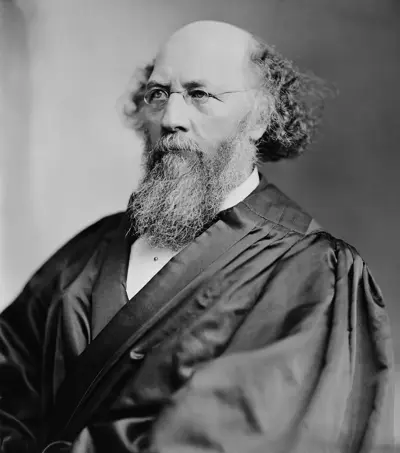
Stephen Johnson Field was an American jurist. He was an Associate Justice of the United States Supreme Court from May 20, 1863, to December 1, 1897, the second longest tenure of any justice. Prior to this appointment, he was the fifth Chief Justice of California.
