Ben Bernanke Quotes
I think that this is the most significant financial crisis in the post-War period for the United States, and it has in fact a global reach.... I think it is extraordinarily important to understand that, as we have seen in many previous examples of different countries and different times, choking up of credit is like taking the lifeblood away from the economy.
Ben Bernanke, Chairman, Federal Reserve Bank, Testimony before the Congressional Joint Economic Committee, September 2008
Sourced by: Eigen's Political and Historical Quotations


Sovereign credit substitution is where the government, one way or another, assumes and guarantees the debts of private corporations. This is an elegant way of saying: “taxpayer bailouts”

Born thought that her agency was responsible for regulating the new esoteric financial products—derivatives including credit default swaps—for otherwise there would be no regulation at all of financial products that could dwarf the stock and bond market. Summers persuaded her to back off. When the Meltdown of 2008 hit, the huge derivative exposure of the large banks and some insurance companies was so great that it was one of the major causes for the meltdown of the entire banking system. Summers, normally a great economist not only called this one wrong, but later, along with most other government and private economists ignored a very explicit warning—See {637168}, {637986}, and {620038}.


Major bankers were not only clueless in the Meltdown of 2008 and the Great Recession that followed, but they were equally hapless in the Market Crash of 1929 and the Great Depression thereafter.


Unmindful of the steady economic prosperity during the 1920s in America, Comintern “assured” American Communists that the economic growth was about to make an abrupt U-turn.


The President had a series of radio talks to the people in which he addressed them directly and explained things as he then understood them.

This quotation amazes many people who believe that Hoover caused the Great Depression and that Roosevelt and the Democrats accused him of this. Actually, as Mrs. Roosevelt says here, the causes were the policies of the Republicans who preceded Hoover. Hoover was actually to blame for not doing much about the Depression. He believed philosophically that the Government should not “intervene” in the market place and that government assistance to individuals would damage their character. Most Americans saw this as uncaring and callous.
The Chairman of the Federal Reserve Board, creatively found alternatives that the Fed had never used before and almost all experts did not even realize that were possible. He and Treasury Secretary Paulson, almost certainly saved the American system of capitalism. But in the process, they in the early stages and Bernanke throughout the crisis took a number of steps to save the system where the very people and companies whose actions had triggered the entire crisis seemed to personally benefit while most Americans were hurt badly and none of them received any immediate personal benefits the way the large bankers did. The amount of money that Bernanke and his Federal Reserve Board associates spend was staggeringly large and that too distressed many Americans. Almost all of the money was actually returned to the taxpayers as a result of the work of the Fed and the Treasury officials, but no one could feel good about the unfair disparity that had so benefitted much of Wall Street particularly and Main Street and the rest of American only generally while so many lost their jobs, their homes, their dignity and their hopes. Only the big banks and bankers also got a personal huge windfall of taxpayer money and took no risk for that. The alternative would have ruined everyone and even have been worse for the average citizen.

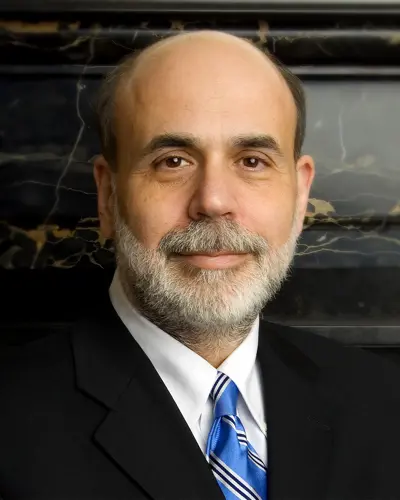
Ben Shalom Bernanke is an American economist at the Brookings Institution who served two terms as the 14th Chair of the Federal Reserve, from 2006 to 2014. During his tenure as chair, Bernanke oversaw the Federal Reserve's response to the late-2000s financial crisis, for which he was named the 2009 Time Person of the Year. Before becoming Federal Reserve chair, Bernanke was a tenured professor at Princeton University and chaired the department of economics there from 1996 to September 2002, when he went on public service leave.
