New York Tribune Quotes
…the knocking down and beating to bloody blindness and unconsciousness of an American Senator while writing at his desk in the Senate Chamber is a novel illustration of the ferocious Southern spirit.
In 1856 Senator Charles Sumner, a strong slavery opponent, was writing at his Senate desk and a Southern Congressman, Preston Brooks, sneaked up behind him and beat him senseless with a heavy cane. The beating shocked most of the country and ended much of the comity between pro-slavery and anti-slavery members of Congress. Sumner was in treatment and therapy for 3 years, but returned to the Senate to be one of the radical Republican abolitionists who pressured Lincoln on the emancipation issue and led the vigorous Reconstruction efforts after the war. For the northern newspapers, this became the symbol of Southern lack of civilization and fanaticism which did as much as anything to set the stage for the Civil War. A majority of the House of Representatives voted to expel Brooks, but the necessary two-thirds could not be obtained because Southerners supported Brooks creating even more division between North and South. Brooks was so shunned however that he shortly resigned.
New York Tribune, May 24, 1856
Sourced by: Eigen's Political and Historical Quotations

Congressman Preston Brooks had attacked and almost murdered, Senator Sumner, who was caught in his desk and could not defend himself. While the beating of legislators who positions that were disliked was castigated by almost all newspapers and community leaders in the North and many in the South, this editorial shows how far the polarization of American had gone before the Civil War. It also illustrated that the issue causing the schism was slavery and not as later Southern apologists suggested, different philosophies of government.


with which he beat senseless Senator Charles Sumner, an abolitionist in a sneak attack

Sumner was sharp and biting in his criticism of slavery and its supporters. Preston Brooks, a South Carolina Democrats, soon after, sneaked up on Sumner and trapped him in his desk bolted to the floor. Sumner was seriously injured; Brooks, lauded throughout the South.
In the lowest point in Senate history, Senator Brooks snuck up behind Senator Charles Sumner, stuck Sumner a massive blow to the back of the head with a heavy stick. While Sumner was half conscious and caught in his desk, Brooks continued to beat Sumner senseless. Sumner did not die but was seriously handicapped for life. Preston attacked Sumner supposedly because Sumner made a senate speech condemning slavery practices in South Carolina and “insulted” Brooks’ cousin—a Congressman who was defending slavery. Because of the polarization between North and Southern senators, no resolution could be passed to condemn and discipline Brooks so the Senate became the only place in America where someone could beat an unarmed, defenseless man senselessly with impunity. Even some Southerners were surprised because at that time “Gentlemen” still fought duels over disputes and in those, both parties would be equally armed.

This statement was made long after slavery had been abolished and Jim Crow was on the rise in the South.


President Andrew Johnson had been impeached by the House of Representatives and was being tried in by the Senate. A majority of the Senators voted for conviction but the vote was 1 short of the two-thirds that were needed. Johnson remained in office. These were two of the charges against Johnson. A Century later Presidents commonly did both of these. George W. Bush made reappointment of Senate rejected nominees into an art form but after the Johnson trial, these were never to be considered reasons for impeachment again.

In 1831 a slave preacher, Nat Turner, led a rebellion in North Carolina killing over 50 whites. Even though Turner and the rebels were captured and executed, whites throughout the South, took vengeance on any slaves they could find. This description was of a North Carolina community.


Despite having passed the House and a majority of the Senate favoring McCain’s bill, a filibuster was led by a few holdouts from his own party. Patiently, McCain assembled sufficient Senate support to break the filibuster.

The senator had broken with his own party on the issue of slavery in the territories.
Parker and other escaped slaves in Christiana fought off slave catchers and killed the slave owner leading them. Charged with treason, he escaped to Canada with his family and lived there the rest of his life. While not a polished writer, after he himself had escaped and went to Christiana and leaned to read and write. He wrote this narrative of his life as a slave—one of the few written works we have from slaves.

Eggleston was an accomplished writer who had served in the Confederate army of the Civil War. 20 year after the war he wrote a series of articles for the prestigious Northern Atlantic Monthly trying to convey the war from the Southerner’s point of view.


The Congressman was not even chastised by the House of Representatives.

Some were calling for a national referendum be taken to determine American policy regarding participating with the League of Nations or other international organizations.

A century afterwards, the biggest change was that the price of the Senate seat had gone up and the Political Action Committees had joined the Party Treasuries as the recipients of the money In the early 21st century almost all the Senators were multi-millionaires.
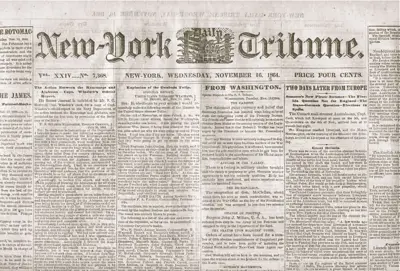
The New-York Tribune was an American newspaper, first established in 1841 by editor Horace Greeley. Between 1842 and 1866, the newspaper bore the name New-York Daily Tribune. From the 1840s through the 1860s it was the dominant Whig Party and then Republican newspaper in the United States. The paper achieved a circulation of approximately 200,000 in the 1850s, making it the largest daily paper then in New York City. The Tribune's editorials were widely read, shared, and copied in other city newspapers, helping to shape national U.S. opinion. It was one of the first papers in the north to send reporters, correspondents, and illustrators to cover the campaigns of the American Civil War.
