Charles Francis Adams II Quotes
Other peoples, at other times, as well as our Southern brethren at present, have felt that the suppression of general discussion was necessary to the preservation of a prized and peculiar institution. Spain, Italy, Germany, France, the Netherlands, England, and Scotland have all, at different times, experienced the forced suppression of some one branch of political or religious thought. Their histories have recorded the effect of that suppression; and the rule to be deduced therefrom is simply this: If the people among whom such suppression is attempted are ignorant, and are kept so as part of a system, the attempt may be successful, though in its results working destruction to the community; — if, however, they are intelligent, and the system incautiously admits into itself any plan of education, the attempt at suppression will be abandoned, as the result either of policy or violence. In this respect, then, on philosophical grounds, the Cotton dynasty is not likely to favor the education of the masses..
Charles Francis Adams II, 1835–1915, Historian, Civil War Colonel, Executive & Writer, President of the American Historical Association, Chairman of the Massachusetts Park Commission, President of the Union Pacific Railroad, Grandson of President John Quincy Adams, “The Reign of King Cotton”, The Atlantic Monthly, April 1861
Sourced by: Eigen's Political and Historical Quotations


This is another of Heine’s predictions of Nazi Germany. The book burning was followed by the Holocaust. See {622242}.


As hard as it is for us to imagine today, while her husband was President of the United States, the First Lady wrote a nationally syndicated newspaper column every single day with politics frequently the subject. While she usually agreed with the President, there were occasions where they seemed to not see things exactly the same. She tended to be more liberal than he. However, there were those who believed that when she criticized politicians, it was with FDR’s knowledge and blessing and she sometimes did his “dirty work.” Eleanor Roosevelt was one of the most influential people in the country—certainly more-so than any First Lady before and since.


The Birth of a Nation was screened at the Woodrow Wilson White House as Wilson was the most racist president since Andrew Johnson. The editorial was persuasive to Boston liberals who were not prepared to impose censorship even to prevent racist propaganda from having an audience.


Spinoza’s ideas were considered so radical and dangerous that he was the only man in history who was excommunicated by the Catholics, the Jews and the Muslims. However, we see in Spinoza the observations and foundations of what would become American and then international views of human rights.


What oven gets overlooked in the history leading up to the Civil War was the terribly repressive atmosphere that developed in the South itself over the issue of slavery. There were some abolitionists in the South, and most of the slaves were held by a relatively few wealthy men. Many with no slaves or only one or two, might go either way on the slavery issue and the various fugitive slave laws. And Northern abolitionists sometimes would come South to investigate and report on the conditions of the slaves of the South. While still in the Union, many Southern areas made a mockery of the Constitutional protections of freedom of speech, freedom of the press. Censorship and repressive activities invaded privacy, and the South, for both Northerners and English travelers, no longer had the charm of the past. Note the use of the term “reign of terror”. Bunch was a seasoned diplomat experienced at reporting on conditions.


For many years, the English Customs Service would prevent books and other literature from being brought into the country if the authorities thought that they were seditious or unwholesome. The right to publish and the right to read was stronger for locally produced sedition or pornography than for imported where there were severe restrictions until recently. America had similar restrictions at the time.


The “burning” is a reference to the range of murders from the burning of heretics in the Middle Ages to the crematorium ovens of the German Concentration Camps in the Holocaust of WWII.


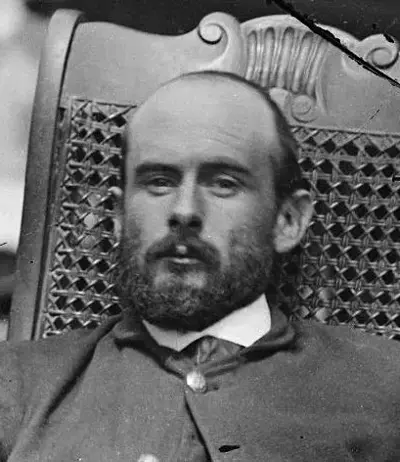
Charles Francis Adams Jr. was an American author and historian. He was a member of the prominent Adams family, and son of Charles Francis Adams Sr. He served as a colonel in the Union Army during the American Civil War. After the war, he was a railroad regulator and executive, an author of historical works, and a member of the Massachusetts Park Commission.
