Martin Van Buren Quotes
The Government, while it most sedulously and rigorously guards against the further introduction of slave, protects at the same time, by remarkable laws, the rights of the owners of that species of property in the States where it exist, and permits it transfer from one of these States to another
Van Buren was Ambassador to England at the time.
Martin Van Buren, 1782-1862, 8th President of the United States (Democrat), Letter to Secretary of State Livingston, August 22, 1815
Sourced by: Eigen's Political and Historical Quotations


When Kansas was a territory and being considered for statehood, slavery was paramount politically in the nation and in Kansas in particular. There was terrible violence against “immigrants: from the East who would vote to make Kansas a free state and retaliation against the southerners and pro-slavery sympathizers. A constitutional convention was called in the town of Lecompton of the then Kansas Territory. The convention was dominated and controlled by slavery advocates and free soilers boycotted rather than give legitimacy to a constitution where they would lose. The quotation would settle the issue of slavery for Kansas the conferees thought. President Buchanan tried to steer the Lecompton Constitution through Congress, but there was enough opposition to block it. Congress decreed a Kansas referendum. The slavery forces lost and Kansas entered as a free state; there were 3 additional constitutional conventions which passed 3 different constitutions before one was settled upon.

Baldwin was a young lawyer at the time. He represented a shipload of ex-slaves who had taken over their Spanish slave ship and landed in America. The Spanish claimed, the ship owners and some of the crew all claimed the “property.”


He was the last Pope to hold temporal power. This defense of slavery was all the more surprising because America was fighting about the issue in the Civil War and nations like England had abolished slavery. 99 years later Vatican II altered Pius IX’s statement forever. See {612715}.

Prior to 1799 it was common for Slave Ship owners to insure their cargo, the life of the slaves. Without such insurance the slave trade was a very risky business. There were cases of captains murdering “difficult” slaves and collecting the insurance on them and the most horrible of all, throwing lots of slaves overboard to avoid arrest by those countries which had outlawed the slave trade, and then collecting insurance on the dead “cargo.” One insurance company simply refused to write insurance on slave ships. See {622020}.

The issue of slavery which had been suppressed in Congress for the first decades of the nation broke out when Missouri was considered for statehood. By previous agreement, slavery was not even discussed in Congress but the time period elapsed. Tallmadge not only proposed that no more slaves could come into Missouri but most shocking to the Southerners was that every person born in the new state would be free at the age of 25. In a generation, there would be no more slavery in Missouri and there would be no economic compensation for slave owners at all. The House of Representatives accepted the amendment, but it failed in the Senate. At that time, Senators were not elected by voters but were appointed by the state legislators and the Southern slave states had a disproportionate share of the senate from a population point of view. But what this quotation shows clearly that a majority of the country in 1819 were opposed to slavery and were willing to end it without compensation.

Baron Brougham and Vaux

The slavery issue was the dominant issue in pre-Civil War America. It even drove foreign policy.


This was a compromise. Most Mexicans wanted immediate emancipation of all slaves. However, Stephen Austin and others desirous of attracting colonists thought that this would inhibit too many American Southerners from immigrating to Texas. Slave enthusiasts wanted no prohibition on slavery. The Mexican Emperor issued this compromise but was soon thereafter overthrown. The law was then repealed by the revolutionary government and emancipation was immediate. However, Austin was able to persuade the junta to keep the law in place for Texas only, and so it was. A similar law was being debated by Congress but the Southerners were able to block it. There were still slaves and slavery in Texas. Four years later {613642} there were more restrictions on slavery.
The first anti-slavery newspaper published in the United States & the first journal in America to advocate immediate, unconditional emancipation


In this case, the Pope was obeyed on the issue of slavery. However, Papal injunctions against slavery have not always had the desired effect. See {617632}

There was a committee proposal to terminate the importation of slaves in 1800. There was a majority for this, but Mr. Randolph proposed that the time be extended to 1808, 20 years thence.
Louisiana to this day has a different legal system from the rest of the United States as it was originally based on the French Napoleonic Code. Most people did not realize that Louisiana had strictures against breaking up families—even with slaves.

Earlier {629154} Smith was much more sympathetic with slavery. His views evolved as you can see by the comparison. He stated that he had a vision and made two prophesies {629156} that indeed came true. The last idea of slave buyouts seemed plausible to many abolitionists initially when they were not really knowledgeable about the economics of slavery. However, once they studied it, it became clear what it would not work even if the Southerners would then be willing to accept Blacks as free laborers which most were not, The two biggest problems were: 1) the international slave trade had been abolished. The only source of new slaves for growth was breeding them. Therefore, having slaves had TWO economic values—the work that they could do and the reproduction of themselves. A critical mass of owned slaves produced an income forever. And for Southerners who were culturally adverse to work (see {629169}), just having cash for their slaves was not enough. They were the servants, the farm labor, and their recreational sex. 2) and most important, the value or the slaves of the South was greater than the economic value of all the land, all the farms, all the buildings, all the factories, and all the inventory of the stores of the South all put together. The Southern slaves were the majority of the wealth of the south. There was no asset that could ever produce enough value to pay for the slaves—even over time. It would be like trying to buy all the shares of all the corporations in America today. There is no asset big enough to raise the money to ever finance it. The idea may have worked in Colonial America or even prior to the outlaw of the international slave trade, but by the time anyone took the idea seriously it was economically no longer feasible.

The Mormons were in Missouri at the time. Phelps was warning the church members essentially not to get involved with the slavery issue. The Mormon Church tended to support the institution of slavery at that time although Mormons themselves did not own slaves. However, we should remember that the Mormons themselves were a very persecuted group and Phelps and other Church leaders probably didn’t want their members alienating the non Mormons more than they already did by their existence. This was very similar to the Roman Catholic Church leaders at the time. The Catholics were also a persecuted minority and the Catholic Bishops often supported slavery—especially in the South to try and avoid hostility from the power structure and the majority. Some individual Mormons and individual Catholics were much opposed to slavery. See {629158} and {629154} for more on the Mormons and slavery. Later, Smith altered his early view.

In the early days of the Civil War slaves who escaped and reached the Northern lines were routinely returned to their Southern owners as the Fugitive Slave Act required. The first actual emancipation of the Civil war was not the President’s proclamation but was Butler who as a Union General ordered that the slaves escaping from Virginia no longer be returned. He was accused of violating the then existing law, however he had a legal rationale which hoisted Virginia on its own petard.
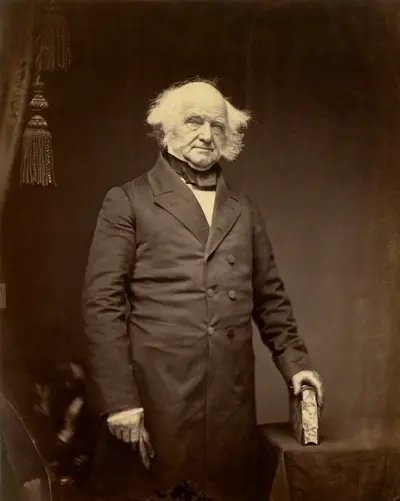
Martin Van Buren was an American lawyer and statesman who served as the eighth president of the United States from 1837 to 1841. A founder of the Democratic Party, he had previously served as the ninth governor of New York, the tenth United States secretary of state, and the seventh vice president of the United States. He won the 1836 presidential election with the endorsement of popular outgoing President Andrew Jackson and the organizational strength of the Democratic Party. He lost his 1840 reelection bid to the Whig nominee, William Henry Harrison, thanks in part to the poor economic conditions surrounding the Panic of 1837. Later in his life, Van Buren emerged as an elder statesman and an important anti-slavery leader who led the Free Soil Party ticket in the 1848 presidential election.
