Kansas Quotes
The right of property is before and higher than any constitutional sanction, and the right of the owner of a slave to such slave and its increase is the same and as inviolable as the right of the owner of any property whatever... The Legislature shall have no power to pass laws for the emancipation of slaves without the consent of the owners, or without paying the owners previous to their emancipation a full equivalent in money for the slaves so emancipated. They shall have no power to prevent immigrants to the State from bringing with them such persons as are deemed slaves by the laws of any one of the United States or Territories, so long as any person of the same age or description shall be continued in slavery by the laws of this State: Provided, That such person or slave be the bona fide property of such immigrants
When Kansas was a territory and being considered for statehood, slavery was paramount politically in the nation and in Kansas in particular. There was terrible violence against “immigrants: from the East who would vote to make Kansas a free state and retaliation against the southerners and pro-slavery sympathizers. A constitutional convention was called in the town of Lecompton of the then Kansas Territory. The convention was dominated and controlled by slavery advocates and free soilers boycotted rather than give legitimacy to a constitution where they would lose. The quotation would settle the issue of slavery for Kansas the conferees thought. President Buchanan tried to steer the Lecompton Constitution through Congress, but there was enough opposition to block it. Congress decreed a Kansas referendum. The slavery forces lost and Kansas entered as a free state; there were 3 additional constitutional conventions which passed 3 different constitutions before one was settled upon.
Kansas, Lecompton Constitution, Article VII, September, 1857
Sourced by: Eigen's Political and Historical Quotations

Van Buren was Ambassador to England at the time.


The political conflict between the right of the slave to liberty and the right of the slave owner to his property made the immediate abolition of slavery very difficult after the Spanish had been overthrown in South America.

Slaves could not own property in most of Southern America. The Greeks, the Romans, the ancient Germans, the Poles, the Portuguese, the Spanish and the French had provided, both by law and by custom, for the possession of property by the slave, which could, not be seized by his master. This is another sense in which American slavery was even worse than most slavery had been.
The Republicans had broken off from the Whig Party and started a new one attracting some liberal Democrats also. The Republican Party described themselves as “radicals” and argued for major reform quickly.

Butler was at the time the Union general in charge of Louisiana. He had on his hand a large group of slaves whose owners had abandoned the area. There was no emancipation yet. He wrote for instructions. The result was the first actual emancipation of slaves.
Most Americans do not realize that for most of Amrcan history there has been open borders with little or no restrcition on immigration. These that there were tend to be rembered becuse of the populism, nativism and unrest taht went with them.

The “slaves” were American merchant sailors whose ships had been taken by the Barbary Pirates of Algiers who the Dey controlled. He was actually negotiating and trying to get a high price with this statement. The graphic shows a Barbary pirate ship chasing a merchant galley.

He was explaining his repudiation of General John Fremont’s military proclamation in Missouri confiscating rebel property and emancipating their slaves. See {633732} .

This was one of the several early unofficial Emancipations that was issued in the Civil War.


The Mormons were in Missouri at the time. Phelps was warning the church members essentially not to get involved with the slavery issue. The Mormon Church tended to support the institution of slavery at that time although Mormons themselves did not own slaves. However, we should remember that the Mormons themselves were a very persecuted group and Phelps and other Church leaders probably didn’t want their members alienating the non Mormons more than they already did by their existence. This was very similar to the Roman Catholic Church leaders at the time. The Catholics were also a persecuted minority and the Catholic Bishops often supported slavery—especially in the South to try and avoid hostility from the power structure and the majority. Some individual Mormons and individual Catholics were much opposed to slavery. See {629158} and {629154} for more on the Mormons and slavery. Later, Smith altered his early view.

Earlier {629154} Smith was much more sympathetic with slavery. His views evolved as you can see by the comparison. He stated that he had a vision and made two prophesies {629156} that indeed came true. The last idea of slave buyouts seemed plausible to many abolitionists initially when they were not really knowledgeable about the economics of slavery. However, once they studied it, it became clear what it would not work even if the Southerners would then be willing to accept Blacks as free laborers which most were not, The two biggest problems were: 1) the international slave trade had been abolished. The only source of new slaves for growth was breeding them. Therefore, having slaves had TWO economic values—the work that they could do and the reproduction of themselves. A critical mass of owned slaves produced an income forever. And for Southerners who were culturally adverse to work (see {629169}), just having cash for their slaves was not enough. They were the servants, the farm labor, and their recreational sex. 2) and most important, the value or the slaves of the South was greater than the economic value of all the land, all the farms, all the buildings, all the factories, and all the inventory of the stores of the South all put together. The Southern slaves were the majority of the wealth of the south. There was no asset that could ever produce enough value to pay for the slaves—even over time. It would be like trying to buy all the shares of all the corporations in America today. There is no asset big enough to raise the money to ever finance it. The idea may have worked in Colonial America or even prior to the outlaw of the international slave trade, but by the time anyone took the idea seriously it was economically no longer feasible.
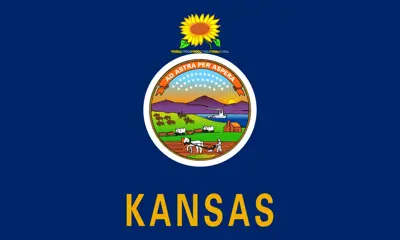
Kansas (/ˈkænzəs/ (listen)) is a state in the Midwestern United States. Its capital is Topeka and its largest city is Wichita. Kansas is bordered by Nebraska to the north; Missouri to the east; Oklahoma to the south; and Colorado to the west. Kansas is named after the Kansas River, which in turn was named after the Kansa Native Americans who lived along its banks. The tribe's name (natively kką:ze) is often said to mean "people of the (south) wind" although this was probably not the term's original meaning. For thousands of years, what is now Kansas was home to numerous and diverse Native American tribes. Tribes in the eastern part of the state generally lived in villages along the river valleys. Tribes in the western part of the state were semi-nomadic and hunted large herds of bison.
