Benjamin Wade Quotes
If a man carries his horse out of a slave State into a free one, be does not lose his property interest in him; but if he carries his slave into a free State, the law makes him free.
Wade, Benjamin F. Speech on the Nebraska and Kansas Bill. 25 May 1854. The Congressional Globe: Appendix, 33rd Cong., 1st sess., John C. Rives, 1854, p. 764.


The nation in 1848 was very polarized over the issue of slavery. Taylor, never even mentioned the subject in his speeches and writings. He reused to answer any questions about the subject or indicate his own views. His strategy worked as the other politicians who took a stand—either way—alienated a large number of voters.

When Kansas was a territory and being considered for statehood, slavery was paramount politically in the nation and in Kansas in particular. There was terrible violence against “immigrants: from the East who would vote to make Kansas a free state and retaliation against the southerners and pro-slavery sympathizers. A constitutional convention was called in the town of Lecompton of the then Kansas Territory. The convention was dominated and controlled by slavery advocates and free soilers boycotted rather than give legitimacy to a constitution where they would lose. The quotation would settle the issue of slavery for Kansas the conferees thought. President Buchanan tried to steer the Lecompton Constitution through Congress, but there was enough opposition to block it. Congress decreed a Kansas referendum. The slavery forces lost and Kansas entered as a free state; there were 3 additional constitutional conventions which passed 3 different constitutions before one was settled upon.

It was not uncommon for free Blacks to purchase slaves, marry them and set them free.


In the early days of the Civil War slaves who escaped and reached the Northern lines were routinely returned to their Southern owners as the Fugitive Slave Act required. The first actual emancipation of the Civil war was not the President’s proclamation but was Butler who as a Union General ordered that the slaves escaping from Virginia no longer be returned. He was accused of violating the then existing law, however he had a legal rationale which hoisted Virginia on its own petard.


What was particularly interesting about this quotation is that Pinkney was a political leader of Maryland, a slave state. He saw the injustice and immorality of slavery but like many others of our founding fathers assumed that ending slavery would infringe on the property rights of the slave holders. Others argued that there can be no right to deny others their basic rights—property and wealth are subordinate to natural rights. See {632258} and {632259} for more on this point.
The Republicans had broken off from the Whig Party and started a new one attracting some liberal Democrats also. The Republican Party described themselves as “radicals” and argued for major reform quickly.


One of the many complaints that many people made at the time about Smith and his Mormons was that they opposed slavery. In fact, Smith not only opposed it be had a plan for compensating the slave owner and a method for paying for it. Smith was not advocating the kinds of personal lifestyle issues of his church the way modern religious leaders do, but was concerned with the much larger issues of expansionism, corruption of the courts and judiciary, and land distribution. He was a classic reform candidate in that sense. Smith had written to most of the then likely Presidential candidates of both major parties asking for their position on the Mormons who were facing persecution wherever they went. None of the politicians would make any satisfactory commitments. Smith took Direct Action and became the only major religious official to have run for the Presidency of the United States until Pat Robertson tried and failed in 2000. Smith’s assassination shortly thereafter cut his run for the Presidency short before it made much headway and politically he had no chance to affect the race.


Although some Arab nations such as Saudi Arabia maintained legal slavery into the 1960s, Tunisia’s Emancipation pre-dated that of the United States.


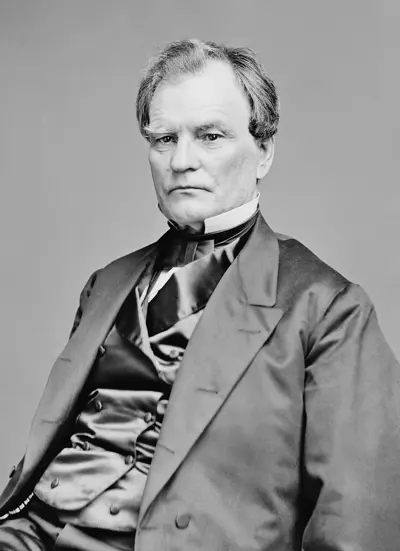
Benjamin Franklin "Bluff" Wade was an American lawyer and politician who served as a United States Senator for Ohio from 1851 to 1869. He is known for his leading role among the Radical Republicans including support for civil rights, women's suffrage, and trade unions. Had the 1868 impeachment of U.S. President Andrew Johnson led to a conviction in the Senate, as president pro tempore of the U.S. Senate, Wade would have become president for the remaining nine months of Johnson's term.
