Horatio Gates Quotes
The deplorable state of the Commisary and Quarter Master's Departments, and the entire Deficiency of Magazines, to supply the Southern Army, obliges me to request General Huger to be the Bearer of this Letter. His Zeal for the Public Service, anticipates my Wish, that he would be my Advocate with your Excellency and the Executive Power of the State, to supply our wants, by immediately establishing Magazines of Provisions and Forage, and properly organizing the Quarter Master General's Departments. Without these Things done, our Army is like a dead whale upon the Sea Shore — a monstrous Carcass without Life or Motion.
Gates had been assigned to take over command of the Southern Department which was a total mess with no provisions or money. He took over from General Lincoln {49731} who had failed for lack of resources and support and then Gates’s career was almost destroyed by the same problem.
Horatio Gates, 1728?-1806, Revolutionary War Adjutant General, Member of the New York State Legislature, Letter to Governor Nash, July 18, 1780
Sourced by: Eigen's Political and Historical Quotations

Eaton was in the Middle East and at the time that region was a part of the Ottoman Empire controlled by the Turks.


While the militia had very few arms, Van Rensselaer had no military training and commanded a critical army because of his political connections—common at the time. After he botched the Battle of Queenston Heights he returned to politics but his military failure dogged him for the rest of his career. The quotation is yet another that illustrated the myth of all Americans armed and ready to fight for the nation. There was no gun culture then, and guns were expensive and a minority of Americans owned them. In this case less than 20 percent of the American militia owned a gun. And Congress would just not at the time spend the money for weapons.

From the beginning, the issue of whether the country should have a standing army or depend on the militia and the citizen soldier has been controversial. There is a , romantic American myth about the Militiamen in Colonial and Revolutionary America—the citizen soldiers who would leave their farms and rise to the military necessity of the day. However, not only were the militia very hard to muster to duty, but most actually didn’t own or have experience with firearms, and the prevailing opinion of knowledgeable military leaders from George Washington on down was that the militia were not very good soldiers. See {613015}, {613016}, {613022}, {613027}, {621987}, {621988}, {613030}, {613033}, & {613056}

Historically, this quotation shows the desperate condition of the 1863 food supply in the Confederacy. The most profitable crops were cotton and tobacco. However, Davis and other Southern leaders had to urge patriotic Southerners to abandon those crops in favor of foodstuffs and fodder for the military and their horses. Some did but many did not.


Surprising to most Americans today, at that time, the Governors controlled the State militias, and in this case two Governors refused to make their militias available for the war effort. This experience and others led to the change which today allows the Federal Government to “call up” the National Guard of any state regardless of the desire of the State Governor.

There were so many Blacks fighting for the Americans in the Revolution that the British Commander had to issue a special proclamation which would make slaves of any Negro captured but issued freedom to those who would desert. Despite the greater risk to Negro Revolutionaries than their white counterparts many volunteered and few deserted.

Even in a relatively frontier state like Indiana at the time, there was little enthusiasm for a militia. See {613320}.

Washington was very unhappy with militia even from his native Virginia. See also {613030} This quotation is very important because the common belief is that all Americans in Colonial America were skilled with a gun and that there was a strong gun ownership culture. Many people quote {613057}. However, that was not the case as this and other research has shown. Less than one quarter of the Virginia militia had any weapon. Guns were expensive and only a minority of Americans could afford them. Despite the image of sharpshooters, and there were some, most guns were very inaccurate in the hands of most men.


He had no authority to do this. He just took it upon himself. This was one of the incidents which caused later Congresses to pass very strict laws limiting the authority of all Federal Military and other intelligence and police forces so that they have little or no authority within the United States. President Lincoln did not allow the order to stand, although he repudiated it very delicately and as privately as possible. Many in his own party strongly favored this proclamation as it cracked down on the Southern Rebels and emancipated slaves—both objectives of many Republicans. In addition, Fremont was very popular with the people and had strong political connections. (He would later run for President.) See {635739}.


His aggressive tactics which had served him so well in the West got his army into trouble at the Second Battle of Bull Run, where he was out maneuvered by Stonewall Jackson and Robert E. Lee. He was sent back to the West.

Lincoln used the very “estimate” to mean value or hold in esteem, a meaning which is no longer in use.

Moltke’s plan for the Marne Campaign did not work out as planned and he and the Kaiser had a difference of opinion so Moltke was replaced as military commander. This quotation is of critical importance as it shows that the Germans were actually planning the First World War and simply used the assassination of Archduke Ferdinand as an excuse. Thus, the reparations Germany was required to pay when they lost the war. See {642096} for more quotational evidence.

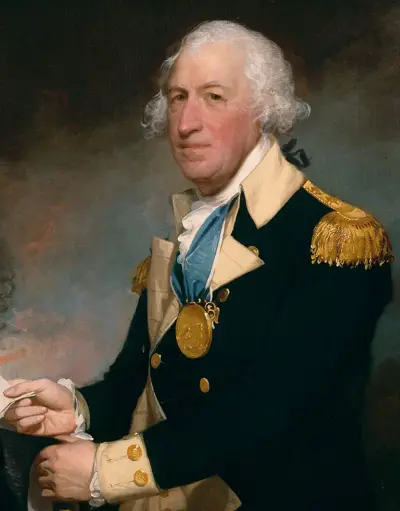
Horatio Lloyd Gates was a British-born soldier who served as a leading American general during the early years of the Revolutionary War. He took credit for the American victory in the Battles of Saratoga (1777) – a matter of contemporary and historical controversy – and was blamed for the defeat at the Battle of Camden in 1780. Gates has been described as "one of the Revolution's most controversial military figures" because of his role in the Conway Cabal, which attempted to discredit and replace General George Washington; the battle at Saratoga; and his actions during and after his defeat at Camden.
