Charles G. Dawes Quotes
We were fighting a war. We did not have time for duplicate vouchers and double-entry bookkeeping. It is a hell-fired shame for everybody [on this Congressional committee] to be trying to pick flyspecks on the greatest army the world ever knew. We did more organization despite our unpreparedness than the French and the British. What do you suppose we went to war for? We went to France to win the war [World War I] and we did it.
Charles G. Dawes, 1865-1951, U. S. Comptroller of the Currency & Director of U. S. Bureau of the Budget, Brigadier General, Allied Expeditionary Forces, Vice President of the United States (Republican), U. S. Ambassador to Great Britain, Nobel Laureate in Peace, Testimony, U. S. Congress, February 2, 1921
Sourced by: Eigen's Political and Historical Quotations


Saddam claimed to his people that Iraq had essentially won the Gulf War as they were stronger afterwards than ever before and they had been able to suppress the Kurds and the Shiites with the helicopters and arms with which the emerged from the war and had been allowed to keep.

This was an official publication of the U. S. Army. The First World War had very little affect on future military preparedness At that time conservatives in Congress were very isolationist and military preparedness was not a high priority or even a significant political issue. The Democrats then were more supportive of military spending than the Republicans. It took World War II, for which America was very unprepared, to produce a change in public and political opinion regarding military preparedness.

From the beginning, the issue of whether the country should have a standing army or depend on the militia and the citizen soldier has been controversial. There is a , romantic American myth about the Militiamen in Colonial and Revolutionary America—the citizen soldiers who would leave their farms and rise to the military necessity of the day. However, not only were the militia very hard to muster to duty, but most actually didn’t own or have experience with firearms, and the prevailing opinion of knowledgeable military leaders from George Washington on down was that the militia were not very good soldiers. See {613015}, {613016}, {613022}, {613027}, {621987}, {621988}, {613030}, {613033}, & {613056}

Gates had been assigned to take over command of the Southern Department which was a total mess with no provisions or money. He took over from General Lincoln {49731} who had failed for lack of resources and support and then Gates’s career was almost destroyed by the same problem.

She was the 5th female member of the House and its first Jewish member. She was the first woman on the House Military Affairs Committee, and was one of the few Republicans who advocated spending for military preparedness. At the time of her service, many Republicans were strict isolationists.


Much of the Chinese military had been distracted from military readiness in favor of political, economic, and ceremonial, activity along with extensive economic corruption. The People’s Liberation Army is a major political force in China which made this a very noteworthy chastisement. Leading Generals were with him however. See {632518}.


Moltke’s plan for the Marne Campaign did not work out as planned and he and the Kaiser had a difference of opinion so Moltke was replaced as military commander. This quotation is of critical importance as it shows that the Germans were actually planning the First World War and simply used the assassination of Archduke Ferdinand as an excuse. Thus, the reparations Germany was required to pay when they lost the war. See {642096} for more quotational evidence.

Note that he assumes that not only will there be another World War, but he assumes that we will be on opposite sides.
In every American war, there have been those leaders who wanted to fight it “on the cheap.” While most modern people are most aware of the George W. Bush Administration providing insufficient funds to our troops in the Iraq War, there was a problem in the First World War, and President Roosevelt had to twist conservative arms to get the funds necessary for the Second World War. But even the American Revolution had the same problem as this quotation illustrates.

This is an excellent historical quotations showing how our government financed the Spanish American War. Wars have always placed economic stress on the nations which wage then. In the American Revolution we borrowed from individuals and from France. After that all our wars were financed by a combination of war bond sales, other borrowing, and tax increases—all except the George W, Bush Afghanistan and Iraq Wars which were not funded thus complicating an economic crises caused by Bush’s Great Recession. While some critics saw Bush’s actions as reprehensible and irresponsible—it was the only time in American history where tax rates were cut in wartime, Bush’s team had a plan. They had an ideological point of view that said that major tax cuts would spur the economy and lead to MORE government revenue as a result of the growth that would come. However, in this case there not only was no growth, but there was the worst recession in American History. But there was a plan to finance the war—it just went awry.
He was very critical of the early Zionist movement which he felt was only concerned with resettling Jews in Palestine rather than turning Palestine into a culturally Jewish nation. On this issue, he was tragically correct.


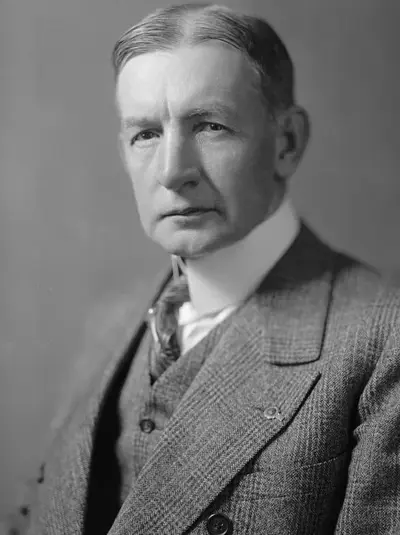
Charles Gates Dawes was an American banker, general, diplomat, composer, and Republican politician who was the 30th vice president of the United States from 1925 to 1929. For his work on the Dawes Plan for World War I reparations, he was a co-recipient of the Nobel Peace Prize in 1925.
