Douglas MacArthur Quotes
War's very object is victory, not prolonged indecision. In war there is no substitute for victory.
MacArthur, Douglas. "Address to the Joint Meeting of Congress." Congressional Record, vol. 97, part 3, 19 Apr. 1951, p. 4125.


Not understanding this point has been the cause of much difficulty for military leaders from the war of 1812 through the Iraq war, the success or failure of the effort depended on a successful peace.


Conant, a great scientist in his own right, had the confidence of the political, academic, and industrial establishment and was appointed to the Committee that was to set policy for the Manhattan Project representing President Roosevelt. Germany had been the world leader in Physics before the war. American leaders and scientists were certain that we were in a scientific race with the Germans. Even after Germany had been defeated, President Truman was told that we had beaten the Germans in the race for the bomb. Actually, although almost no one in the US government realized it then, the Germans had NO PROGRAM of nuclear weapons development at all. Hitler did not trust the Theoretical Physics and Theory of Relativity because Einstein and other Jewish scientists had been instrumental in its development. He derogatorily referred to it as “Jewish Science”. Germany bet its scientific efforts on the V2 Rockets and the Jet Airplane, both of which they were successful with but too late to have any material effect on the war. Ironically, even after most of the great German physicists were run out of Germany, there were still two of the greatest who may well have been capable of nuclear weapons development. But neither Werner Heisenberg or Otto Hahn were inclined to engage in that kind of research, and neither of them were even asked whether or not they thought it was possible. The anti-Semitic Nazis just assumed that it could not be. Truman and his associates did not find out for another year or more that there was no race. There was one OSS spy, Moe Berg, who had actually talked to Heisenberg in the midst of the war, and concluded that he not only was not working on an atomic bomb, but was not up on the latest pre-war critical research needed to develop a bomb. Hahn knew and had created the first chain reaction for which he later won the Nobel prize but he was a chemist and didn’t really understand the Physics and mathematics involved in making a weapon and was a confirmed pacifist. Ironically, his colleague, Lise Meitner who had done the physics and mathematics on that experiment was Jewish and had to flee Germany. In Denmark she gave the results to Niels Bohr, who shared them with Leo Slizard and Einstein when Bohr came to the United State and that initiated the famous letter that was sent to FDR which triggered the Manhattan Project. The German first nuclear reaction was used by the Americans because the politicians listened to the scientists, while in Germany, the politicians gave no credence to their scientists and their experiments in nuclear fission.

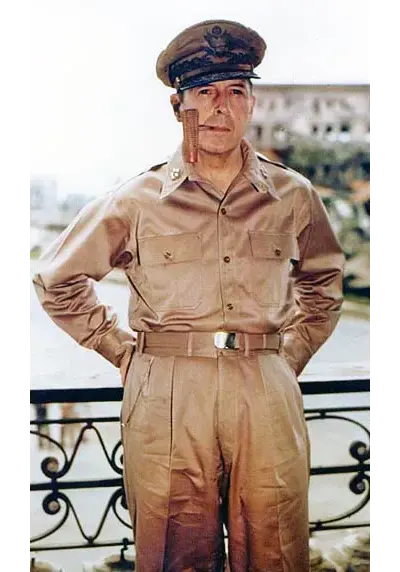
General of the Army Douglas MacArthur was an American five-star general and Field Marshal of the Philippine Army. He was Chief of Staff of the United States Army during the 1930s and played a prominent role in the Pacific theater during World War II. He received the Medal of Honor for his service in the Philippines campaign, which made him and his father Arthur MacArthur Jr. the first father and son to be awarded the medal. He was one of only five to rise to the rank of General of the Army in the U.S. Army, and the only one conferred the rank of field marshal in the Philippine Army.
