Jefferson Davis Quotes
Let fields be devoted exclusively to the production of corn, oats, beans, peas, potatoes, and other food for man and beast; let corn be sown broadcast for fodder... and let all your efforts be directed to the prompt supply of these articles in the districts where our armies are operating.
Historically, this quotation shows the desperate condition of the 1863 food supply in the Confederacy. The most profitable crops were cotton and tobacco. However, Davis and other Southern leaders had to urge patriotic Southerners to abandon those crops in favor of foodstuffs and fodder for the military and their horses. Some did but many did not.
Jefferson Davis, 1808-1889, U. S. Congressman & U. S. Senator (Democrat, MS), U. S. Secretary of War, President, Confederate States of America, April 10, 1863
Sourced by: Eigen's Political and Historical Quotations


While this was somewhat hyperbolic at the time, it became true during the century.
For many nations, it is an important objective to be totally self-sufficient in their food supply—so that they would not have to depend in other nations in what might be a world famine or food supply. For those nations agricultural subsidies are useful if their farmers cannot produce as cheaply and efficiently as other nations do. In the United States, with the most efficient agriculture in the world, subsidies are a waste of public money {633243} and the result of lobbying and special interest pressure and or corruption {633245}.


Slogan of U. S. Food Administration during World War I. Herbert Hoover, then its Director, coined the slogan for the agency.

This was the same man who as a Senator only 4 years before threatened the North that the South was economically and militarily invincible.

Gates had been assigned to take over command of the Southern Department which was a total mess with no provisions or money. He took over from General Lincoln {49731} who had failed for lack of resources and support and then Gates’s career was almost destroyed by the same problem.


The Confederate Civilian & Military Authorities in the Confederate Capital were grossly insensitive to the perceptions and opinions of the women of the South. This statement was a classic example. It also indicates the terribly serious plight the Confederacy was in at the time. Just as the leadership deluded themselves into thinking that the women of Richmond would riot and loot for “license ” and not for shortage and want of necessities, they did not face the reality of their strategic military situation.

The historical import of this quotation is that North Carolina was unable to support its troops fighting in Virginia so they resorted to asking for private donations. In addition greedy speculators were offering inflated prices to citizens for needed military supplies and after buying them jacking the price up much higher and selling it to the state who because of the lack of productivity, the men in the field and the Union embargo had very few options to obtain needed supplies.
Lincoln and the Union leaders were still hopeful of ending the rebellion and getting things back to a pre-war footing economically. At this point they were trying to preserve components of the Southern Economy at no small cost. As that hope was shown to be futile, the Total War strategy of Grant and Sherman prevailed to the satisfaction of men like Opdycke. That actually ended the war quickly, but the Southern Economy was devastated in the process.


From a technical and production point of view, there is no practical limit to population size that is imposed by food production. We can produce sufficient food for the world even if population increases dramatically. None the less, even today we have some starvation and much malnutrition problems. These however are political, economic and tend to be distributional. We can produce the food. Morris does NOT advocate large population growth. Although food need not be a problem with an expanding population, job availability, medical care, energy, land, natural resources, ethnic hatred, migration, violence, and other problems are produced by population growth.
New agricultural techniques like drip irrigation and hydroponics lend themselves to factory style agriculture which can function in cities. At the time, Israel already did some on a commercial basis. In addition to having fresher food where the population is, the cost of transportation and use of energy for same is reduced, but may be needed for the new agricultural techniques themselves.

He was Chancellor of the Exchequer at the time of this speech. Gladstone was certain about most of his views on foreign policy but correct on only some with many blunders on his watch. This view was very important for the Confederacy as it was a prerequisite to diplomatic recognition. The latter never came.

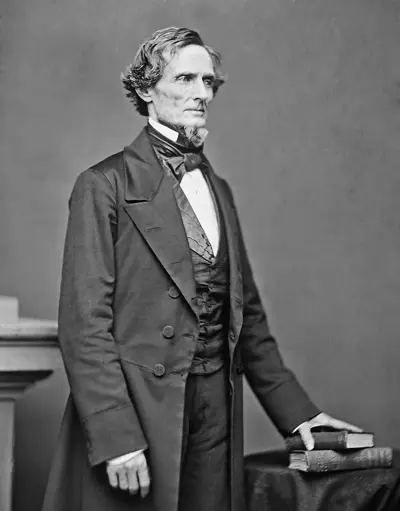
Jefferson Finis Davis was an American politician who served as the president of the Confederate States from 1861 to 1865. As a member of the Democratic Party, he represented Mississippi in the United States Senate and the House of Representatives before the American Civil War. He previously served as the United States Secretary of War from 1853 to 1857 under President Franklin Pierce.
