George Washington Quotes
[I wonder] whether a case similar to ours is to be found: to wit, to maintain a post against the flower of the British troops for 6 months altogether, without powder, and at the end to have the army disbanded and raised within the same distance of the reinforced enemy.
George Washington, 1732-1799, 1st President of the United States (VA), Referring to the Patriots holding of Boston despite overwhelming British advantages, Quoted in Kevin Phillips, 1775: A Good Year For Revolution, 2012
Sourced by: Eigen's Political and Historical Quotations

From the beginning, the issue of whether the country should have a standing army or depend on the militia and the citizen soldier has been controversial. There is a , romantic American myth about the Militiamen in Colonial and Revolutionary America—the citizen soldiers who would leave their farms and rise to the military necessity of the day. However, not only were the militia very hard to muster to duty, but most actually didn’t own or have experience with firearms, and the prevailing opinion of knowledgeable military leaders from George Washington on down was that the militia were not very good soldiers. See {613015}, {613016}, {613022}, {613027}, {621987}, {621988}, {613030}, {613033}, & {613056}


The French and English, with larger numbers and more experienced troops and officers, wanted the American units to come under the command or their officers and be integrated into the allied army. However Wilson established the tradition that American troops fighting abroad most always fight as an American Army under American Command. Although resented then and into the 21st century by America’s allies who are expected to fight under American command, it is a tradition that no American major politician has seriously challenged since then.


3 years later he led America on a huge invasion and nation building project in Iraq. It turned out that had he listened to his own advice and not flip-flopped, the huge cost of the Iraq War might have been avoided.


Things were looking bleak for the British & they were dependent on material help from the U.S. to give them a chance. The British navy was one of the largest and most powerful in the world & this cable was a veiled threat that if U.S. military aid did not come, England could not defend the country in the air, Churchill might be kicked out of office & his successors surrender to Germany turning over the British fleet to Hitler giving Germany control of the seas & with their ally Japan a naval force stronger than America’s. Anglophiles would not describe it as a threat, but merely a statement of the reality of the time. Roosevelt’s Ambassador to Britain, Joseph P. Kennedy, a Nazi sympathizer & some American military officers were opposed to aid to Britain seeing it as a lost cause. Roosevelt, however, acting on his own marvelous instinct, his advice from Harry Hopkins, and his back-channel contacts in England, decided that if armed Britain could hold out. He turned out to be right.


Gates had been assigned to take over command of the Southern Department which was a total mess with no provisions or money. He took over from General Lincoln {49731} who had failed for lack of resources and support and then Gates’s career was almost destroyed by the same problem.


He had wanted more troops for the Afghan War than President Obama would approve. The Republican members of the Congress tried to make the difference a major issue of a President not supporting his commanders. The General made this brilliant response.

The British had won an expensive victory against the Boers in South Africa. The casualties among the officers was particularly high. The British military uniforms were very important to the senior military leaders and the officers in general always wanted to distinguish themselves from the enlisted men. This had traditionally been accomplished by outfitting the officers in a contrasting color from the ranks. This allowed the rebel Boer farmers, who were good shots and had no tradition of not targeting officers as many European armies did, to pick off the officers and with few to lead them thee British troops did not continue their attack. The young queen of 29 years, with no military training whatsoever, was very familiar with the uniforms as a result of all the pomp and circumstance associated with the crown. She immediately recognized the problem and instructed the military leaders to change the uniforms. It is hard to believe how hidebound and traditional the British military was even when their own lives were at stake. It is yet another example of the intellect and knowledge of the queen and shows that her insistence on not being a figurehead extended even to the all male bastion of the military. There was no aspect of British society and government that this talented Queen did not get involved with.


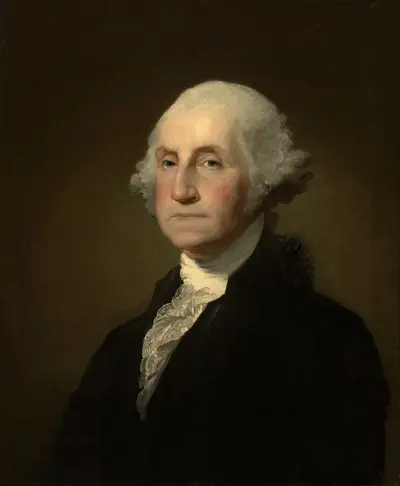
George Washington was the first President of the United States (1789-97), the Commander-in-Chief of the Continental Army during the American Revolutionary War, and one of the Founding Fathers of the United States. He presided over the convention that drafted the current United States Constitution and during his lifetime was called the "father of his country".
