Ulysses S. Grant Quotes
The condition of the colored man within our borders may become a source of anxiety, to say the least .... It was looking to a settlement of this question that led me to urge the annexation of San Domingo during the time I was President of the United States. San Domingo was freely offered to us, not only by the administration but by all the people, almost without price. The island is upon our shores, is very fertile, and is capable of supporting fifteen million people. The products of the soil are so valuable that labor in her fields would be so compensated as to enable those who wished to go there to quickly repay the cost of their passage. I took it that the colored people would go there in great numbers, so as to have independent states governed by their own race. They would still be states of the Union, and under the protection of the general government, but the citizens would be almost wholly colored.
Grant had negotiated for what is today the Dominican Republic to become a Black state where American Negroes could go. However, like Lincoln before him and most others arguing for Negro emigration, he underestimated the Negro desire to remain where they were and just be free with equal opportunity. See {625675}, {625686}, {625684}, {625683}, {625682} for additional quotations arguing for Black emigration.
Ulysses S. Grant, 1822-1885, 18th President of the United States (Republican, OH), Description of his attempt to add a Black state to the Union
Sourced by: Eigen's Political and Historical Quotations

See {625686}, {625684}, {625683}, {625682}, {625676} for additional quotations arguing for Black emigration.

See {625675}, {625686}, {625684}, {625683}, {625676} for additional quotations arguing for Black emigration.

See {625675}, {625686}, {625684}, {625682}, {625676} for additional quotations arguing for Black emigration.

See {625675}, {625686}, {625683}, {625682}, {625676} for additional quotations arguing for Black emigration.

See {625675}, {625684}, {625683}, {625682}, {625676} for additional quotations arguing for Black emigration.
_0_thumbnail_47x47.jpg "A portrait of Richard Allen, a Methodist bishop and founder of the African Methodist Episcopal Church")


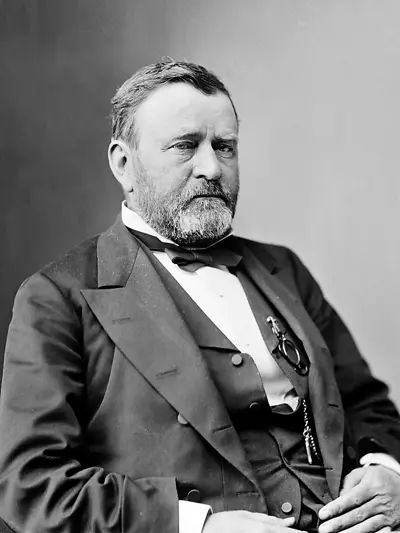
Ulysses S. Grant was an American military leader who served as the 18th president of the United States from 1869 to 1877. As president, Grant was an effective civil rights executive who created the Justice Department and worked with the Radical Republicans during Reconstruction to protect African Americans. As Commanding General, he led the Union Army to victory in the American Civil War in 1865 and thereafter briefly served as Secretary of War.
