W. E. B. Du Bois Quotes
After Emancipation, it was the plain duty of some one to assume this group leadership and training of the Negro laborer. I will not stop here to inquire whose duty it was—whether that of the white ex-master who had profited by unpaid toil, or the Northern philanthropist whose persistence brought on the crisis, or the National Government whose edict freed the bondmen; I will not stop to ask whose duty it was, but I insist it was the duty of some one to see that these workingmen were not left alone and unguided, without capital, without land, without skill, without economic organization, without even the bald protection of law, order, and decency,—left in a great land, not to settle down to slow and careful internal development, but destined to be thrown almost immediately into relentless and sharp competition with the best of modern workingmen under an economic system where every participant is fighting for himself, and too often utterly regardless of the rights or welfare of his neighbor.
W. E. B. Du Bois, 1868-1963, Educator and author, Co-Founder of the NAACP, The Souls of Black Folk, 1905
Sourced by: Eigen's Political and Historical Quotations

This marvelous quotation gives us a picture of the essence of the conflict in conception of freedom between Southern whites and negroes. There was no way to change the large majority of whites’ opinions and it is easy to see why Jim Crow and Southern discrimination evolved as it did. The emancipated Blacks had insufficient power or resources and there was not enough effort or success at changing white attitudes and no where near enough law enforcement to impose the view on the majority of the Southern white population.
Some whites began to understand the negative effect that slavery had on the Negroes. He like many Northerners interested in the rehabilitation of former slaves was convinced that a strong education program was necessary and the ex-slaves should not be dependent in their ex-masters for the education and acclimation to American life. However, with a President (Andrew Johnson) uninterested in Black development and a local white population totally opposed to such efforts only a little progress was made and the consequences affected America for the next 100 years.


This quotation is interesting for two reasons. First it is a good example of the twisted logic of some of the Slavery apologists who claimed that the Negro slave was better off than the free wage earner. The second reason is that it illustrates the norms of the treatment of the working man before the Civil War. The union movement would change the situation for the free laborer over the next century and then holidays and worker rights became normalized in American society. See {641290} for another of his absurd arguments.

Ever since the Civil War, there has been an imbalance between the areas of the country with large unemployed populations and those areas where jobs were available. Even in 1870, the authorities were trying to get the unemployed to relocate but this was a hard thing to do at the time—physically, economically, and psychologically. It was not until the 2nd World War when huge numbers of Blacks migrated from areas of poor economic prospects in the South to areas of opportunity in the North. Also, note the classic welfare dilemma expressed whereby if humanitarian assistance is provided, people will not be desperate enough to move to areas with better opportunities.

The minister was the leader of a sect that had emigrated from Germany to the new colony of George where slavery had been banned but wealthy planters were pointing to South Carolina north of them where slavery was producing riches for the slave owners and asking the Trustees back in England to allow slavery as they were at a competitive disadvantage. Oglethorpe, the leader of the community argued against slavery and was joined by other community leaders including Reverend Boltzius, The argued that slavery would curtail the opportunity for common white men. In this quote Boltzius pointed to Charlestown South Carolina to show the effect that slavery produced there. The wages for slaves, were wages paid to the slave’s owner. While plantation slavery was the most common form of slavery, but many slave owners without large plantations simply rented out his slaves. In some cases, the slaves were taught trades like carpentry so the owner could receive ore for his work. But the system allowed the slave owner to undercut the market, and all a white worker could make was the wage that slave owners were demanding for slave labor.

When the slaves were emancipated, they were free but they were no yet citizens with civil and political rights either. They had no land or other property and racial discrimination in the ex-slave states was vicious and rampant.


Julian, the chemist who developed the industrial process of producing human steroids from soybeans, was the most famous and accomplished African American chemist at the time and the first Black laboratory director in America.

The letter was written in the supposed style of a Black after Emancipation and includes most of the ugly false stereotypes of the worst of the racists of the present and the slaveowners of past times. Williams stated that he was not a racist and was trying to make a point about freedom required risk and responsibility. However, the effort was interpreted by many people, Black and white, to be insulting and a put down of African Americans. At the same time, although most of the Tea Party members were not racists, most of the racists in America were supporters of the Tea Party. Those people interpreted the quotation as "telling it like it is" about Blacks who do not want the responsiblities and risks of freedom and are not yet developed sufficiently to be equal citizens in a democracy.
This letter was signed by a local white Priest and two other leading planters. This quotation gives us a marvelous feeling for what occurred when parts of the South was occupied by the Union Army shortly after the Emancipation Proclamation was issued. Minor and his fellows just did not “get it.” The concept of freedom of the slaves was intellectually so foreign to them, that they wanted the Union Army to “compel” the freed slaves to work. They were horrified that slaves went wherever they wanted, and they were most outraged when former slaves who had enlisted in the Army, would “visit” their old plantation setting such a terrible example. The letter gives us a perspective on how difficult it was to change the mental set of Southern Whites and why Reconstruction was so difficult. The year of the letter is somewhat uncertain as the original letter appears to be dated 1862 but the writing is not clear and that date does not comport with the history of the era and we believe 1863 was the correct year. The photograph is of the first official colored troops mustered into the Union Army. They were called the Louisiana Native Guards and contained the ex slaves who went over to the Union side just before the time this slave owner complained. These ex slaves, in uniform, and with arms would sometimes visit the plantations where they and been enslaved, thrilling the remaining slaves and infuriating owners like Minor.
There was no Federal Program to pay for teachers of the recently freed slaves who had been prohibited by Southern State’s laws from learning to read or write at all. The Southern States were a shambles as a result of the war. An NGO raised private money to provide some education to Blacks, not a popular activity for most white Southerners.

The military weapon of freeing the slaves was advocated from the earliest days of the Civil War. However, most Northern political leaders were sure that the South would be economically broken by emancipation, and many were hoping to end the rebellion swiftly by some military victories, and the Confederate soldiers could return to an economically viable South. If the slaves were freed, Southern soldiers would have little to return to and would all have to become laborers and thus would fight then to the death. However, the more battlefield success the South had, the more the combination of the moral pressure of the abolitionists and the practical strategic pressure of those who wanted to cripple the South militarily by freeing the slaves, influence Lincoln’s decision.

Earlier {629154} Smith was much more sympathetic with slavery. His views evolved as you can see by the comparison. He stated that he had a vision and made two prophesies {629156} that indeed came true. The last idea of slave buyouts seemed plausible to many abolitionists initially when they were not really knowledgeable about the economics of slavery. However, once they studied it, it became clear what it would not work even if the Southerners would then be willing to accept Blacks as free laborers which most were not, The two biggest problems were: 1) the international slave trade had been abolished. The only source of new slaves for growth was breeding them. Therefore, having slaves had TWO economic values—the work that they could do and the reproduction of themselves. A critical mass of owned slaves produced an income forever. And for Southerners who were culturally adverse to work (see {629169}), just having cash for their slaves was not enough. They were the servants, the farm labor, and their recreational sex. 2) and most important, the value or the slaves of the South was greater than the economic value of all the land, all the farms, all the buildings, all the factories, and all the inventory of the stores of the South all put together. The Southern slaves were the majority of the wealth of the south. There was no asset that could ever produce enough value to pay for the slaves—even over time. It would be like trying to buy all the shares of all the corporations in America today. There is no asset big enough to raise the money to ever finance it. The idea may have worked in Colonial America or even prior to the outlaw of the international slave trade, but by the time anyone took the idea seriously it was economically no longer feasible.

Much of the South was so insular that people knew nothing about the notion of abolition and just assumed that no one would ever consider freeing the slaves. Many never knew that it was the South that first fired on the Union troops and flag. If the North won the war, the assumption was that Northerners would then own the plantations and the valuable slaves. In reality, while all slaves were emancipated in the South, very few plantations and farms were confiscated from their Southern owners by Northerners despite the fact that there was political pressure in the North to confiscate the land of all rebels who had committed treason and use the value to repay the Union bonds and care for the wounded Union veterans and the widows of dead Union Soldiers. Eggleston was an accomplished writer who had served in the Confederate army of the Civil War. 20 year after the war he wrote a series of articles for the prestigious Northern Atlantic Monthly trying to convey the war from the Southerner’s point of view.


This was one of the several early unofficial Emancipations that was issued in the Civil War.

Some whites opposed Slavery and new slave states, not becasue of any sympathy with Negroes or concern for the immorality of slavery, but becasue slavery made it difficult for the working white man to thrive.

He was lecturing to an audience of 1500 Blacks. Darrow was castigated for telling Negroes that they did not have an inherently inferior capacity from whites, This was feared would make them too demanding and insist on unrealistic equality.
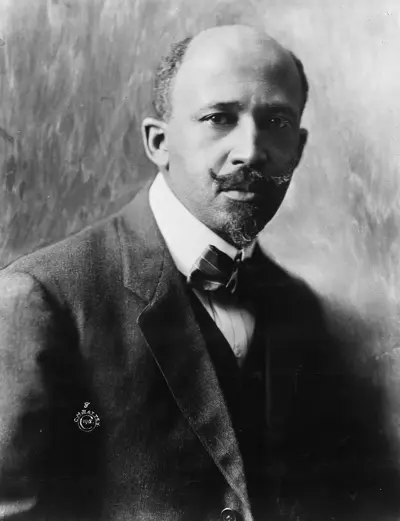
William Edward Burghardt Du Bois was an American sociologist, socialist, historian, and Pan-Africanist civil rights activist. Born in Great Barrington, Massachusetts, Du Bois grew up in a relatively tolerant and integrated community. After completing graduate work at the Friedrich Wilhelm University (in Berlin, Germany) and Harvard University, where he was the first African American to earn a doctorate, he became a professor of history, sociology, and economics at Atlanta University. Du Bois was one of the founders of the National Association for the Advancement of Colored People (NAACP) in 1909.
