Lewis Tappan Quotes
The event of the landing of these brethren upon our shores is to be, not without its beneficial effect, as well to the colored population of this country, as it promises to be to ill-fated Africa.
Tappan, Lewis. Africans Taken in the Amistad. Anti-Slavery Depository, 1840.


Most free Blacks were not enthusiastic about the possibility of colonization. Those that were, wanted a colony in the Western part of America—not Africa or the Caribbean. See {613811}.

See {625675}, {625684}, {625683}, {625682}, {625676} for additional quotations arguing for Black emigration.

Grant had negotiated for what is today the Dominican Republic to become a Black state where American Negroes could go. However, like Lincoln before him and most others arguing for Negro emigration, he underestimated the Negro desire to remain where they were and just be free with equal opportunity. See {625675}, {625686}, {625684}, {625683}, {625682} for additional quotations arguing for Black emigration.

See {625686}, {625684}, {625683}, {625682}, {625676} for additional quotations arguing for Black emigration.

He led 88 Black Americans to colonize Africa as the first official U. S. Government colonization attempt in conjunction with the American Colonization Society.

See {625675}, {625686}, {625684}, {625682}, {625676} for additional quotations arguing for Black emigration.
The organization was named for James Bruce—Lord Elgin, the Governor-General of Canada who was very favorably disposed towards Blacks colonists. When a slave reached Canada, he or she was automatically free under Canadian law, and Canada was the preferred destination of many runaway slaves. The Elgin Association was best know for the founding of Buxton—See {590063}.

Lincoln later changed his mind about Colonization when some Black leaders pointed out that the Blacks had built a large part of America and also survived slavery, it they were given fair opportunity, there was no reason that they would not be able to compete and thrive.
_0_thumbnail_47x47.jpg "A portrait of Richard Allen, a Methodist bishop and founder of the African Methodist Episcopal Church")
Many whites thought that the solution to the problem of free and emancipated Negroes was to send them to Africa. They assumed that the negroes would by desirous of that solution also, but they rarely asked them. When they did, they received answers much like this one from one of the leading Black clergymen in America.
Lincoln, just before the Civil War, quoted Jefferson that if slavery were not ended in America the results would be disastrous. But Lincoln at the time probably did not imagine how right Jefferson was, and Jefferson himself probably 1 how terrible the Civil War would be.
This quotation’s authenticity and accuracy are challenged by many scholars. The only source is the personal reminiscences of General Butler, a politician with Presidential aspirations who had his own agenda. The nuance of wording is very critical as to whether Lincoln was trying to accomplish export or whether he was asking Butler to staff out the feasibility so that Lincoln could deal with others who had raised the issue. Butler’s reply was that it was not feasible ({633655}), and there is no other record of the idea being advocated or implemented. The quotation, if indeed it was a quotations, is taken by some to indicate that Lincoln was no friend of Blacks and very racist to boot.

This was not an original notion with Abraham Lincoln. Seward and most of the “Radical Republicans” believed that the slavery issue had to be resolved and attempts to compromise were futile.
This prophecy written in the later years of Jefferson’s life turned out to be all too true. St. Domingo was an Island in the Caribbean where slavery produced a bloody war. The American Civil War would be far worse.

Earlier {629154} Smith was much more sympathetic with slavery. His views evolved as you can see by the comparison. He stated that he had a vision and made two prophesies {629156} that indeed came true. The last idea of slave buyouts seemed plausible to many abolitionists initially when they were not really knowledgeable about the economics of slavery. However, once they studied it, it became clear what it would not work even if the Southerners would then be willing to accept Blacks as free laborers which most were not, The two biggest problems were: 1) the international slave trade had been abolished. The only source of new slaves for growth was breeding them. Therefore, having slaves had TWO economic values—the work that they could do and the reproduction of themselves. A critical mass of owned slaves produced an income forever. And for Southerners who were culturally adverse to work (see {629169}), just having cash for their slaves was not enough. They were the servants, the farm labor, and their recreational sex. 2) and most important, the value or the slaves of the South was greater than the economic value of all the land, all the farms, all the buildings, all the factories, and all the inventory of the stores of the South all put together. The Southern slaves were the majority of the wealth of the south. There was no asset that could ever produce enough value to pay for the slaves—even over time. It would be like trying to buy all the shares of all the corporations in America today. There is no asset big enough to raise the money to ever finance it. The idea may have worked in Colonial America or even prior to the outlaw of the international slave trade, but by the time anyone took the idea seriously it was economically no longer feasible.
Jamaica, then part of the British Empire which had outlawed slavery, was quite racially integrated with negroes and mulattos in civil positions such as magistrate. When the ship landed, the slave, John Anderson, was kept locked below deck since if he ran off and reached shore, the Jamaican authorities would have declared him a free man. The presence of the captive negro slave leaked out and a group of Jamaicans boarded the ship uninvited and forcibly removed Anderson, He was taken before a Jamaican magistrate who declared him a free person. The ship’s captain demanded that the authorities return the American private property which had been stolen from an American ship by a “mob”. Harrison, the US Counsel complained to the Jamaican Governor of the “Insult” to the American Flag that had taken place and demanded redress. In both efforts, the original decision of the magistrate was supported and Anderson was a free man. Harrison, an ardent Southerner from Virginia was apoplectic and asked the State Department to make this case a major issue in relations with London. His description of the public opinion then in Jamaica was classic. His racial bias was even supplemented by a virulent anti-Semitism because not only had Jewish Jamaican merchants supported abolition of slavery but some had intermarried with Negroes who had converted to Judaism.


The cause of the Civil War was slavery. When the Souh fired on the nation’s army and governmental personal, the secession became treason. So Slavery was the cause of the treason. Douglass argued that if we eliminate slavery, we eliminate the cause of the Treason.
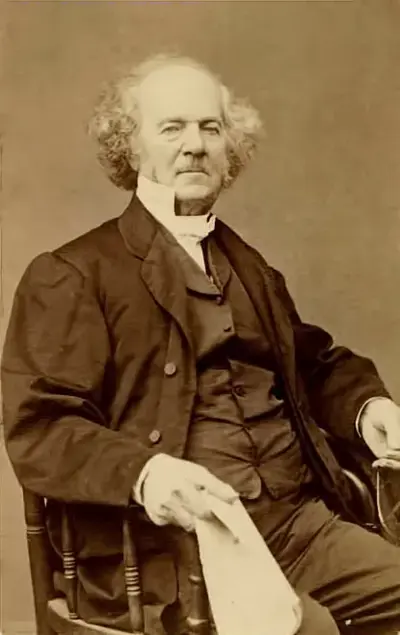
Lewis Tappan was a New York abolitionist who worked to achieve freedom for the enslaved Africans aboard the Amistad. Tappan was also among the founders of the American Missionary Association in 1846, which began more than 100 anti-slavery Congregational churches throughout the Midwest, and after the American Civil War, founded numerous schools and colleges to aid in the education of freedmen.
