National Intelligencer Quotes
It is something singular that the colored race—those in reality most interested in the future destinies of Africa—should be so lightly affected by the evidences continually being presented in favor of colonization
Most free Blacks were not enthusiastic about the possibility of colonization. Those that were, wanted a colony in the Western part of America—not Africa or the Caribbean. See {613811}.
The National Intelligencer, October 23, 1850
Sourced by: Eigen's Political and Historical Quotations


He led 88 Black Americans to colonize Africa as the first official U. S. Government colonization attempt in conjunction with the American Colonization Society.

Abraham Lincoln in his famous eulogy to Clay in Springfield, IL, used this quotation.
More than a decade before the Civil War there were many proposals and plans for ending slavery in America without war. Many of these debates took place amongst major religious institutions. John Price Durbin, an eminent Methodist clergyman and former president of Dickinson College proposed one. His plan called for compensation to slaveholders and the relocation of the freed slaves to Africa—a form of ethnic cleansing. Brown disagreed with forced colonization to Africa. Instead, he suggested California as a voluntary option. Brown’s idea received about 9 months of serious consideration, but in January of 1848, gold was discovered in California and the Gold Rush was on. Black colonization of California was off the table.
_0_thumbnail_47x47.jpg "A portrait of Richard Allen, a Methodist bishop and founder of the African Methodist Episcopal Church")
Many whites thought that the solution to the problem of free and emancipated Negroes was to send them to Africa. They assumed that the negroes would by desirous of that solution also, but they rarely asked them. When they did, they received answers much like this one from one of the leading Black clergymen in America.


This idea has been rejected by American Blacks from before the Civil War. There were many Black families that have been in America longer than Rockwell who always had the choice to go back to where they cam from if they were unhappy with America but they never did.

Approximately 15,000 Blacks chose to emigrate.

See {625675}, {625686}, {625684}, {625682}, {625676} for additional quotations arguing for Black emigration.
Jefferson was referring to a plan then proposed and discussed to establish a colony in Africa which would be populated with free American Negroes and slaves when and if slavery could be ended. See Quotation xxx.


Eldest son of Robert Walpole. Lord Dunmore, royal governor of Virginia, had issued a proclamation offering freedom to slaves willing to defend the Crown

Lincoln early in his career had thought that voluntary Negro emigration would be a solution to the race problem in America. However, over time he lost his enthusiasm for this. Conversations with Black leaders had persuaded him that American Negroes had helped build this country and wanted their fair place in it. Hay thought that the idea was not only immoral but impractical and considered the suggestion always to be a proposed solution which would never be practically implemented. There were a few attempts and there was a society set up to encourage emigration. The Nation of Liberia was founded by returning American ex-slaves, but there has been friction between the descendants of the Americans and those of the natives ever since.

The organization was named for James Bruce—Lord Elgin, the Governor-General of Canada who was very favorably disposed towards Blacks colonists. When a slave reached Canada, he or she was automatically free under Canadian law, and Canada was the preferred destination of many runaway slaves. The Elgin Association was best know for the founding of Buxton—See {590063}.
Colonization of Blacks back to Africa The first anti-slavery newspaper published in the United States & the first journal in America to advocate immediate, unconditional emancipation

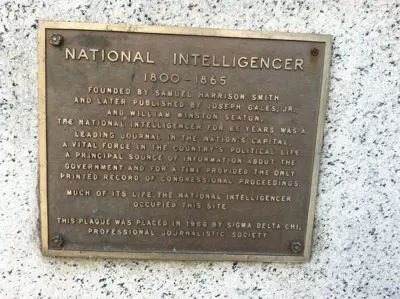
The National Intelligencer and Washington Advertiser was a newspaper published in Washington, District of Columbia from October 30, 1800 until 1870. It was the first newspaper published in the District, which was founded in 1790. It was originally a Tri-weekly publication. It covered early debates of the United States Congress. The paper had a strong bias to Republicans and Thomas Jefferson.
