Benjamin Franklin Quotes
Mr. President, I have gone very carefully over my calculations as to the power of the country to export the Negroes of the South and I assure you that, using all your naval vessels and all the merchant marines fit to cross the seas with safety, it will be impossible for you to transport to the nearest place that can be found fit for them—and that is the Island of San Domingo, half as fast as Negro children will be born here.
The response was supposedly to the President’s question of the feasibility of using the Navy to remove the Negro soldiers to another land. See {590147}. This quotation’s authenticity and accuracy are challenged by many scholars. The only source is the personal reminiscences of General Butler, a politician with Presidential aspirations who had his own agenda. The nuance of wording is very critical as to whether Lincoln was trying to accomplish export or whether he was asking Butler to staff out the feasibility so that Lincoln could deal with others who had raised the issue. There is no record of his having asked anyone in the Navy to staff out such a proposal, and the Secretary of the Navy at the time, Gideon Wells kept a detailed diary. Butler’s conclusion that 150,000 people could not be transported fast enough to exceed the breeding rate of those Blacks remaining also is challenged by many, especially if the Navy and the Merchant Service were both used. This casts even more doubt on the accuracy of the quotations.
Benjamin Franklin, 1818-1893, U. S. Congressman (Republican, MA), Governor of Massachusetts (Democrat & Greenback), Union General in Charge of Louisiana, Presidential candidate of the Greenback and Anti-Monopolist parties, Response to President Lincoln, 1865, Personal Reminiscences of General Butler
Sourced by: Eigen's Political and Historical Quotations

This quotation’s authenticity and accuracy are challenged by many scholars. The only source is the personal reminiscences of General Butler, a politician with Presidential aspirations who had his own agenda. The nuance of wording is very critical as to whether Lincoln was trying to accomplish export or whether he was asking Butler to staff out the feasibility so that Lincoln could deal with others who had raised the issue. Butler’s reply was that it was not feasible ({633655}), and there is no other record of the idea being advocated or implemented. The quotation, if indeed it was a quotations, is taken by some to indicate that Lincoln was no friend of Blacks and very racist to boot.

See {625675}, {625686}, {625684}, {625682}, {625676} for additional quotations arguing for Black emigration.
_0_thumbnail_47x47.jpg "A portrait of Richard Allen, a Methodist bishop and founder of the African Methodist Episcopal Church")
Many whites thought that the solution to the problem of free and emancipated Negroes was to send them to Africa. They assumed that the negroes would by desirous of that solution also, but they rarely asked them. When they did, they received answers much like this one from one of the leading Black clergymen in America.


Lincoln, just before the Civil War, quoted Jefferson that if slavery were not ended in America the results would be disastrous. But Lincoln at the time probably did not imagine how right Jefferson was, and Jefferson himself probably 1 how terrible the Civil War would be.
The United States should authorize payment for


The general issued a military order emancipating slaves in Florida, Georgia and South Carolina. President Abraham Lincoln rescinded the order feeling it was too premature and it would cause the slave states that stayed in the Union--Delaware, Maryland, and Kentucky--to go over to the Confederates.

Abraham Lincoln in his famous eulogy to Clay in Springfield, IL, used this quotation.

Washington and his staff had throughout the Revolution wanted to enlist Negroes but were thwarted by the Southern and conservative blocs of the Continental Congress when they tried it in the South. However, they finally succeeded in Rhode Island. Other states followed when it was clear that the Rhode Island experiment had been successful. See {614120} for the policy statement of the legislature and {614119} for the motto and a picture of the Negro regiment. This was however not the first Black military unit in North America. The Loyalist Governor of Virginia had formed a regiment comprised of slaves who he emancipated. See {636965}.

When the Confederate Government realized that the Union was planning to arm escaped slaves and induct them into the Union Army, they quickly passed a law that declared any escaped slave who joined the Union Army or wore its uniform was guilty of Treason and would be executed. Most Union Generals one way or another got word to the Confederate Officers that they had better treat all Negro Union Soldiers as prisoners of war. Even President Lincoln warned the South. Butler, however, had a large number of Negro troops in his area and had heard threats of some of the Southerners to execute Black prisoners of war. He had a way of making things very clear, and he was able to prevent murder of any of his Negro troops despite the Treason law.

This quotation is very important for in the 20th century Southern revisionists made a major effort to ennoble the Confederate cause by claiming that Slavery and the desire to keep Blacks in bondage and unequal was just of byproduct of the reason for secession—States Rights and the decentralization of government. Many of the school history books were changed to reflect this claim. However, each of the seceding states left a legislative record of secession and the reasons for it. In all cases, Slavery and the preservation of Slavery in the South was the central and in most cases the only reason stated. In this case, Texas made its reasons clear. There was nothing noble therein but racism and racial exploitation.

More than a decade before the Civil War there were many proposals and plans for ending slavery in America without war. Many of these debates took place amongst major religious institutions. John Price Durbin, an eminent Methodist clergyman and former president of Dickinson College proposed one. His plan called for compensation to slaveholders and the relocation of the freed slaves to Africa—a form of ethnic cleansing. Brown disagreed with forced colonization to Africa. Instead, he suggested California as a voluntary option. Brown’s idea received about 9 months of serious consideration, but in January of 1848, gold was discovered in California and the Gold Rush was on. Black colonization of California was off the table.
This letter was signed by a local white Priest and two other leading planters. This quotation gives us a marvelous feeling for what occurred when parts of the South was occupied by the Union Army shortly after the Emancipation Proclamation was issued. Minor and his fellows just did not “get it.” The concept of freedom of the slaves was intellectually so foreign to them, that they wanted the Union Army to “compel” the freed slaves to work. They were horrified that slaves went wherever they wanted, and they were most outraged when former slaves who had enlisted in the Army, would “visit” their old plantation setting such a terrible example. The letter gives us a perspective on how difficult it was to change the mental set of Southern Whites and why Reconstruction was so difficult. The year of the letter is somewhat uncertain as the original letter appears to be dated 1862 but the writing is not clear and that date does not comport with the history of the era and we believe 1863 was the correct year. The photograph is of the first official colored troops mustered into the Union Army. They were called the Louisiana Native Guards and contained the ex slaves who went over to the Union side just before the time this slave owner complained. These ex slaves, in uniform, and with arms would sometimes visit the plantations where they and been enslaved, thrilling the remaining slaves and infuriating owners like Minor.
loyalty oath to the King of England His “Ethiopian Regiment” was the first Black military regiment in North America. Soon after, Rhode Island organized a Black military unit—see {613949}.

Much of the South was so insular that people knew nothing about the notion of abolition and just assumed that no one would ever consider freeing the slaves. Many never knew that it was the South that first fired on the Union troops and flag. If the North won the war, the assumption was that Northerners would then own the plantations and the valuable slaves. In reality, while all slaves were emancipated in the South, very few plantations and farms were confiscated from their Southern owners by Northerners despite the fact that there was political pressure in the North to confiscate the land of all rebels who had committed treason and use the value to repay the Union bonds and care for the wounded Union veterans and the widows of dead Union Soldiers. Eggleston was an accomplished writer who had served in the Confederate army of the Civil War. 20 year after the war he wrote a series of articles for the prestigious Northern Atlantic Monthly trying to convey the war from the Southerner’s point of view.

One of the puzzles of American Civil War history has been how the poor whites of the South (who provided most of the military manpower that fought and died in the Civil War) were persuaded to fight against a much stronger, more highly industrialized, and more affluent few, that had many more soldiers. One of the main reasons, though difficult for us to understand today, was that the Southern leadership actually persuaded the Southerners that men from the North were cowards and lacked the character, virtue or will to fight. The general “party line” of the South was that one Southern solder was worth more than 5 Northern Soldiers,
When the first Southern States seceded, each appointed a whose job it was to persuade the other Southern States to also secede. In this case Hale was marketing secession to Kentucky which with Maryland were the only two Southern States to reject what they regarded as treason and rebellion. The importance of the quotation however is in his argument which was all based on enmity to racial equality and abolition. Later Southern apologists would argue that the Civil War was fought, not about slavery and racism butt about different philosophies of government. See {623715} .

Actually Blacks did all three. Some returned to Africa and established the state of Liberia. Others went to South America and most stayed in the United States and continued to help build the nation.

See {625675}, {625686}, {625683}, {625682}, {625676} for additional quotations arguing for Black emigration.

The reason for secession was the threat to slavery, which was a great threat to the slave-owners of the South. However, the non slave-owners had a very strong vested interest in maintaining slavery in that most Southerners had been brought up with such a negative view of Blacks that they were paranoid of Black equality or even worse some Blacks in positions of authority over whites. At the time, it was the Republican Party that was the advocate for minority equality and the Democratic Party embraced the racists. The parties would flip flop after the Civil Rights Act of 1964 ending legal segregation was passed by a Democratic President and a Democratic Majority Congress.
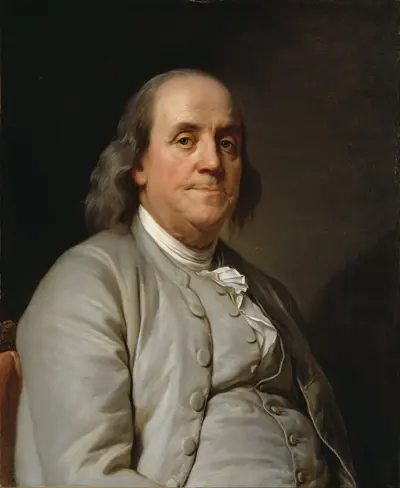
- Born: January 17, 1706
- Died: April 17, 1790
- Nationality: American
- Profession: Politician
Benjamin Franklin FRS FRSA FRSE was one of the Founding Fathers of the United States. A polymath, he was a leading writer, printer, political philosopher, politician, Freemason, postmaster, scientist, inventor, humorist, civic activist, statesman, and diplomat. As a scientist, he was a major figure in the American Enlightenment and the history of physics for his discoveries and theories regarding electricity. As an inventor, he is known for the lightning rod, bifocals, and the Franklin stove, among other inventions. He founded many civic organizations, including the Library Company, Philadelphia's first fire department, and the University of Pennsylvania.
