David Hunter Quotes
Slavery and martial law in a free country are altogether incompatible.
The general issued a military order emancipating slaves in Florida, Georgia and South Carolina. President Abraham Lincoln rescinded the order feeling it was too premature and it would cause the slave states that stayed in the Union--Delaware, Maryland, and Kentucky--to go over to the Confederates.
David Hunter, 1802–1886, Union General in Command of the Southern Department, General Order No. 11, May 9, 1862
Sourced by: Eigen's Political and Historical Quotations

There was little thought of emancipating slaves or their value to the South by the senior officers of the Union Army at the beginning of the war. The Secretary of War changed that. See {629183}for a typical Union General’s view at the beginning of the war.

Fremont and some of the Radical Republicans wanted Lincoln immediately to declare the slaves of the rebelling states free. As a major general in charge of an area, he wrote a military order emancipating all the slaves in his jurisdiction. President Lincoln countermanded the order as soon as he found out. He wanted Fremont to only free the slaves whose owners were actively working against the union. Lincoln needed to hold the border states like Maryland in the Union and was working on a plan whereby slave owners who were loyal to the Union would be economically compensated when their slaves were freed. If loyal slaveholders in Fremont’s area would lose their slaves with no compensation, Lincoln feared that the otherwise loyal border states would be driven to the confederacy thus shifting the balance of power. Lincoln had his own plan for emancipation and would not allow Fremont to alter that. As a result of this speech, the Radical Republicans nominated Fremont to run against Lincoln. For a few weeks he looked like he would run, but then he and Lincoln made a deal. Lincoln fired Montgomery Blair, Fremont’s arch enemy, from the cabinet, and Fremont withdrew from the election.

Negotiations regarding the exchange of prisoners and property. This was his view of his supposed obligation to return Negro slaves who had escaped and gone to the British during the war. The treaty of peace specified that all “property” including slaves, taken by, the British be returned to the Americans. But he and other officers did not always do so as they thought they had higher moral obligations. See {621936} for example.


This is an important quotation because it shows that slavery was the principle reason that the South succeeded and began their rebellion. In the early 20th century, there was a movement to make the Confederacy and the rebellion more noble by promoting the idea that the Civil War was fought by the South for more lofty reasons such as States Rights, Original Construction, different economic philosophies and the like. This was a more noble cause then the right to deny other human beings their rights, to own other human beings who they could beat, torture, sexually use and even murder them was a pretty selfish and demeaning reason to have started a rebellion that would then cost more Americans their lives than any other American conflict. The succession documents and others of the Southern States and the Confederacy make it clear that slavery was THE issue and fleeting references to any of the others were only made to complain about the potential effect on abolition and the refusal of the abolitionist states to cease aiding and protecting fugitive slaves.

She was one of the early abolitionists. Despite the Southern attempted repression of information of slave resistance, some of the facts emerged and were well known in the North. The South tried to suppress these incidents lest other slaves get ideas from it. Also the Southerners often maintained that Africa was so primitive and underdeveloped, that the slaves were better off in America; these actions of rebellion belied this notion.


In the early days of the Civil War slaves who escaped and reached the Northern lines were routinely returned to their Southern owners as the Fugitive Slave Act required. The first actual emancipation of the Civil war was not the President’s proclamation but was Butler who as a Union General ordered that the slaves escaping from Virginia no longer be returned. He was accused of violating the then existing law, however he had a legal rationale which hoisted Virginia on its own petard.

This letter was signed by a local white Priest and two other leading planters. This quotation gives us a marvelous feeling for what occurred when parts of the South was occupied by the Union Army shortly after the Emancipation Proclamation was issued. Minor and his fellows just did not “get it.” The concept of freedom of the slaves was intellectually so foreign to them, that they wanted the Union Army to “compel” the freed slaves to work. They were horrified that slaves went wherever they wanted, and they were most outraged when former slaves who had enlisted in the Army, would “visit” their old plantation setting such a terrible example. The letter gives us a perspective on how difficult it was to change the mental set of Southern Whites and why Reconstruction was so difficult. The year of the letter is somewhat uncertain as the original letter appears to be dated 1862 but the writing is not clear and that date does not comport with the history of the era and we believe 1863 was the correct year. The photograph is of the first official colored troops mustered into the Union Army. They were called the Louisiana Native Guards and contained the ex slaves who went over to the Union side just before the time this slave owner complained. These ex slaves, in uniform, and with arms would sometimes visit the plantations where they and been enslaved, thrilling the remaining slaves and infuriating owners like Minor.


Many historians point to this quotation as demonstrating Jefferson’s antipathy to slavery. However, others, more cynical, observe that by curtailing the ability to bring new slaves into Virginia, the economic value of the slaves who already existed increased markedly, First because there was a limited supply and a growing economy, but more important because the slave owner could breed and sell slaves from the existing stock he had. Jefferson was very aware of this economic fact, had worked out the mathematics and economics, and even advised friends to take advantage of it. See {629765}. Jefferson’s view of slavery was very complex and ambivalent.

As an entertainer she had toured much of the world and seen American slavery and that of some other nations. She became a staunch abolitionist and like entertainers in the 20th and 21st centuries she used her celebrity to give anti-slavery lectures and perform for audiences where she donated the proceeds of the event to the abolition cause. She is a particularly interesting political figure in that she seems to be one of the first entertainers to perform for a social cause and become an activist.
Parker and other escaped slaves in Christiana fought off slave catchers and killed the slave owner leading them. Charged with treason, he escaped to Canada with his family and lived there the rest of his life. While not a polished writer, after he himself had escaped and went to Christiana and leaned to read and write. He wrote this narrative of his life as a slave—one of the few written works we have from slaves.


The bill was defeated in the Confederate Senate {590064} so was the last good opportunity for the Confederacy. Lee was totally correct about what the Union would do, and the Northern use of Negro troops from the South was the final nail in the Confederate coffin.
After the Civil War and Reconstruction, the American nation was still bitterly divided intelelctually, socially, emotionally and poliotically. In an effort to bring more unity to America, most of the power stucture and the influentials of the nation began to avoid those issues that would divide North and South and try and promote a narrative that both sides might be able to live with. And this is what Zeitz describes in this quotation. America went through a period of Revisionist History that even in the 21st century was held by many people. It wasn't until the middle of the 20th century that the real history and narrative of the Civil War and Reconstrution emerged from the few academics who had all along criticized the fabricated narritive that did unify the country at the cost of historical accuracy and truth. Many scholars point out that the price that America paid for this unity was the Jim Crow era and a century of legalized racism. Much of the nation was built on the labor of Negro slaves and the victims of the slavery era, also bore the brunt of American unity and reconcilliation.

This was part of his presentation to Northern influential business men showing them what he claimed was the New South. He was particularly complimentary about the negro Christian viewpoint that inhibited revenge or retaliation for their terrible treatment. The favorable lines about Negroes were well received by Northerners. However, they were mostly unaware of his racist views he expressed when in the South. See Quotation 643649.

This Civil War recruiting poster was described by the Free Library of Philadelphia as “Civil War recruitment print targeting African Americans by evoking the freedoms granted by the Emancipation Proclamation. Depicts a montage of symbolic scenes centered around an African American Union soldier triumphantly holding up a sword and an American flag with the banner "Freedom to the Slave." He stands near broken shackles upon a tri-color flag adorned with a coiled snake. The flag is tugged upon by one of three joyous slaves freed by an African American soldier. Other scenes depict an African American man reading a newspaper on a rocking chair near a plow and child, African American children entering a "Public School" near a church, and a regiment of "U.S. Colored Troops" marching across a battlefield strewn with dead bodies.”

In early New England the General Court served as both a legislature and a judiciary before separation of powers was introduced. 5 years later the Court banned importing African slaves at all. While slavery was not common in Rhode Island, the laws was not seriously enforced on those who would defy them. It does represent a public anti-slavery sentiment that existed in Early America. It would take 200 years for Rhode Island to finally eliminate all forms of slavery.
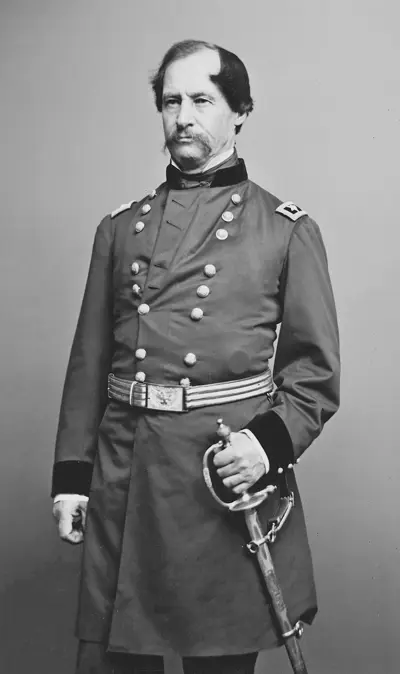
David Hunter was a Union general during the American Civil War. He achieved fame by his unauthorized 1862 order (immediately rescinded) emancipating slaves in three Southern states, for his leadership of United States troops during the Valley Campaigns of 1864, and as the president of the military commission trying the conspirators involved with the assassination of U.S. President Abraham Lincoln.
