John Fremont Quotes
Today we have in this country the abuses of a military dictation without its unity of action and vigor of execution.
Fremont and some of the Radical Republicans wanted Lincoln immediately to declare the slaves of the rebelling states free. As a major general in charge of an area, he wrote a military order emancipating all the slaves in his jurisdiction. President Lincoln countermanded the order as soon as he found out. He wanted Fremont to only free the slaves whose owners were actively working against the union. Lincoln needed to hold the border states like Maryland in the Union and was working on a plan whereby slave owners who were loyal to the Union would be economically compensated when their slaves were freed. If loyal slaveholders in Fremont’s area would lose their slaves with no compensation, Lincoln feared that the otherwise loyal border states would be driven to the confederacy thus shifting the balance of power. Lincoln had his own plan for emancipation and would not allow Fremont to alter that. As a result of this speech, the Radical Republicans nominated Fremont to run against Lincoln. For a few weeks he looked like he would run, but then he and Lincoln made a deal. Lincoln fired Montgomery Blair, Fremont’s arch enemy, from the cabinet, and Fremont withdrew from the election.
John Fremont, 1813-1890, Explorer, General, and Republican Candidate for President, Criticism of Abraham Lincoln, Speech, Radical Republications' Convention, May 31, 1864
Sourced by: Eigen's Political and Historical Quotations


The general issued a military order emancipating slaves in Florida, Georgia and South Carolina. President Abraham Lincoln rescinded the order feeling it was too premature and it would cause the slave states that stayed in the Union--Delaware, Maryland, and Kentucky--to go over to the Confederates.

Roosevelt, after refusing to run for a third term in 1908, decided to run in 1912:

There was little thought of emancipating slaves or their value to the South by the senior officers of the Union Army at the beginning of the war. The Secretary of War changed that. See {629183}for a typical Union General’s view at the beginning of the war.


Eggleston was an accomplished writer who had served in the Confederate army of the Civil War. 20 year after the war he wrote a series of articles for the prestigious Northern Atlantic Monthly trying to convey the war from the Southerner’s point of view.


After the Civil War and Reconstruction, the American nation was still bitterly divided intelelctually, socially, emotionally and poliotically. In an effort to bring more unity to America, most of the power stucture and the influentials of the nation began to avoid those issues that would divide North and South and try and promote a narrative that both sides might be able to live with. And this is what Zeitz describes in this quotation. America went through a period of Revisionist History that even in the 21st century was held by many people. It wasn't until the middle of the 20th century that the real history and narrative of the Civil War and Reconstrution emerged from the few academics who had all along criticized the fabricated narritive that did unify the country at the cost of historical accuracy and truth. Many scholars point out that the price that America paid for this unity was the Jim Crow era and a century of legalized racism. Much of the nation was built on the labor of Negro slaves and the victims of the slavery era, also bore the brunt of American unity and reconcilliation.


Arguing the need to limit the power of the legislature:


The dictator that he thought Russia needed, Stalin, turned on him in 1937 for not agreeing with Stalin enthusiastically enough, had a 1 day trial for treason, and executed the best military man in the country despite the fact that Russia would need its military to fight the German invasion.


FDR was a marvelous judge of men and their character. De Gaulle could not separate himself from France and pushed the French Republic towards one man rule (himself) as much as anyone since Napoleon Bonaparte.

Much of the South was so insular that people knew nothing about the notion of abolition and just assumed that no one would ever consider freeing the slaves. Many never knew that it was the South that first fired on the Union troops and flag. If the North won the war, the assumption was that Northerners would then own the plantations and the valuable slaves. In reality, while all slaves were emancipated in the South, very few plantations and farms were confiscated from their Southern owners by Northerners despite the fact that there was political pressure in the North to confiscate the land of all rebels who had committed treason and use the value to repay the Union bonds and care for the wounded Union veterans and the widows of dead Union Soldiers. Eggleston was an accomplished writer who had served in the Confederate army of the Civil War. 20 year after the war he wrote a series of articles for the prestigious Northern Atlantic Monthly trying to convey the war from the Southerner’s point of view.

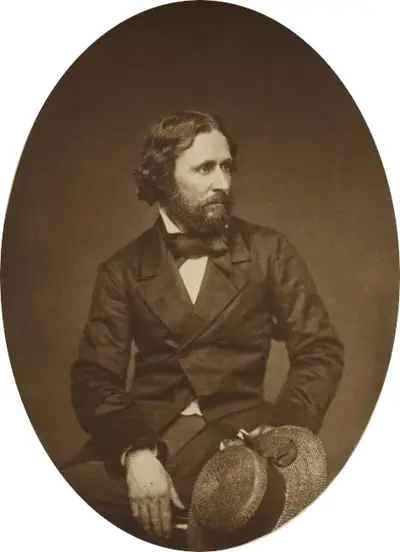
John Charles Frémont or Fremont was an explorer of the Western United States, military officer, and politician. He was a U.S. Senator from California, and in 1856 was the first Republican nominee for President of the United States. A native of Georgia, he was an opponent of slavery but also a contributor to Native American genocide.
