Bassem Youssef Quotes
Theocratic and military authorities share one thing: they have no sense of humour.
Youssef, Bassem. Revolution for Dummies: Laughing Through the Arab Spring. Dey Street Books, 2017, p. 76.


Arguing the need to limit the power of the legislature:

FDR was a marvelous judge of men and their character. De Gaulle could not separate himself from France and pushed the French Republic towards one man rule (himself) as much as anyone since Napoleon Bonaparte.


Eggleston was an accomplished writer who had served in the Confederate army of the Civil War. 20 year after the war he wrote a series of articles for the prestigious Northern Atlantic Monthly trying to convey the war from the Southerner’s point of view.


Charles I had caused the death of his subjects with impunity and was called to account. However, the English Parliament did not know what specific crime the King had committed. Kings had executed people, guilty of crimes and otherwise, for centuries. For what could a king be accountable. Cooke developed the crime of Tyranny and drew up and presented the indictment for that. The King was found guilty and executed. This was the first time in legal history that a ruler was called to account for crimes committed against his own people. It became the foundation for many trials thereafter including that of Saddam Hussein in 2006.


He was expelled from Parliament for such.

See Louis Brandeis for a later judicial interpretation of this view.

Urging a presidential veto of a tough ethics law prohibiting unethical behavior on the part of government officials:

This is a very important quotation. It explains in great part, why there have been so few internal revolutions in Muslim countries. Al-Ghazi’s interpretation of Islamic Law and Theology concluded that even if the ruler is incompetent, corrupt, or destructive he should be supported and obeyed by all good Muslim citizens. The reason was that anarchy and/or chaos was an evil much worse for the Islamic community. There was one exception in the case of a ruler who was blasphemous or did not follow Islam. Then it was the duty of good Muslims. Since then, the ruler of an Islamic state, first seeks to ingratiated himself with the clergy. In Saudi Arabia, for example, the Royal Family gives enormous sums to all the clerics. They then urge dissidents and would be revolutionaries to accept the Royal Family with its flaws and shortcomings and accept their lack of freedom and human rights. And they tell all that the King and his family are all religious and support Islam. Therefore any revolt would be a tantamount to a sin. The Christian world had a different technique for inhibiting Revolution. Christian rulers claimed the Devine Right of Kings—that God had selected and ordained the king to lead. Regime change was contrary to the word of God. In a sense, the Islamic approach is more intellectually honest and seems to have worked much better than the Christians who have had so many revolutions. Better that is from the rulers point of view. From a democratic, Jeffersonian point of view revolting against an evil ruler was almost a moral obligation, and Al-Ghazali’s principle is all wrong and is keeping the Muslim countries from reaching democracy.

At the time of this statement most people thought that Bush was joking. But by the end of his Presidency many looked back on the quote and thought that Bush had such preferences. He unilaterally took the country into the Iraq War and assumed Presidential Powers that no other president had ever attempted. Most serious, his administration actually took the formal legal position that the President did not have to obey the law if he unilaterally thought that it was not in the nation’s interest from the point of view of the Commander in Chief. So many debate whether this quotation was a light hearted joke of a harbinger of his real feelings about the Presidency.


Prevented by the Military from ever taking office. She was commenting on recent attacks against minority Muslims by the majority Buddhists and one of the major reasons she claimed was the lack of trust in the Muslim community that had developed during the period of military dictatorship.
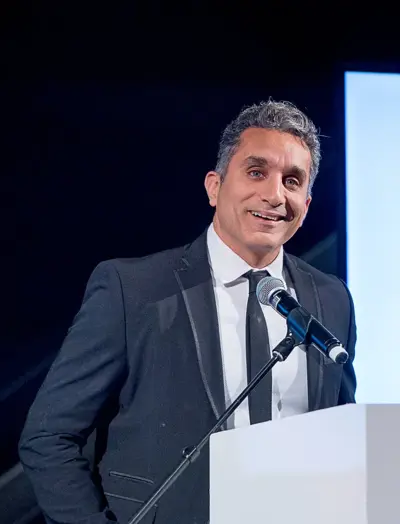
Bassem Raafat Mohamed Youssef is an Egyptian comedian, writer, producer, surgeon, doctor, media critic, and television host, who hosted El-Bernameg (The Show), a satirical news program, from 2011 to 2014. The press has compared Youssef with American comedian Jon Stewart, whose satire program The Daily Show inspired Youssef to begin his career. In 2013, he was named as one of the "100 most influential people in the world" by Time magazine. Youssef's current projects are Tickling Giants, The Democracy Handbook, and Revolution For Dummies.
