Marcus Garvey Quotes
Where is the black man's Government? Where is his King and his Kingdom? Where is his President, his country, and his ambassador, his army, his navy, his men of big affairs? I could not find them, and then I declared, "I will help to make them.
Marcus Garvey, 1887-1940, Black Nationalist Leader and Founder, Universal Negro Improvement Association, Quoted in Cronon, Black Moses, University of Wisconsin Press, 1957
Sourced by: Eigen's Political and Historical Quotations


He was one of the people who popularized the term “Black Power”


The Negro World, Garvey’s Newspaper, was the country’s largest Black newspaper. The statement brought great distress to white Europe whose colonial interests were threatened.


Grant had negotiated for what is today the Dominican Republic to become a Black state where American Negroes could go. However, like Lincoln before him and most others arguing for Negro emigration, he underestimated the Negro desire to remain where they were and just be free with equal opportunity. See {625675}, {625686}, {625684}, {625683}, {625682} for additional quotations arguing for Black emigration.

This was the last public speech that Lincoln made before he was shot.


In the early 20th century, Carver and Du Bois were the two most important Negro leaders in America. However, they disagreed over tactics. Carver tended to believe that if the Negro would be educated and trained for meaningful occupations, he would rise in the eyes of the whites and discrimination would diminish. Du Bois was more cynical as can be seen in this quotation as he looked back on history when he was 95 and close to death. He had the advantage at this time of seeing that Washington’s strategy had failed, but he opposed Washington on this from the beginning. Most whites preferred Washington’s view as whites were relived of immediate moral responsibility for racism and the burden was placed on Blacks to train, develop and display themselves as worthy. It was only when very large numbers of Blacks had done this and nothing much changed in terms of civil and economic rights, that it was clear that Washington’ view had been hopelessly naïve.


At the time segregation was legal, Southern Blacks could not vote, racism was rampant, and a Black President seemed impossible.


Pickering referred to Jefferson as the “Negro President” because he believed his presidential power rested on the shoulders of slavery.
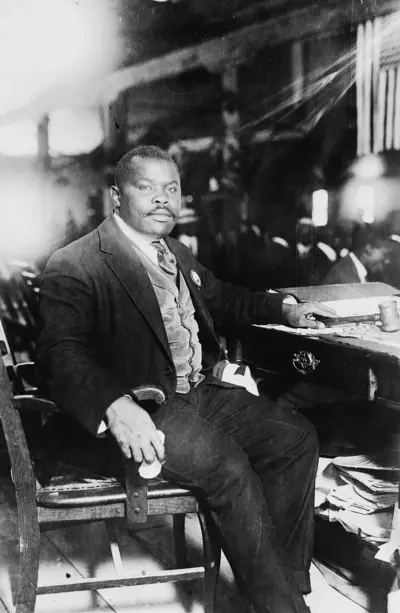
Marcus Mosiah Garvey Sr. ONH was a Jamaican political activist, publisher, journalist, entrepreneur, and orator. He was the founder and first President-General of the Universal Negro Improvement Association and African Communities League (UNIA-ACL, commonly known as UNIA), through which he declared himself Provisional President of Africa. Ideologically a black nationalist and Pan-Africanist, his ideas came to be known as Garveyism.
