Jefferson Davis Quotes
The argument is exhausted. All hope of relief in the Union through the agency of committees, congressional legislation or constitutional amendments, is extinguished. We are satisfied the honor, safety, and independence of the Southern people require the organization of a Southern confederacy.
Jefferson Davis, 1808-1889, U. S. Congressman & U. S. Senator (Democrat, MS), U. S. Secretary of War, President, Confederate States of America, December 14, 1860
Sourced by: Eigen's Political and Historical Quotations

The early Union military leadership was so poor and timid that it was not clearly demonstrated that a Confederacy was not viable until later in the war, and the Southerners possessed an extraordinary capacity for ignoring reality and self-delusion, that it was not demonstrated until Grant’s major victories and Sherman’s March through Georgia and the Southern East Coast that an independent South was not going to be.


The Prime Minister had a penchant for mis-assessing world affairs in both the old world and the new.

Bragg and other Southerner leaders had an unusual concept of equality. Ever since the original Constitution, Northerner’s votes counted for themselves only while a single Southerner’s vote counted for all his slaves as well. So the individual Southerner always had more political power than his Northern counterpart. However, this notion of equality reached it’s acme when it came to the new territories. The Southern argument was that Southerners could not equally prosper in the new territories of Kansas and Nebraska if they could not bring their slaves to work the land. The thought that Southerners were equally able to personally work the new lands or pay labor seems to never have occurred to them. If Northerners could prosper that way then Southerners should be equally able to do so also. However, many Southern whites simply could not conceive of a “gentleman” working in the fields. Therefore they would not be equally able to prosper in the new territories.

Jackson makes the case against the South Carolina argument for nullification. In the related quote, he makes his threat which was very successful in ending the notion of “nullification”. The extensive quotation is given as it summarizes the entire issue that was one of the crises of early America.

After the Presidential years of James Buchanan who protected the South from slavery reform and abolition as the North was gaining political power and the abolitionists were having a greater and greater effect on public opinion in the North. While Southerners did not believe Lincoln would emancipate the slaves, they realized that the majority of the growing nation was opposed to slavery, and more and more Northern states were passimg laws making any slave who sets foot in the State a free person. Slaves coud not only have more reason to run away, but slave owners would not be able to get their “property” back. Lincoln would not help the South as Buchanan did, and the Southerners realized that over time, slavery would no longer be feasible or profitable. Cobb, very experienced at Washington politics, realized the changes that would come and thought that they would be “certain and speedy.” The irony was that if the South had not seceded and simply dragged its feet legislatively, it would have taken two or three decades for slavery to end. However, by seceding and initially fighting so hard and well while poor Union generals were in command, Lincoln was forced to try more drastic measures and issued the Emancipation Proclamation after only a few years. The Civil War and seccession was not only a tactical and strategic error for the South, but rapidly brought about just what the Southerners were fighting to prevent.


In many respects, it is amazing that secession did not take place earlier.

When the first Southern States seceded, each appointed a whose job it was to persuade the other Southern States to also secede. In this case Hale was marketing secession to Kentucky which with Maryland were the only two Southern States to reject what they regarded as treason and rebellion. The importance of the quotation however is in his argument which was all based on enmity to racial equality and abolition. Later Southern apologists would argue that the Civil War was fought, not about slavery and racism butt about different philosophies of government. See {623715} .

The Southern states were illegal rebels. A confederacy had always meant a voluntary association of otherwise independent entities. However technically the Southern states were not independent but in a state of illegal rebellion against the United States. Lincoln, a lawyer, could not being himself to refer to the South by their preferred name—the Confederacy. So this was how he and many in his administration referred to the South.


Much of the South was so insular that people knew nothing about the notion of abolition and just assumed that no one would ever consider freeing the slaves. Many never knew that it was the South that first fired on the Union troops and flag. If the North won the war, the assumption was that Northerners would then own the plantations and the valuable slaves. In reality, while all slaves were emancipated in the South, very few plantations and farms were confiscated from their Southern owners by Northerners despite the fact that there was political pressure in the North to confiscate the land of all rebels who had committed treason and use the value to repay the Union bonds and care for the wounded Union veterans and the widows of dead Union Soldiers. Eggleston was an accomplished writer who had served in the Confederate army of the Civil War. 20 year after the war he wrote a series of articles for the prestigious Northern Atlantic Monthly trying to convey the war from the Southerner’s point of view.
Eggleston was an accomplished writer who had served in the Confederate army of the Civil War. 20 year after the war he wrote a series of articles for the prestigious Northern Atlantic Monthly trying to convey the war from the Southerner’s point of view.

The Governor was a staunch Confederate supporter but his state legislature majority favored the Union. He was forced out of the governorship when the 1861 election gave the legislature a veto-proof pro Union majority.
It is often said that “elections have consequences”. The 1960 election was one that certainly had profound consequences. Lincoln was unwilling to force the Northern states to return fugitive slaves against the constitution, laws and will of the people of those states as Buchanan said he was (but had a hard time doing). Also Lincoln was unwilling to allow new territories to enter the union if they allowed slavery. In the end, most pro Slavery politicians realized that with the greater growth rate of the North, they Southern disproportionate power in the Congress was doomed as would be the institution of slavery itself. Crittendon a strong Unionist from a border state, understood the implication of Lincoln’s election for the Union.
He was Chancellor of the Exchequer at the time of this speech. Gladstone was certain about most of his views on foreign policy but correct on only some with many blunders on his watch. This view was very important for the Confederacy as it was a prerequisite to diplomatic recognition. The latter never came.
There was some political pressure in the North, to offer terms to the South where they could cease the rebellion and return to the Union and return to the status quo ante—before the rebellion.


This was more than 15 years before South Carolina became the first state to secede from the Union. The idea of secession existed long before Abraham Lincoln was elected to the Presidency.

This oath was required of Southern Rebels who wanted obtain amnesty from treason which they had committed by engaging in the Civil War. See {623307} for the Presidential Proclamation.
In the related quote, Jackson makes the case against the South Carolina argument for nullification. Here he makes his threat which was very successful in ending the notion of “nullification”. The extensive quotation is given as it summarizes the entire issue that was one of the crises of early America.
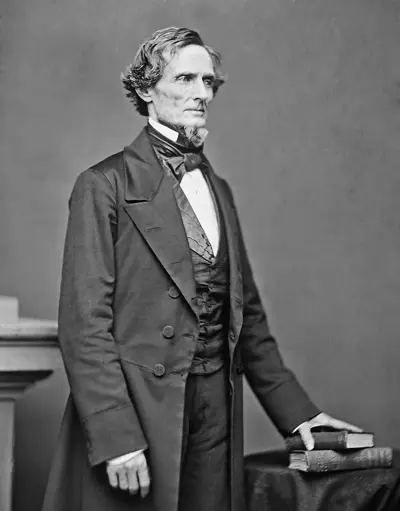
Jefferson Finis Davis was an American politician who served as the president of the Confederate States from 1861 to 1865. As a member of the Democratic Party, he represented Mississippi in the United States Senate and the House of Representatives before the American Civil War. He previously served as the United States Secretary of War from 1853 to 1857 under President Franklin Pierce.
