Henry Clay Quotes
From developments now being made in South Carolina, it is perfectly manifest that a party exists in that state seeking a dissolution of the Union.
This was more than 15 years before South Carolina became the first state to secede from the Union. The idea of secession existed long before Abraham Lincoln was elected to the Presidency.
Henry Clay, 1777-1852, U.S. Congressman and Senator (National Republican & Whig, KY), Speaker of the House, U.S. Secretary of State, Letter to The Tuscaloosa Monitor, July 1, 1844
Sourced by: Eigen's Political and Historical Quotations


As just one example of Southern States' reasons, see {583044}. Many of the Northern States had passed laws declaring everyone in the state was free and making it illegal to return or assist in the returning of escaped slaves. The Southerners got the Federal Fugitive Slave Act passed which required all Americans to assist in recapturing escaped slaves. It was the Northern States who claimed states' rights were being trampled. The South was vehemently opposed to States' Rights when it came to allowing individual states to decide who was free and who was not. The Southerners had only one fundamental reason for secession—the maintenance of the Negro slavery system on which much of their economy depended as did their sociology, culture, and way of life.


Jackson makes the case against the South Carolina argument for nullification. In the related quote, he makes his threat which was very successful in ending the notion of “nullification”. The extensive quotation is given as it summarizes the entire issue that was one of the crises of early America.

Fortunately he was wrong, but the threat of a breakup of the American Union intimidated most members of Congress to avoid anything that would offend a state or group of states. Thus slavery became more and more entrenched till it exploded into the Civil War. At the time the issues of contention included the fact that Louisiana was primarily Roman Catholic and ALL other states were majority Protestant. The territory functioned under French Law—the Napoleonic Code, while all the other states operated under the English Common Law (even today this is so), and there was concern with the French and Creole language and whether the Creoles would fit into American Culture.


Bragg and other Southerner leaders had an unusual concept of equality. Ever since the original Constitution, Northerner’s votes counted for themselves only while a single Southerner’s vote counted for all his slaves as well. So the individual Southerner always had more political power than his Northern counterpart. However, this notion of equality reached it’s acme when it came to the new territories. The Southern argument was that Southerners could not equally prosper in the new territories of Kansas and Nebraska if they could not bring their slaves to work the land. The thought that Southerners were equally able to personally work the new lands or pay labor seems to never have occurred to them. If Northerners could prosper that way then Southerners should be equally able to do so also. However, many Southern whites simply could not conceive of a “gentleman” working in the fields. Therefore they would not be equally able to prosper in the new territories.
It would be almost 30 years until Jackson would have been proved correct and the Civil War had begun.


Warning to John Calhoun and other South Carolinians about the implications of their nullification of the Tariff Act of 1832:


In many respects, it is amazing that secession did not take place earlier.

There were some Southern Apologists who during the Jim Crow era and even into modern times, argued that slavery and the desire to maintain that was a minor cause of the Civil War but succession came about over differences in philosophy of government. This document by Mississippi made it perfectly clear why they favored succession: Slavery and their desire to maintain that institution.

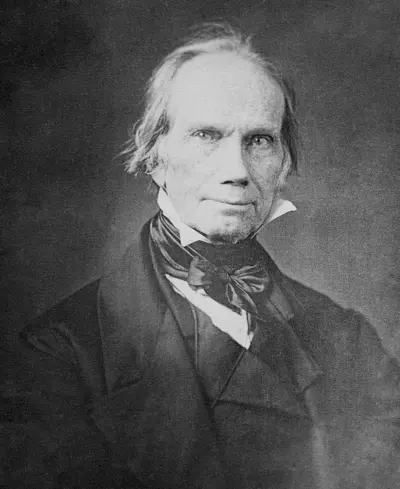
Henry Clay Sr. was an American attorney and statesman who represented Kentucky in both the Senate and House. He was the seventh House Speaker and the ninth Secretary of State. He received electoral votes for president in the 1824, 1832, and 1844 presidential elections. He also helped found both the National Republican Party and the Whig Party. For his role in defusing sectional crises, he earned the appellation of the "Great Compromiser" and was part of the "Great Triumvirate".
