Jefferson Davis Quotes
God forbid that the day should ever come when to be true to my constituents is to be hostile to the Union.
Davis, Jefferson. The Congressional Globe. 31st Cong., 1st sess., Appendix, John C. Rives, 1850, p. 1538.


While Douglas and Lincoln were political opponents with little love lost between them, both were patriots. Douglas’s position were much more popular in the South, and the moment he realized that Lincoln would win the Presidency, he headed South where he was very persuasive in trying to hold the Union together, but he could not see all the potential rebels and was only effective with some. South Carolina not only seceded, but in order to prevent any changing of minds, some the worst of the South Carolinians, attacked Fort Sumter firing on the American Flag and attacking and capturing the Union troops who were totally outnumbered. The Civil War was then inevitable.
While Douglas and Lincoln were political opponents with little love lost between them, both were patriots. And Douglas was committed to seeing that Lincoln was inaugurated and the Union preserved, if Lincoln won the election. When Lincoln did so, Douglas traveled throughout the South trying to persuade Southerners to stay in the Union. See {584870}.

Lincoln was a deist but he was never a favorite of the official clergy of any of the religions. When he ran for President in 1860, 20 of the 23 clergymen of his home town, Springfield, IL, opposed him. As he assumed office he was much more prudent in his religious remarks and in the view of some historians political realities and pragmatics caused him to be more circumspect. His oldest friend and law partner believed him to be an unbeliever. See {586285}.

At the time his Vice President, John C. Calhoun, was expounding a theory of “nullification” by which the states could supersede and nullify federal law in their states. When Jackson finished his toast, it was Calhoun’s turn (See {635896}.) His toast supported the States’ Rights position over the federal government. In those days Presidents and Vice President’s were often political enemies or of opposite parties. The President’s advisors thought that his toast might be misinterpreted. So when they gave the toast to the press as “The Federal Union: It must be preserved.” That was the form in which the press reported the President’s toast and for many years that was the version most quoted even though it was never delivered that way. However Jackson was responsible for both versions.


The then Vice President was accosted on the train by southerners who believed that he was on his way to his home state of Tennessee to persuade the legislature not to secede from the union. Amid cries to hang him and after he was punched by one of the mob, ex-Senator Wigfall—the man who had received the surrender sword at Sumter, who was also on the train, persuaded the crowd to hear Johnson out. Johnson thus began his speech which was potentially for his life, but never wavered from his view that secession was a mistake. Most of the crowd calmed down and as the train pulled out, they let him go though there were still a few shouts for “hanging.” There was no secret service protection for the President or vice President at the outbreak of the Civil War. Pinkerton had organized some informal protection for the President and thwarted some plots, but it was the Vice President who was attacked first. And there was not sufficient protection to prevent Lincoln’s assassination.


There was some political pressure in the North, to offer terms to the South where they could cease the rebellion and return to the Union and return to the status quo ante—before the rebellion.


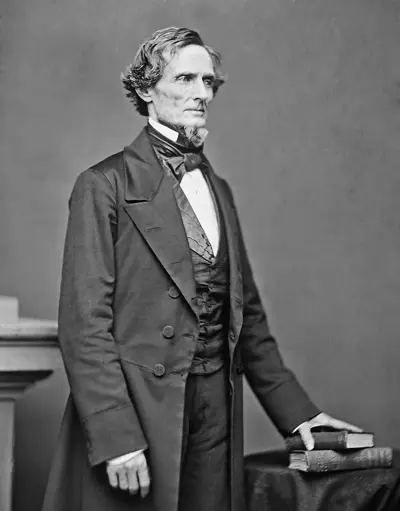
Jefferson Finis Davis was an American politician who served as the president of the Confederate States from 1861 to 1865. As a member of the Democratic Party, he represented Mississippi in the United States Senate and the House of Representatives before the American Civil War. He previously served as the United States Secretary of War from 1853 to 1857 under President Franklin Pierce.
