Andrew Jackson Quotes
Each secession destroys the unity of a nation.
Andrew Jackson, 1767-1845, 7th President of the United States (Democrat, TN), Criticism of South Carolina Nullification, December 1832
Sourced by: Eigen's Political and Historical Quotations


It would be almost 30 years until Jackson would have been proved correct and the Civil War had begun.

In the related quote, Jackson makes the case against the South Carolina argument for nullification. Here he makes his threat which was very successful in ending the notion of “nullification”. The extensive quotation is given as it summarizes the entire issue that was one of the crises of early America.

There was an active secession movement by the Western States. New Orleans was then controlled by the Spanish who would not allow U.S. goods access to export from New Orleans. Some of the wealthier Western citizens thought that they would fare better as a vassal state of Spain rather than part of the newly formed United States. Jefferson, did not overreact and the movement for secession faded.


At the time his Vice President, John C. Calhoun, was expounding a theory of “nullification” by which the states could supersede and nullify federal law in their states. When Jackson finished his toast, it was Calhoun’s turn (See {635896}.) His toast supported the States’ Rights position over the federal government. In those days Presidents and Vice President’s were often political enemies or of opposite parties. The President’s advisors thought that his toast might be misinterpreted. So when they gave the toast to the press as “The Federal Union: It must be preserved.” That was the form in which the press reported the President’s toast and for many years that was the version most quoted even though it was never delivered that way. However Jackson was responsible for both versions.


Thunder Rolling Down the Mountain

Compare Mark 3:25, above, and Abraham Lincoln's use of the phrase in one of his most famous speeches.

Jackson makes the case against the South Carolina argument for nullification. In the related quote, he makes his threat which was very successful in ending the notion of “nullification”. The extensive quotation is given as it summarizes the entire issue that was one of the crises of early America.


The debate had come to an impasse over the issue of voting and taxation by state equally or proportional to the population. Witherspoon warned of the consequence of there being no agreement on some form of unity.
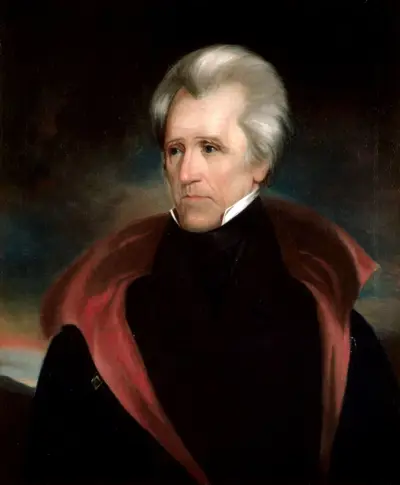
Andrew Jackson was an American lawyer, soldier, and statesman who served as the seventh president of the United States from 1829 to 1837. Before being elected to the presidency, Jackson gained fame as a general in the United States Army and served in both houses of the U.S. Congress. An expansionist president, Jackson sought to advance the rights of the "common man" against a "corrupt aristocracy" and to preserve the Union.
