F. W. de Klerk Quotes
For many years, I supported the concept of separate states.
De Klerk, F. W. Interview by Christiane Amanpour. Amanpour, CNN, 11 May 2012.


Arguing that the Arabs will never agree willingly to a Jewish state:

Thunder Rolling Down the Mountain


In one of the most unusual revolutions in world history, Brazil became independent from Portugal via a revolution led by the son of the Portuguese King and heir to the throne, Pedro I. Ironically the King of Portugal, John VI, in this famous quote, encouraged his son to lead the revolution. There were strong separatist sentiment in Brazil and the King thought it would be better to have an independent Brazil lead by a member of his family.

French Canadian separatists had begun a movement for an independent Quebec. The area that was to be an independent nation, however, included the land of several Indian tribes including the Cree. They insisted on the same right of self-determination within Quebec as the French Canadians claimed within Canada. Their opposition among others led to the failure of the Meech Lake Accord.


The Texans wanted independence from Mexico and this quotation illustrates their three possible alternatives. Most Texans wanted to join the United State, but the United States was not very enthusiastic about having Texas. In a sense, Texas was made up of the malcontents, failures and riffraff from the United States. Many felt the nation was good to be rid of them. So initially, Texas was an independent republic. However, public and elite opinion began to change, and finally Texas was admitted.

There was an active secession movement by the Western States. New Orleans was then controlled by the Spanish who would not allow U.S. goods access to export from New Orleans. Some of the wealthier Western citizens thought that they would fare better as a vassal state of Spain rather than part of the newly formed United States. Jefferson, did not overreact and the movement for secession faded.
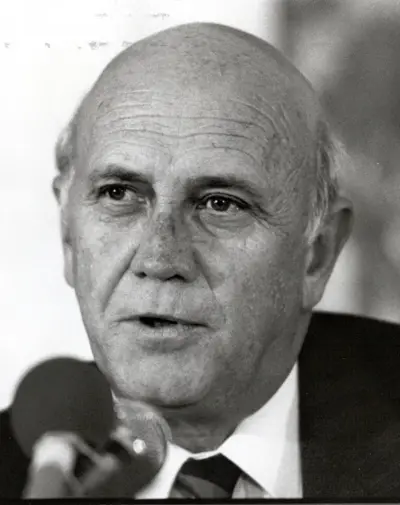
Frederik Willem de Klerk OMG DMS is a South African retired politician, who served as State President of South Africa from 1989 to 1994 and as Deputy President from 1994 to 1996. As South Africa's last head of state from the era of white-minority rule, he and his government were forced to dismantle the apartheid system and introduced universal suffrage. Ideologically a conservative and an economic liberal, he led the National Party from 1989 to 1997.
