King James I Quotes
That if any public reader in either our Universities, or any head or master of a College, or any other person respectively in either of them, shall affix any new sense to any Article, or shall publicly read, determine, or hold any public disputation, or suffer any such to be held either way, in either the Universities or Colleges respectively; or if any divine in the Universities shall preach or print any thing either way, other than is already established in convocation with our royal assent; he, or they the offenders, shall be liable to our displeasure, and the Church's censure in our commission ecclesiastical, as well as any other: and we will see there shall be due execution upon them.
Rulers & Government have been worried by what goes on at universities and colleges for a long time.
James I, 1566-1625, King of Great Britain & Scotland (James VI of Scotland), King's Declaration Prefixed to the Articles of Religion, November 1628
Sourced by: Eigen's Political and Historical Quotations


In addition to being a Roman Catholic priest, Father Coughlin was an outspoken radio commentator who was well known for his controversial political opinions, see {598783}, {598784}.

Metternich called a conference of the heads of all the German states to deal with what they perceived as a dangerous liberalism enveloping German society. Metternich did not personally draft all the resolutions but he controlled the conclave and all the resolutions which are usually ascribed to him.

Note the opposition to freedom of speech for contrary theological views. This has been typical of most religions whenever they could exercise or influence state power.


This quotation is often used to illustrate the complete intellectual conformity that was (and for some still is) required of the Roman Catholic Church. Although this was a theological statement, it is sometimes functionally used as a definition of loyalty to a President or other political figure with respect to staff.

Much of the then prevailing opinion was the opposite—that men and women should be taught these things from birth and education. Right and God’s plan, they argue, need not be contested for with temptation and wrong or worse, the word of Satan.


In 1877 Annie Besant and Charles Bradlaugh attempted to publish The Fruits of Philosophy in Britain. It was a book on Birth Control. The two were immediately arrested and charged with publishing an ‘obscene’ book. Gifford was the Public Prosecutor. The authors were convicted and sentenced to 6 months in prison. However, they appealed and were exonerated in the appeal. The case was good for Gifford who went on to become Lord Chancellor of Britain. The trial was a strong motivator for Annie Besant to have a very activist career thereafter.

Dodd, in Berlin from 1933 to the onset of WWII, was able to see first hand what Hitler and the Nazi Movement was really like, Although he for the United States and Churchill for England warned early on, the politics of the times would not allow any action to stop or curtail Hitler. America, in particular, had a strong isolationist Republican wing and in addition, a small but loud core of pro Fascist, Hitler admirers such as Charles Lindburg, Father Coughlin, and Henry Ford. America had virtually no serious military capacity at the time, and with the Depression, FDR had all he could do to just gradually build up the military. By the time the Democracies realized that Dodd and Churchill were right, it was too late to prevent WWII. Dodd died in 1940 just when it was clear that he had been right.
“Musalmans” was then another English term for Muslims. At the time, the Hindus and Muslims of India were both under the rule of the British. As bad as Colonial Rule was, it had some advantages for the subjects and their desire to reform government and education. Ironically, there is no Islamic nation today, with the exception of Turkey, where Muslims have the rights, freedom and privileges as they had at the turn of the century in Colonial India.

This quote is significant for several reasons. First, it illustrates the theological dimension of the Saudi Arabian kingdom where the Royal Family maintains its position by always accommodating and financing the Wahabi fundamentalist version of Islam. Second, it shows how difficult it is for modern science to be taught and understood in fundamentalist Islamic societies. Third, it illustrates a historically classic repressive logic: He who disagrees with the current religious orthodoxy is disagreeing with the espousers of that religion. And if the espousers are wrong, they are lying. Therefore the dissenter is accusing God and his prophets of being liars. That is blasphemy and an insult to all believers. Last, it illustrates the parallel between Islam and Christianity in development. The latter is 700 years older than Islam, and about that long ago, the Roman Catholic Church repressed Galileo for claiming that the Earth was not the center of the universe.

Santorum’s view was not quite as absurd as this quotation would indicate. His concern was that he believed that colleges and universities were dominated by left wing, liberal faculty, who indoctrinate the students and turn them into Democrats or liberal Republicans. This he thought was bad for the country. The view is not complete paranoia. Higher Education is rarely indoctrination in America. Virtually every school has some politically conservative faculty as well as faculty who are in the political left and some are apolitical. However most of the good schools are liberal in the traditional meaning of the word and as it has been used in Europe and initially in the United States. This liberal tradition is characterized by openness to all ideas and points of view including those that the government or other institutions of society are sometimes uncomfortable with. This intellectual tolerance makes some ultraconservatives uncomfortable. However, other political conservatives are very “liberal” in the intellectual sense including most of the great conservative writers and philosophers and economists of the last centuries. There are people of all political and religious persuasions in most societies who are concerned that the ideas young people might be exposed to are harmful to them and detrimental to society. Most have more faith in young people and see the major role of education is to expose the student to new and different ideas for the student to consider. Santorum is one of the former; all his Republican opponents were of the other point of view.

This anarchist vision of religion in the state is that of America with its first amendment, The reason that religion was still an issue for American Anarchists were that at the time and earlier, community norms and customs throughout the country dominated life and the First Amendment separation of church and state was commonly transgressed with few citizens willing to stand up against the community majority and force the issue in courts or in the political arena. That changed in the remainder of the 20th century and while there still are violations, they are relatively few in the 21st century.

The writer was born and brought up a Muslim and because he criticizes Islam, he has had a death fatwa issued against him much like Salman Rushdie.

The trial convicted a teacher, Scopes, of the “crime” of teaching the theory of evolution in a school.
Saint Benedicta was born and brought up as a Jew and converted to Catholicism. She and a few other leading German Catholics spoke out forcefully against Nazi crimes and immoralities. She was one of the few German Catholics who wanted the Pope to act more forcefully in Germany. The most controversial aspect of the Pontificate of Pius XI was his relative silence and failure to use the powers of the church and excommunication to condemn and control the Nazi rise to power and their, aggression, discrimination, and atrocities including mass murders. The Pope did occasionally speak out condemning the worst of the German Nazi outrages to morality, but he did not do so very vigorously or order the German Cardinals and other bishops to do so. Supporters of Pius XI point out that the entire Catholic Church in Germany was in peril. The Nazis might have shut down their churches, jailed or murdered priests and seize church property. Many of the German Catholics, including the clergy, were Nazi party members or supporters, and he feared a political schism of German Catholics as well. And Italy, surrounding the Vatican was then under the control of the Italian Fascists who were allies of the Nazis, The Vatican itself and its staff were themselves vulnerable and could have been easily occupied. Apologists for Pius XI observe that the entire Church and its leadership could have been wiped out had they ignored the practicality that the Fascists were in control and would tolerate the Church just so far. Saint Teresa and other Catholics who were outspoken, along with the few Protestant Lutheran Clerics who opposed the Nazis, were indeed arrested and Saint Teresa was finally murdered at the Auschwitz concentration camp. Even that did not galvanize Pope Pius XI to assertive anti Nazi action. The records of the Vatican for that period have not been opened for public study so it is not known for sure that the Pope even saw Saint Teresa’s letter or it was intercepted by the strong pro Nazi faction in the Vatican. That year, Pius signed a Concordat (agreement) with the Nazi Government which many in the Vatican naively believed would control and limit the worst of the Nazi actions. But by 1937, Pius condemned the “violations” of the Concordat and Nazi anti-Semitism as well (encyclical written in German, Mit brennender Sorge (With Burning Anxiety). His critics observe that he went no further, even with the Catholic Nazi clerics and other Catholics. The Carmelite order tried to protect Saint Teresa who was then just a non and leading Catholic intellectual (she had a PhD in philosophy) by sending her to a Carmelite facility in Holland. But the Germans overran the Netherlands, arrested her and sent her to Auschwitz where she was martyred. She was beatified by Pope John Paul II in 1987.

In many eras in many countries, there have been major complaints about the quality of the pre-college education. This statement is typical of many made in 2010 America about the public schools. The term “public schools” in Engand refers to what we call private schools. In 1830, there were few pubic schools in the American sense of free, government operated schools.


Samuel Langhorne Clemens, 1835-1910

Many of the difficulties been Islam and the West can be traced to a huge gulf in what constitutes a proper education. In this case, the Indian Governor General was explaining to Queen Victoria that while the Hindus in India were getting very well educated and were qualified for many government administrative positions, the Muslims were not. See {630719}. Even in modern times most colleges and universities in Islamic nations are highly focused on religion to the expense of mathematics, the sciences, and non Islamic literature.
This seemingly innocuous quotation became a cause celebre about freedom of speech and separation of church and state. Ms. Nootbaar, a brilliant, straight A student had a theme in her valedictory address of young people not being sure of their future aspirations. The audience laughed at the line and applauded her speech. However, her use of the word “hell” was considered a great sin by the school principle, David Smith. Smith refused to deliver Kaitlin’s diploma unless she apologized, which the young woman refused to do as it would be insincere and that lying would be a sin. Prague is in the middle of the “Bible Belt” where religious fundamentalists want the schools to enforce their view of acceptable behavior and using the word “hell” in that way was cursing and hence a sin. Nootbar was accepted at College anyway and the issue of her entitlement to the diploma went into the legal and political arena.
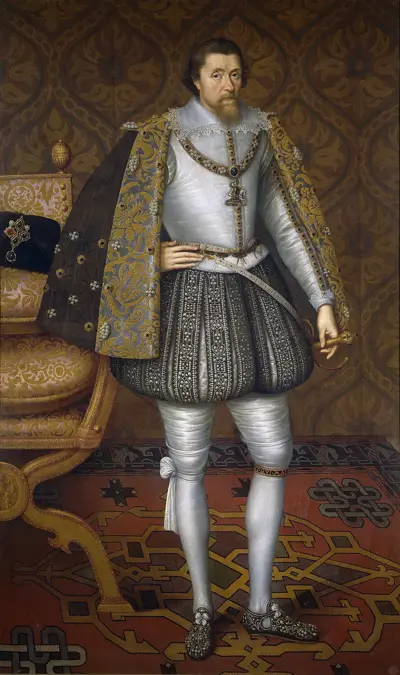
James VI and I was King of Scotland as James VI from 24 July 1567 and King of England and Ireland as James I from the union of the Scottish and English crowns on 24 March 1603 until his death in 1625. The kingdoms of Scotland and England were individual sovereign states, with their own parliaments, judiciaries, and laws, though both were ruled by James in personal union.
