Qianlong Emperor Quotes
Our Celestial Empire possesses all things in prolific abundance and lacks no products within its borders. There is therefore no need to import the manufactures of outside barbarians in exchange for our own produce. But the tea, silk and porcelain which the Celestial Empire produces are absolute necessities to European nations and to yourselves, we have permitted, as a signal of our favor, that private hongs should be established at Canton, so that your wants might be supplied and your country thus participate in our beneficence.
This was in response to English Emissaries who wanted to establish trading businesses in China. The Emperor would not even meet personally with Lord McCartney, the first British envoy because McCartney would not kow-tow to the Emperor. The “hongs” were special businesses set up by Chinese businessmen who had paid the Proper fee, for the purposes of being traders with foreigners. Canton, now Guangzhou, is 150 years later still the major international trading center in China although there are no longer restrictions. At the time, the British paid for their Chinese good with Opium that they had purchased in their Indian Colony. English cloth and other goods would be sent to India, traded for opium, which was brought to China and traded for tea, silks and porcelain which were returned to England and turned into cash than was worth much more than their original purchase and the cost of the voyage.
Qianlong, 1711-1799, Fifth emperor of the Chinese Manchu Qing Dynasty, Message to King George III of England, 1793
Sourced by: Eigen's Political and Historical Quotations

Macartney did not even get to see the Emperor. Qianlong wrote the statement and left it on his throne and that is all that the British Emissary got from his trip. In reality much of the difficulty had to do with the refusal of the English party to observe Chinese Court Etiquette. It all had to do with bowing and kowtowing. The Chinese chief minister persuaded the Emperor that since China was the center of the Universe and the most advanced civilization as such China was in no need of the Barbarian English. Macartney would not kowtow or prostrate themselves in front of the Dragon Throne insisting that kneeling on one knee and bow to the throne as they did for their King. So the king never appeared and MacArtney returned empty-handed. In contrast Isaac Titsingh, the Dutch trade emissary did kowtow and follow court etiquette and was quite successful.


This is one of the earliest enumerations of the methods by which nations might rectify an imbalance of trade.

A self-contained market would be one in which a country only makes products that it sells within its borders, and only sells products that in makes in the country. Very primitive cultures were self-contained markets, but trading generally takes place whenever two cultures interact unless politicians artificially prevent it.


As opposed to having tax collectors within the United States. At the time, import duties were the only taxes Jefferson approved of.


“Laid up” means “saved”. “Commutable”means fungible—gold and silver can buy anything else.

Congress was delighted with this report. This quotation is interesting for a number of reasons. In this first contact between Americans and the Chinese, foreign trade was the main subject of interest, and when the Chinese saw the size of the new nation, their immediate interest was to sell America Chinese manufactured goods. By the start of the 21st century, the largest trade the world had ever seen was that between American and China with us getting Chinese manufactured goods just as the 1785 Chinese and Americans at this meeting envisioned.


Turgot was one of the most advanced economic thinkers in Europe and realized, even before most of the Americans, that by freeing itself England, that the Americans would be forced to become free traders and that in turn would make America a major Economic power despite the fact that American economic policy over the years vacillated between protectionism and free trade.

3rd Viscount Palmerston. This historical quotations illustrates the worst of the British Empire. British merchants were making large profits shipping opium to China and selling it there. Drug addiction became a major problem and some local Chinese Authorities passed laws banning the importing and selling of opium. However, the English merchant ship captains paid no attention to these laws claiming their rights as Englishmen to free trade. The Chinese finally seized a number of shipments of opium and burned them. The British then appointed Captain Elliot to lead a squadron of ships to China, arrange for payment in compensation for the value of the seized opium and to open up the opium trade, by force if necessary. The Chinese position was not unreasonable and Captain Elliot was not able to secure the concessions the English government wanted without starting a small war with the loss of many lives. Temple, who was the Foreign Minister at this time, fired Elliot and replaced him with someone who was less concerned about problems of drug addiction and the Chinese. Thus began the First Opium War. Note that the then British view of equity was that if they had to send an expedition of ships and soldiers to force the Chinese to allow the English to sell opium, then part of the terms must be that the Chinese pay the costs for the British ships and soldiers who invaded their country and forced them to keep poisoning their own people. See {621319} for Captain Elliot’s view.

This historical quotation shows us that the nation under Republican control at the end of the 19th century was highly protectionist. In addition. It shows us how a party can flip flop on its most cherished principles. A century later, free trade was the cornerstone of Republican philosophy and opponents who held to the Republican 19th century principles were accused of being detriments to the American growth and economic system.
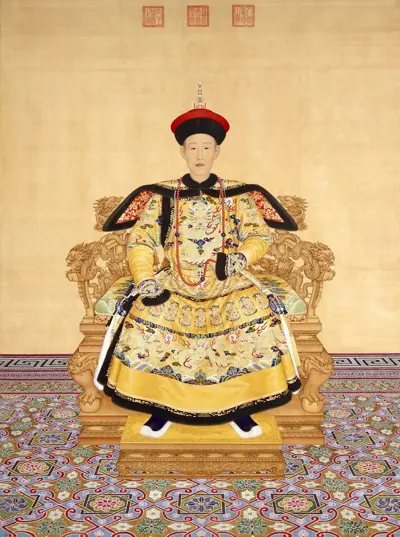
The Qianlong Emperor was the fifth Emperor of the Qing dynasty, and the fourth Qing emperor to rule over China proper, reigned from 1735 to 1796. Born Hongli, the fourth son of the Yongzheng Emperor, he reigned officially from 11 October 1735 to 8 February 1796. In 1796, he abdicated in favour of his son, the Jiaqing Emperor—a filial act in order not to reign longer than his grandfather, the Kangxi Emperor, who ruled for 61 years. Despite his retirement, however, he retained ultimate power as the Retired Emperor until his death in 1799. He thus was one of the longest-reigning rulers in the history of the world, and dying at the age of 87, one of the longest-lived. As a capable and cultured ruler inheriting a thriving empire, during his long reign the Qing Empire reached its most splendid and prosperous era, boasting a large population and economy. As a military leader, he led military campaigns expanding the dynastic territory to the largest extent by conquering and sometimes destroying Central Asian kingdoms.
