Charles C. Mann Quotes
All of Europe’s potatoes descended from few tubers sent across the ocean by curious Spaniards… the potato was as important to the modern era as the invention of the steam engine.
There were no potatoes in Europe until the Spanish conquistadors sent some back from South America where they were and still are a food staple. From Europe they came to North America. To this day we and the Europeans know only a few species of potatoes while in Bolivia, there are over 500 different species.
Charles C. Mann, Science & History Writer & Journalist, 1493: Uncovering the New World Columbus Created, 2011
Sourced by: Eigen's Political and Historical Quotations

Most of us have little idea of many of the benefits that have come from the native, indigenous population of the Americas. And most assume that it was only Europe that interacted with the “New World”. China however obtained the sweet potato from South America and its productivity and nutritional value benefitted those areas of China not ideal for rice cultivation.


Turgot was one of the most advanced economic thinkers in Europe and realized, even before most of the Americans, that by freeing itself England, that the Americans would be forced to become free traders and that in turn would make America a major Economic power despite the fact that American economic policy over the years vacillated between protectionism and free trade.

Prior to WWII, it was the conservative Republicans who had opposed foreign trade and supported protectionism. The Democrats were free traders. By the end of the war, both parties advocated free trade. Liberals like Mrs. Roosevelt generally thought that if there was a strong labor union movement in foreign countries, that would push wages up so the loss of jobs would not be so great. However, there is no low wage country that ever allowed a strong labor movement to flourish, and labor costs have never yet equalized.

Britain, in order to protect the landed gentry and aristocracy who made their money via agriculture, long had the Corn Laws (Corn was the term for wheat.) which was a protectionist system making it virtually to import food grains, rice or potatoes into Britain. However, with the growth of the population and a protected agricultural industry that had no drive to be more productive there was not quite enough food in the kingdom. When there was a potato blight in Ireland, the situation reached critical proportions. Victoria was not generally in favor of protectionism, and given the shortage and high cost of food then, she wanted to allow food imports. Robert Peel presided over a government where the protectionists who represented the large landowners had a very strong block. Pushing for an end to the Corn Laws could have caused the government to collapse. Peel himself did not think the Corn Laws were good policy and created a hardship for most people especially the poor. But he was the leader of his party and the party was split on the Corn Law issue. Victoria, in this private letter, tells him to do what he things is right and not what is politically expedient. Peel tried but at this time could not get a majority to repeal the Corn Laws, and the Irish Potato Famine killed millions. See {630738} . Peel however stuck with the Queen’s and his perception of what was right. The following year he proposed the Importation Act 1846 which repealed the Corn Laws. Many of his own party would not support it, but this time, he went to the two opposition parties and created a slim majority which passed the bill much to the approval of the Queen.

This was in response to English Emissaries who wanted to establish trading businesses in China. The Emperor would not even meet personally with Lord McCartney, the first British envoy because McCartney would not kow-tow to the Emperor. The “hongs” were special businesses set up by Chinese businessmen who had paid the Proper fee, for the purposes of being traders with foreigners. Canton, now Guangzhou, is 150 years later still the major international trading center in China although there are no longer restrictions. At the time, the British paid for their Chinese good with Opium that they had purchased in their Indian Colony. English cloth and other goods would be sent to India, traded for opium, which was brought to China and traded for tea, silks and porcelain which were returned to England and turned into cash than was worth much more than their original purchase and the cost of the voyage.


The term “America” was used by him and others to refer to South and Central America—not the United States.


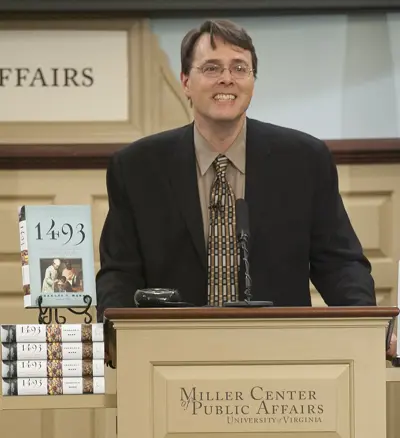
Charles C. Mann (born 1955) is an American journalist and author, specializing in scientific topics. His book 1491: New Revelations of the Americas Before Columbus won the National Academies Communication Award for best book of the year. He is the coauthor of four books, and contributing editor for Science, The Atlantic Monthly, and Wired.
