Adam Smith Quotes
The commodities of Europe were almost all new to America, and many of those of America were new to Europe. A new set of exchanges, therefore, began and which should naturally have proved as advantageous to the new, as it certainly did to the old continent. The savage injustice of the Europeans rendered an event, which ought to have been beneficial to all, ruinous and destructive to several of those unfortunate countries.
Adam Smith, 1723-1790, Scottish Political Economist, The Wealth of Nations, 1776
Sourced by: Eigen's Political and Historical Quotations


Many are surprised that the first Mexican revolutionary leaders were Catholic Priests, because the Catholic Church was always on the side of Spain and against Mexican revolutionary efforts. The church and the state were totally intertwined at the time, so the Church officials supported the government officials and vica verca. However, there were priests who saw the injustice and corruption of the colonial Spanish government, and not only sided with the revolutionists but became revolutionary leaders. These were opposed and usually excommunicated by the Church establishment authorities.


Genocide generally means the intentional destruction and elimination of a people. In the case of Columbus and the Spanish Conquistadors, they thought little of the lives of the indigenous people of the New World, but they wanted them for slaves to extract the gold and silver. They wiped out several peoples, mostly as a result of the communicable diseases (mainly smallpox) they brought from Europe for which the South Americans had little or no immunity. Also the size of the invasion forces (the Spanish) was relatively small. The size in land and number of people who they invaded was huge. The Spanish were the worst of the European empires from the point of view of the native colonized people. And Columbus was the trigger. So Chavez has a point in castigating Columbus and the Spanish but, typically, and like many politicians, his oratory lacked the precision of total accuracy.

A bronze statue of Lin Zexu was erected in his honor in Chatham Square (Kimlau Square) of New York City's Chinatown.

The Spaniardes have executed most outragious and more then Turkishe cruelties in all the west Indies
He was one of the strongest English advocates of colonization of the New World. At that time this was as strong an epithet of cruelty as could be made by Europeans. It was an accurate assessment.

St. Domingue was the name of Haiti which had had the only successful national slave revolt, but it was incredibly bloody with many casualties.


America and several other nations object to the European Community agricultural subsidies in that they are an illegal trade practice under GATT to which all European nations are signatories. However, the US also makes agricultural subsidies but not to the same extent,

There were no potatoes in Europe until the Spanish conquistadors sent some back from South America where they were and still are a food staple. From Europe they came to North America. To this day we and the Europeans know only a few species of potatoes while in Bolivia, there are over 500 different species.

The white Europeans had over centuries built up immunity to some of the worst infectious diseases but when they first landed in the New World brought smallpox and other deadly diseases to which the Indians had no immunity.
Bourne was an expert in the history of the the New World

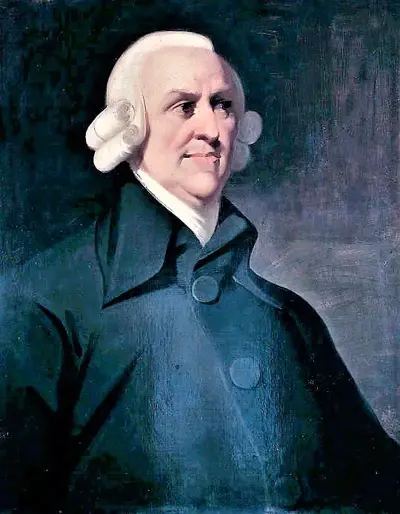
Adam Smith FRSA was a Scottish economist, philosopher as well as a moral philosopher, a pioneer of political economy, and a key figure during the Scottish Enlightenment, also known as ''The Father of Economics'' or ''The Father of Capitalism''. Smith wrote two classic works, The Theory of Moral Sentiments (1759) and An Inquiry into the Nature and Causes of the Wealth of Nations (1776). The latter, often abbreviated as The Wealth of Nations, is considered his magnum opus and the first modern work of economics. In his work, Adam Smith introduced his theory of absolute advantage.
