Lin Zexu Quotes
We find that your country is sixty or seventy thousand li from China. Yet there are barbarian ships that strive to come here for trade for the purpose of making a great profit. The wealth of China is used to profit the barbarians. That is to say, the great profit made by barbarians is all taken from the rightful share of China. By what right do they then in return use the poisonous drug to injure the Chinese people? Even though the barbarians may not necessarily intend to do us harm, yet in coveting profit to an extreme, they have no regard for injuring others. Let us ask, where is your conscience?
A bronze statue of Lin Zexu was erected in his honor in Chatham Square (Kimlau Square) of New York City's Chinatown.
Lin Zexu, 1785–1850, Chinese Scholar & Imperial Commissioner of Guangdong, Governor-General of Shaanxi-Gansu, Open Memorial (Moral Essay) to England, 1839
Sourced by: Eigen's Political and Historical Quotations

The Chinese authorities wanted to stop the distribution and use of opium, but the British merchants, in one of the more disgraceful episodes of British history, would not stop the trade and actually went to war when the Chinese tried to stop the opium trade. See {625957} for more on this incident and the First Opium War that followed.

The “foreign tribes” were the English and other European traders who were bringing opium to China. Lin had assembled a fleet of 80 ships at the mouth of the Pearl River to persuade the European powers that they would fight if the foreign ships would not cease trading in opium. The British in particular were not intimidated, and they militarily forced the Chinese to accept their “right” to sell opium. The Emperor sent Lin to the “boondocks”—see {621320} for misjudging and provoking British military action, but Lin is remembered for his sound moral and public health perspective. A bronze statue of Lin Zexu was erected in his honor in Chatham Square (Kimlau Square) of New York City's Chinatown and many other places in the world.
He was the first Chinese official to make opium illegal. However, British many merchants were involved in a complicated trade scheme whereby they brought opium to Canton. They paid not attention to the new laws against opium the same as their Chinese customers. Lin Zexu, perceiving Queen Victoria to have powers equivalent to the Chinese Emperor who could do anything in China, He assumed that the Queen could and would control the merchant’s behavior, and before punishing the British merchants, he was putting the Queen on notice. There is no record of what Victoria did, if anything. When Lin Zexu tried to enforce his ban on opium, the British Merchants resisted and the First Opium War broke out between China and Britainin which the Chinese were humiliated and resent to this day. A bronze statue of Lin Zexu was erected in his honor in Chatham Square (Kimlau Square) of New York City's Chinatown.


British merchants and the East India Company made huge profits from the drug trade buying opium in India and selling it to China where it had become immensely popular. But when the Chinese (led by Lin Zexu) tried to ban the import of opium, the British fought two wars with China to force the reopening of the opium trade. At the end of the 20th century, some referred to England and the English Crown as the largest Drug Cartel in history.


The title of this controversial poem became a rallying cry for imperialists and anti-imperialists both. The imperialists saw it as a justification for expansionism and colonialism—that the white had a moral responsibility to bring civilization to the other races. To the anti-imperialists it was a racist justification for imposing Christian values on the rest of the world which didn’t want them. In the quotation example here, the poem was used to state a dilemma of foreign aid and trying to bring democracy and freedom to the world.


In 1839 opium was the leading commodity internationally traded in the world. The Chinese told the foreign opium merchants to cease trade in China. When they refused the Chinese dumped the opium into the river. English opium merchants demanded that Parliament force the Chinese to make restitution even if it meant war. Parliament agreed and started the Opium War. Gladstone, then an MP was one of the few who took the Chinese side when addressing the traders.

In 1832 the President sent Edmund Roberts, a New Hampshire sea captain, to arrange commercial treaties with Asian countries such as Burma, Indo-China, Siam and Japan:


Opium addiction was ravaging Chinese society and the British were very large opium traders with most of the Chinese market. The moral and ethical argument fell on deaf ears and the British continued to sell opium to China. While it is hard to understand the British position today, consider the export sales of American cigarettes to the third world. A few countries have tried to legislate limits and restrictions and our State Department has kept all these markets open by threatening to restrict sales to the U. S. from those countries. The “logic” is that if the U. S. stopped exporting cigarettes, then the French or other country would move into the market or the local businesses would take over the cigarette trade. And cigarettes are far more lethal than opium. The British businessmen were convinced that there would be no reduction of use—the only difference would be who profits from the opium. A few years later the Opium Wars ensued.


3rd Viscount Palmerston. This historical quotations illustrates the worst of the British Empire. British merchants were making large profits shipping opium to China and selling it there. Drug addiction became a major problem and some local Chinese Authorities passed laws banning the importing and selling of opium. However, the English merchant ship captains paid no attention to these laws claiming their rights as Englishmen to free trade. The Chinese finally seized a number of shipments of opium and burned them. The British then appointed Captain Elliot to lead a squadron of ships to China, arrange for payment in compensation for the value of the seized opium and to open up the opium trade, by force if necessary. The Chinese position was not unreasonable and Captain Elliot was not able to secure the concessions the English government wanted without starting a small war with the loss of many lives. Temple, who was the Foreign Minister at this time, fired Elliot and replaced him with someone who was less concerned about problems of drug addiction and the Chinese. Thus began the First Opium War. Note that the then British view of equity was that if they had to send an expedition of ships and soldiers to force the Chinese to allow the English to sell opium, then part of the terms must be that the Chinese pay the costs for the British ships and soldiers who invaded their country and forced them to keep poisoning their own people. See {621319} for Captain Elliot’s view.

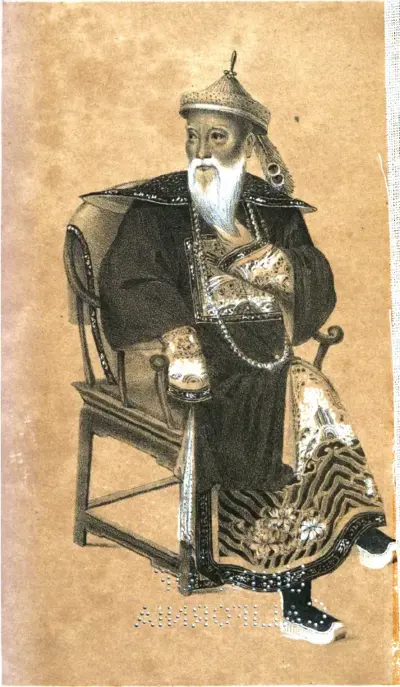
Lin Zexu, courtesy name Yuanfu, was a Chinese head of states (Viceroy), Governor General, scholar-official under Emperor of the Qing dynasty best known for his role in the First Opium War of 1839–42. He was from Fuzhou, Fujian Province. Lin's forceful opposition to the opium trade was a primary catalyst for the First Opium War. He is praised for his constant position on the "moral high ground" in his fight, but he is also blamed for a rigid approach which failed to account for the domestic and international complexities of the problem. The Daoguang Emperor endorsed the hardline policies and anti-drugs movement advocated by Lin, but then blamed Lin for the resulting disastrous war.
