Dudley North Quotes
It will be found, that as some particular Men in a Town grow richer, and thrive better than others; so also do Nations, who by Trade serving the occasions of their Neighbors, supply themselves with what they have occasion for from abroad; which done, the rest is laid up, and is Silver, Gold, etc. for as I said, these being commutable for everything, and of small bulk, are still preferr'd to be laid up, till occasion shall call them out to supply other Necessaries wanted.
“Laid up” means “saved”. “Commutable”means fungible—gold and silver can buy anything else.
Dudley North, 1641-1691, English Economist, Discourses Upon Trade 1691
Sourced by: Eigen's Political and Historical Quotations


This quotation is interesting as it shows that and the end of the 19th century, although the United States was over 100 years old, we were first beginning to be major world traders. Not that our merchant marine was not yet world class. Another interesting facet of the quote is that the President was claiming that foreign trade was good for the domestic economy. Much of America in its first 100 years supported protectionism for American manufacturers.


This remarkable treatise is one of the first to explain the concept of Balance of Trade.


The assumption was that money would always be backed by gold or silver. In effect, raising or allaying the money was to change the amount of gold or silver that a particular denomination of money would be able to be exchanged for. This is one of the interesting proofs that these processes did nothing economically—for if they could, no one would want the money. This has always been a weakness or a strength—depending on one’s political point of view—of a gold standard.
This is one of the earliest enumerations of the methods by which nations might rectify an imbalance of trade.


Harvey was one of those who argued that silver and not gold should be the basis of American money. The country was growing and the amount of gold was relatively fixed; therefore money was scarce and many believed the English and American financiers were hording gold deliberately. The final solution was not a gold standard or a silver standard but what we have today—a currency backed only by the full faith and credit of the U. S.


The nation, under the pressure of a depression, had adopted a free trade philosophy. We would go back to protectionism in the 1930s and back to free trade in the 1960s. Ironically, it was generally the Republican party that has driven these shifts. There has always been a free trade wing of the party and an isolationist wing.
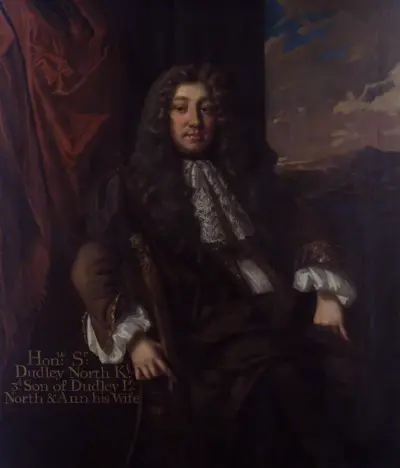
Sir Dudley North was an English merchant, politician and economist, a writer on free trade.
