William McKinley Quotes
No subject can better engage our attention than the promotion of trade and commerce at home and abroad. Domestic conditions are sure to be improved by larger exchanges with the nations of the world. We are already reaching out with good results. Our surplus products of agriculture and manufacture are finding a foreign market, and in the latter case to a degree which would not have been believed possible a quarter of a century ago. We have made wonderful progress in this direction, and have only just begun. Our manufactured products go to every nation of the world, and I hope the time may be not far distant when our ships, under the Stars and Stripes, will be on every sea where commerce is carried and the wants of mankind are to be supplied.
This quotation is interesting as it shows that and the end of the 19th century, although the United States was over 100 years old, we were first beginning to be major world traders. Not that our merchant marine was not yet world class. Another interesting facet of the quote is that the President was claiming that foreign trade was good for the domestic economy. Much of America in its first 100 years supported protectionism for American manufacturers.
William McKinley, 1843-1901, 25th President of the United States (Republican, OH), Speech, Cincinnati, October 30, 1897
Sourced by: Eigen's Political and Historical Quotations

This has been a difference between England and the United States. The former has always been much more active in promoting business and industry abroad—even forming Government chartered companies for the purpose. In America, the major responsibility has been that of the private companies. When the Government has aided a particular company in an industry, other companies ask why that company and not mone? Other industries argue that if you help sell airplanes who not lawnmowers or dresses.


“Laid up” means “saved”. “Commutable”means fungible—gold and silver can buy anything else.

All money has based on the Gold Standard then. But the economic output of the American colonies was increasing rapidly. If the money supply stays fixed, there is a shortage of money and this then inhibits further growth, Franklin realized this and called for an increase in the money supply. He was only 23 years old when he wrote this essay and had these insights.


This is the origin of one of the first Departments of Commerce.

The nation, under the pressure of a depression, had adopted a free trade philosophy. We would go back to protectionism in the 1930s and back to free trade in the 1960s. Ironically, it was generally the Republican party that has driven these shifts. There has always been a free trade wing of the party and an isolationist wing.

This section of the message was all about the Erie Canal that was under construction. Note that unlike today, where interest in public works and development is so localized, Clinton was extolling the virtue of developing the economy of the region and the nation. The money was all New York State money. The Federal Government would not fund the Erie Canal as they did not believe it was technically feasible to construct. See {624484} . Patriotism had a different meaning then.


His prediction was accurate and the consequence was an increase in the production of agricultural products and a shrinking proportion of Americans employed in farming and ranching.


This is one of the first recorded recognitions of globalization as an economic force.


The entire exploration, founding and colonization of New York was a business enterprise right from the start.

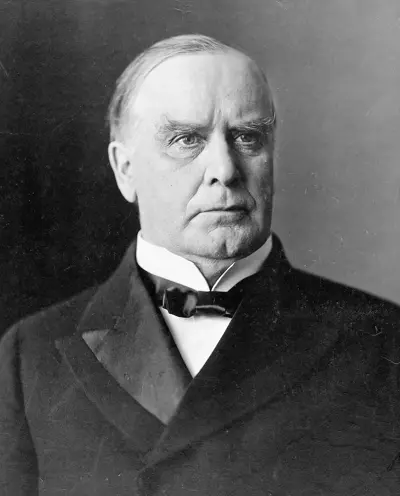
William McKinley was the 25th president of the United States, serving from 1897 until his assassination in 1901. McKinley was president during the Spanish–American War of 1898, raised protective tariffs to boost American industry, and rejected the expansionary monetary policy of free silver, keeping the nation on the gold standard.
