Charles D'Avenant Quotes
In a trading nation, the bent of all the laws should tend to the encouragement of commerce, and all measures should be there taken, with a due regard to its interest and advancement.
Charles D'Avenant, 1656–1714, English Economist, An Essay on the East-India Trade, 1697
Sourced by: Eigen's Political and Historical Quotations


This has been a difference between England and the United States. The former has always been much more active in promoting business and industry abroad—even forming Government chartered companies for the purpose. In America, the major responsibility has been that of the private companies. When the Government has aided a particular company in an industry, other companies ask why that company and not mone? Other industries argue that if you help sell airplanes who not lawnmowers or dresses.

As absurd as it seems to us today, traders were not very high in the English social order. Business itself was not well respected. English governing councils were devoid of anyone who had trade of business experience. Holland, in contrast, perhaps went to the other extreme in that traders and business men dominated to political structure. The Dutch were much more successful in foreign trade relatively than the English.


Republicans at that time were adamant protectionists and were violently opposed to free trade. They made a total flip flop on free trade after the Second Word War when the industrial capacity of all of the major industrial nations except America was completely emaciated. America still had production and there was huge money to be made from being the only nation that could deliver goods to the world. Meanwhile Germany, France, England, and Italy, our largest competitors could hardly manufacture for their own needs and could not compete in the American market. So the American corporations then wanted to become free traders.

At that period of American History, the Republicans supported high tariffs and protectionism for American companies and it was the Democrats who were the advocates of free trade. Later each of the parties would flip flop their positions and then say that they were advocating their traditional principles.


This is one of the earliest enumerations of the methods by which nations might rectify an imbalance of trade.

This quotation is interesting as it shows that and the end of the 19th century, although the United States was over 100 years old, we were first beginning to be major world traders. Not that our merchant marine was not yet world class. Another interesting facet of the quote is that the President was claiming that foreign trade was good for the domestic economy. Much of America in its first 100 years supported protectionism for American manufacturers.
The nation, under the pressure of a depression, had adopted a free trade philosophy. We would go back to protectionism in the 1930s and back to free trade in the 1960s. Ironically, it was generally the Republican party that has driven these shifts. There has always been a free trade wing of the party and an isolationist wing.

The industrial revolution was also creating an entirely new form and structure for international economics.


This was an expression of concern from the merchants of Rhode Island to England regarding curtailing aspects of the slave trade. Ironically, this Remonstrance is one of the first documents objecting to the management of America’s affairs by England when America had no representation. Therefore it played a part in the process which culminated in the American Revolution and freedom from England. And yet the subject was not freedom at all but just the opposite—the prerogative of maintaining the slave trade. Note that the appeal to the Board of Trade was not couched in ethical or political argument but as a mercantile argument—Rhode Islander’s would import less British goods.
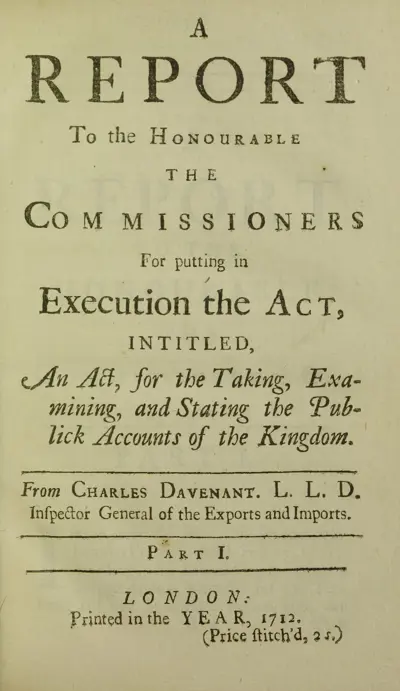
Charles Davenant (1656–1714) was an English mercantilist economist, politician, and pamphleteer. He was Tory member of Parliament for St Ives (Cornwall), and for Great Bedwyn.
