Louis XIV Quotes
Considering how advantageous it would be to this realm to reestablish its foreign and domestic commerce, ... we have resolved to establish a council particularly devoted to commerce, to be held every fortnight in our presence, in which all the interests of merchants and the means conducive to the revival of commerce shall be considered and determined upon, as well as all that which concerns manufactures. …. We also inform you that we are setting apart, in the expenses of our state, a million livres each year for the encouragement of manufactures and the increase of navigation, to say nothing of the considerable sums which we cause to be raised to supply the companies of the East and West Indies;
This is the origin of one of the first Departments of Commerce.
Louis XIV, 1638-1715, King of France, Letter to the Town Officers and People of Marseilles, August 26, 1664
Sourced by: Eigen's Political and Historical Quotations

This is one of the earliest examples of the establishment of a type of Commerce Department – a government institution to look after the commercial affairs of the state.

In 1701 exports of wool accounted for ¼ of all exports. By 1770, it was almost 1/3.

This quotation is interesting as it shows that and the end of the 19th century, although the United States was over 100 years old, we were first beginning to be major world traders. Not that our merchant marine was not yet world class. Another interesting facet of the quote is that the President was claiming that foreign trade was good for the domestic economy. Much of America in its first 100 years supported protectionism for American manufacturers.


This is one of the first recorded recognitions of globalization as an economic force.


The issue of free trade verses protectionism has been with us throughout American history with national sentiments going one way and then later the other, only to come back and the cycle has gone on. Floyd was very modern in his economic views, so much so that he, even as a Southern politician, opposed slavery on the grounds that it was economically inefficient and the South would never develop industrially if it had no incentive, as existed in the North and England, to reduce the amount of labor required for economic opportunity. He was right on that point as well.
He had introduced a bill to provision a military garrison at the mouth of the Columbia River on the West Coast and protect and develop trade with China and India. President Monroe was for it and he persuaded the House to vote for it, but the bill to encourage foreign free trade with the Orient died in the Senate. Floyd was another American ahead of his time. . Floyd was very modern in his economic views, so much so that he, even as a Southern politician, opposed slavery on the grounds that it was economically inefficient and the South would never develop industrially if it had no incentive, as existed in the North and England, to reduce the amount of labor required for economic opportunity. He was right on that point as well.


The reason for the secrecy was that he was informing Congress of the Lewis & Clark Expedition. Potentially, the Spanish, English or French might try to interfere with the expedition which was the precursor to American domination of the entire continent. Unfortunately, Jefferson’s plan for the Indians was not supported by many other Americans with the exception of New York State and the Iroquois remaining after many left after supporting the British in the Revolution. But the Iroquois who remained were already farmers in fixed communities and were experienced traders. Further, they had a complex governmental structure with many elements of democracy, and several had already succeeded in European educational settings. Their successful integration with the rest of New York can be demonstrated by the fact that New York is the only state where the average Native American Income is the same as the average white income, and there is no Indian gaming in New York. Jefferson’s vision, unfortunately, was never implemented in early the Westward Expansion.


This section of the message was all about the Erie Canal that was under construction. Note that unlike today, where interest in public works and development is so localized, Clinton was extolling the virtue of developing the economy of the region and the nation. The money was all New York State money. The Federal Government would not fund the Erie Canal as they did not believe it was technically feasible to construct. See {624484} . Patriotism had a different meaning then.

The industrial revolution was also creating an entirely new form and structure for international economics.

1st Earl Lloyd-George of Dwyfor


The French had a much different agenda in the new world than the British who wanted to create residential colonies. The French were more interested in trade—not in establishing permanent colonies. The result was that the French were in many ways better trading partners for the Indians than the English. They came without women, intermarried among the Indians and learned the languages; they did not contest for land, and they paid the Indians more for pelts and furs than the English were willing to. At the same time they exacerbated conflicts with the colonists, and encouraged Indian attacks on settlers as that kept competition out. They were not above giving Indians alcohol and encouraging them to rob the furs and/or kill their English competitors. So on two levels, they had to be removed. See the military view of Robert Rogers: {614122}.

North was none-the-less in favor of allowing interest rates be much higher, but was stating the best argument, believed at the time by most English experts, and many American economists today.
Subsidies for Economic Development are not a modern invention.
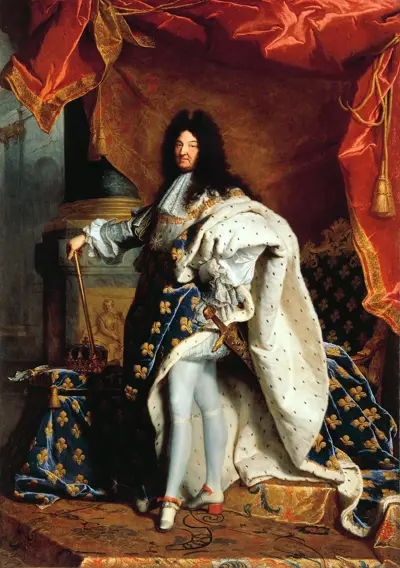
Louis XIV, also known as Louis the Great (Louis le Grand) or the Sun King (le Roi Soleil), was King of France from 14 May 1643 until his death in 1715. His reign of 72 years and 110 days is the longest recorded of any monarch of a sovereign country in European history. Louis XIV's France was emblematic of the age of absolutism in Europe. The King surrounded himself with a variety of significant political, military, and cultural figures, such as Mazarin, Colbert, Louvois, the Grand Condé, Turenne, Vauban, Boulle, Molière, Racine, Boileau, La Fontaine, Lully, Charpentier, Marais, Le Brun, Rigaud, Bossuet, Le Vau, Mansart, Charles Perrault, Claude Perrault, and Le Nôtre.
