Adam Smith Quotes
The inland trade is almost perfectly free. This freedom of interior commerce. .. is perhaps one of the principal causes of the prosperity of Great Britain.
Adam Smith, 1723-1790, Scottish Political Economist, Quoted in Arnold J. Toynbee, Lectures on the Industrial Revolution of the 18th Century in England
Sourced by: Eigen's Political and Historical Quotations


While generally true, Mises here again exaggerates his “proof” by selectively ignoring or being ignorant of counter-examples. The Roman Catholic Church is a classic counter-example where priests, monks, and others owned nothing as individuals, but produced some great science (eg Gregor Mendel), art (the illuminated texts of the middle ages), literature (St Thomas Aquinas, etc). The best counter example that was just evident in the last decade of Misis’ life is Communist Russia. Russian science was better than Fance and Germany and second only to the United States. The Russian ballet and orchestras were second to none. Great literature came out of the Soviet Union and the best of it complained about and attacked the Soviet system of the times. In general, Mises principle tended to be correct throughout history but not always as he dogmatically stated.


America’s first political economist


“Service” referred to what was then the 7 year time of apprenticeship that a typical American apprentice was required to work for a master tradesman before he was given colonial citizenship and allowed to trade for himself. Under the bill that was passed anyone could come to the British American colonies (except Jews) by taking an oath of allegiance and paying a small fee. Holland and some thought that it discriminated against those apprentices who had come before and apprenticed themselves thus “playing by the rules.” Ever since, immigration and citizenship debates have faced the tension between the need for labor in America and the fairness to the people who had followed the earlier existing rules restricting immigration.


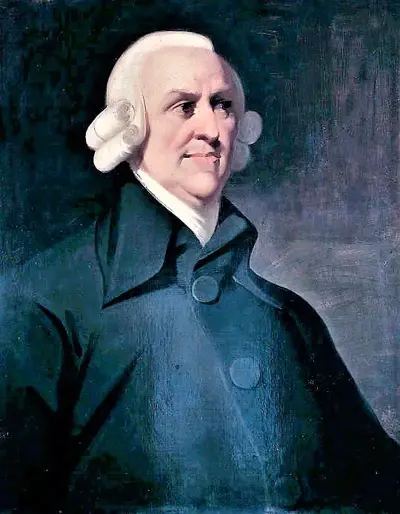
Adam Smith FRSA was a Scottish economist, philosopher as well as a moral philosopher, a pioneer of political economy, and a key figure during the Scottish Enlightenment, also known as ''The Father of Economics'' or ''The Father of Capitalism''. Smith wrote two classic works, The Theory of Moral Sentiments (1759) and An Inquiry into the Nature and Causes of the Wealth of Nations (1776). The latter, often abbreviated as The Wealth of Nations, is considered his magnum opus and the first modern work of economics. In his work, Adam Smith introduced his theory of absolute advantage.
