John Floyd Quotes
At this moment came the direful struggle between the great parties in Congress founded upon the claim which the majority ... from the north of the Potomac made to the right to lay any tax upon the importations into the United States which was intended to act as a protection to northern manufacturers by excluding foreign fabrics of the same kind. Hence all the states to the south of the Potomac became dependent upon the Northern States for a supply of whatever thing they might want, and in this way the South was compelled to sell its products low and buy from the North all articles it needed from twenty-five to one hundred and twenty-five per cent higher than from France to England. .
The issue of free trade verses protectionism has been with us throughout American history with national sentiments going one way and then later the other, only to come back and the cycle has gone on. Floyd was very modern in his economic views, so much so that he, even as a Southern politician, opposed slavery on the grounds that it was economically inefficient and the South would never develop industrially if it had no incentive, as existed in the North and England, to reduce the amount of labor required for economic opportunity. He was right on that point as well.
John Floyd, 1783-1837, U. S. Congressman (Whig, VA), Governor of Virginia, Diary Entry Reflecting on the Politics of 1828
Sourced by: Eigen's Political and Historical Quotations

At that period of American History, the Republicans supported high tariffs and protectionism for American companies and it was the Democrats who were the advocates of free trade. Later each of the parties would flip flop their positions and then say that they were advocating their traditional principles.


Most Republicans at the time were beholden to corporations and business who then demanded high tariffs and other protectionisms so they could maintain high prices and not have to compete with British and European imports. Roosevelt and a few other reform Republicans were free traders along with most Democrats. Roosevelt had so many other reforms in the fire that he decided not to take this one on at the same time and thought that the benefit would not be good enough for the nation to offset the open civil war of the Republican Party that would ensue. In the latter half of the 20th century, large American companies had opened or invested in foreign corporations and/or were manufacturing many of their products abroad. So they then advocated free trade. When they did, the Republican Party flip flopped and adopted free trade as one of its basic principles. Meanwhile, the Democrats who were free traders in the early 20th Century had become protectionists by the end of the 20th century as labor movement wanted to protect American jobs.


Earlier, Jefferson was opposed to manufacturing in America as factories were a social blight in Europe which he wanted to keep out of the United States. He felt that we could import whatever we needed from Europe and not have the evils of industrialization. However, with the War of 1812, the Barbary Pirates and his mellowing when no longer President, and his willingness to change his positions as he learned more, he issued this letter. See another the following year: {615634}. His was considered such an important change of position—today we would accuse him of a flip flop— that other journals and periodicals reprinted the letter and commented upon his change. Despite his changed position, most Americans believe that Jefferson was opposed to manufacturing and industrialization for his entire life—not just the first part.


The same problem has always existed with full scale trade wars always a possibility.

Harris opened up trade with Japan for the United States. The problem at the time had nothing to do with the potential economic effects of trade on domestic industry or balance of payments, but for the Japanese was strictly a cultural problem. They were in great fear of what today some call “cultural imperialism”--the adoption of a foreign culture. The Japanese had been so fearful of cultural influence of foreigners that when some Japanese fishermen’s boat had been sunk and they had been rescued by foreign seamen and returned to Japan, they were executed as they had been “contaminated” and could “contaminate” the rest of the population.


There has always been pressure from different interests to exempt certain products from duty and place higher duties on others. Calhoun urged a policy that would be based on general economic prinicples and conditions and not on pressure from special vested interests. He was a senator at the time.


This quotation illustrates two important points. First, that foreign and domestic trade and merchants were very much appreciated at the time and an important component of society that there were special protections for traders and merchants. Second, was the national preemption of jurisdiction and control over business and commerce that would enter and leave the city. On most matters the local authorities would handle things, but intercity and international commerce was historically continuously impaired by individual nobles and other authorities making rules affecting merchants who might come to their town or city. The Crown preempted this authority in the 13th century and the “Commerce Clause” of our Constitution was not an unusual concept and had an extensive legal and economic history.

The U. S. was very protectionist in its early history. Grant overestimated the time that it would take for us to change by about 100 years.


This is one of the earliest examples of the establishment of a type of Commerce Department – a government institution to look after the commercial affairs of the state.


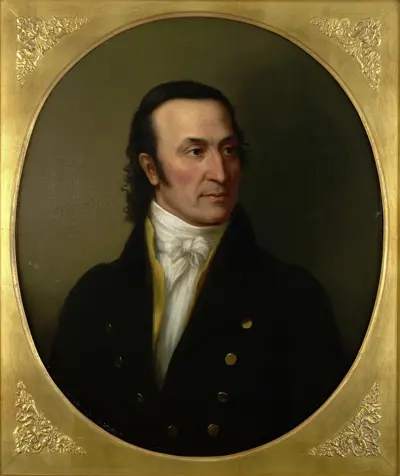
John Floyd was a Virginia politician and soldier. He represented Virginia in the United States House of Representatives and later served as the 25th Governor of Virginia.
