Ulysses S. Grant Quotes
In 200 years when the United States will get all that it can from protectionism, it too will adopt free trade.
The U. S. was very protectionist in its early history. Grant overestimated the time that it would take for us to change by about 100 years.
Ulysses S. Grant, 1822-1885, 18th President of the United States (Republican, OH), Juan Gonzales, C-SPAN Book TV, August 26, 2000
Sourced by: Eigen's Political and Historical Quotations


Democratic politicians of that era mostly opposed free trade because the experience ever since NAFTA showed that many manufacturing jobs were lost in the United States although many new jobs were created but few of these were good paying jobs that Americans with limited educations could perform as they were able to with manufacturing jobs. And during that period, the requirements for fair trade and foreign workers rights have been very poorly enforced. The Democrats split between those who thought that new trade treaties could be negotiated and enforced, correcting the problems of the past, and those who did not believe that such proper free trade was very likely.


A self-contained market would be one in which a country only makes products that it sells within its borders, and only sells products that in makes in the country. Very primitive cultures were self-contained markets, but trading generally takes place whenever two cultures interact unless politicians artificially prevent it.


In England at the time, the liberals were for free trade and the conservatives against. In both England and America both liberals and conservatives have flip flopped their roles in foreign trade several times. Free trade is a two edged sword; it aids domestic growth, employment and prosperity in some cases and hurts them on others. And there are always winners and losers for each example of free trade within any country. The result is no long term commitment and much flip flopping.


Most Republicans at the time were beholden to corporations and business who then demanded high tariffs and other protectionisms so they could maintain high prices and not have to compete with British and European imports. Roosevelt and a few other reform Republicans were free traders along with most Democrats. Roosevelt had so many other reforms in the fire that he decided not to take this one on at the same time and thought that the benefit would not be good enough for the nation to offset the open civil war of the Republican Party that would ensue. In the latter half of the 20th century, large American companies had opened or invested in foreign corporations and/or were manufacturing many of their products abroad. So they then advocated free trade. When they did, the Republican Party flip flopped and adopted free trade as one of its basic principles. Meanwhile, the Democrats who were free traders in the early 20th Century had become protectionists by the end of the 20th century as labor movement wanted to protect American jobs.
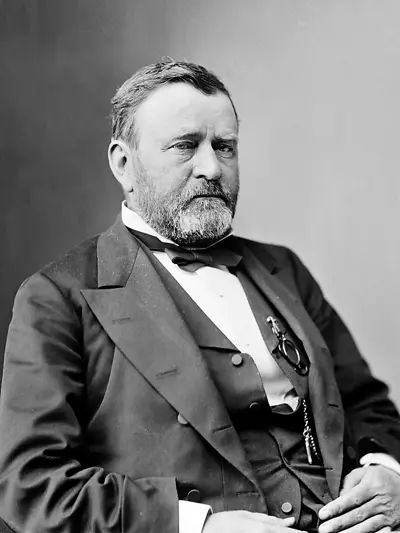
Ulysses S. Grant was an American military leader who served as the 18th president of the United States from 1869 to 1877. As president, Grant was an effective civil rights executive who created the Justice Department and worked with the Radical Republicans during Reconstruction to protect African Americans. As Commanding General, he led the Union Army to victory in the American Civil War in 1865 and thereafter briefly served as Secretary of War.
