John C. Calhoun Quotes
We ought to go for a uniform ad valorem duty without any discrimination.
There has always been pressure from different interests to exempt certain products from duty and place higher duties on others. Calhoun urged a policy that would be based on general economic prinicples and conditions and not on pressure from special vested interests. He was a senator at the time.
John C. Calhoun, 1782-1850, Vice President of the United States (Democrat, SC), U. S. Congressman & Senator (Democrat, SC), Letter to new senator Robert M. T. Hunter, June 1839
Sourced by: Eigen's Political and Historical Quotations


Republicans at that time were adamant protectionists and were violently opposed to free trade. They made a total flip flop on free trade after the Second Word War when the industrial capacity of all of the major industrial nations except America was completely emaciated. America still had production and there was huge money to be made from being the only nation that could deliver goods to the world. Meanwhile Germany, France, England, and Italy, our largest competitors could hardly manufacture for their own needs and could not compete in the American market. So the American corporations then wanted to become free traders.

The issue of free trade has been controversial during the entire history of our Republic. At the time it was the Republicans who were the protectionists and the Democrats, the free traders.

The nation, under the pressure of a depression, had adopted a free trade philosophy. We would go back to protectionism in the 1930s and back to free trade in the 1960s. Ironically, it was generally the Republican party that has driven these shifts. There has always been a free trade wing of the party and an isolationist wing.

The U. S. was very protectionist in its early history. Grant overestimated the time that it would take for us to change by about 100 years.


The issue of free trade verses protectionism has been with us throughout American history with national sentiments going one way and then later the other, only to come back and the cycle has gone on. Floyd was very modern in his economic views, so much so that he, even as a Southern politician, opposed slavery on the grounds that it was economically inefficient and the South would never develop industrially if it had no incentive, as existed in the North and England, to reduce the amount of labor required for economic opportunity. He was right on that point as well.


At that period of American History, the Republicans supported high tariffs and protectionism for American companies and it was the Democrats who were the advocates of free trade. Later each of the parties would flip flop their positions and then say that they were advocating their traditional principles.


The revenue laws he referred to were tariff duties on foreign imports that were instituted to protect fledgling American domestic manufacturers. The problem was that at the same time as it helped the manufacturers, it caused everyone to pay higher prices. Worse, it destroyed the business of the importers, and the retail merchants who specialized in fine European imports. It also hurt the shipping business so owners and sailors alike were damaged. Maritime and importing states were outraged and if enough people did not support the tariffs, smuggling would increase. Polarization and controversy were rife at the time. Unlike today conservatives tended to be for the protectionist tariffs and the left wing tended to be for free trade. Jackson insisted that the law be obeyed, but he wanted Congress to pay attention to the damaged forces.

The same problem has always existed with full scale trade wars always a possibility.


Most Republicans at the time were beholden to corporations and business who then demanded high tariffs and other protectionisms so they could maintain high prices and not have to compete with British and European imports. Roosevelt and a few other reform Republicans were free traders along with most Democrats. Roosevelt had so many other reforms in the fire that he decided not to take this one on at the same time and thought that the benefit would not be good enough for the nation to offset the open civil war of the Republican Party that would ensue. In the latter half of the 20th century, large American companies had opened or invested in foreign corporations and/or were manufacturing many of their products abroad. So they then advocated free trade. When they did, the Republican Party flip flopped and adopted free trade as one of its basic principles. Meanwhile, the Democrats who were free traders in the early 20th Century had become protectionists by the end of the 20th century as labor movement wanted to protect American jobs.


The right of English merchants had been attained earlier when Ivan IV, the Terrible, was Czar. However the Czar35266s were so autocratic that one might or might not live up to agreements made by their predecessors. So Queen Elisabeth's diplomats had to repeatedly negotiate free trade agreements with Russian Czars.


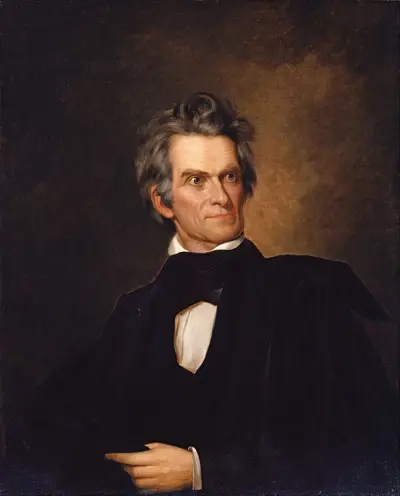
John Caldwell Calhoun was an American politician and political theorist from South Carolina who held many important positions including being the seventh vice president of the United States from 1825 to 1832, while adamantly defending slavery and protecting the interests of the white South when its residents were outnumbered by Northerners. He began his political career as a nationalist, modernizer, and proponent of a strong national government and protective tariffs. In the late 1820s, his views changed radically, and he became a leading proponent of states' rights, limited government, nullification, and opposition to high tariffs. He saw Northern acceptance of those policies as a condition of the South remaining in the Union. His beliefs and warnings heavily influenced the South's secession from the Union in 1860–1861.
