Andrew Jackson Quotes
It is my painful duty to state that in one quarter of the United States opposition to the revenue laws has arisen to a height which threatens to thwart their execution, if not to endanger the integrity of the Union. Whatever obstructions may be thrown in the way of the judicial authorities of the General Government, it is hoped they will be able peaceably to overcome them by the prudence of their own officers and the patriotism of the people.
The revenue laws he referred to were tariff duties on foreign imports that were instituted to protect fledgling American domestic manufacturers. The problem was that at the same time as it helped the manufacturers, it caused everyone to pay higher prices. Worse, it destroyed the business of the importers, and the retail merchants who specialized in fine European imports. It also hurt the shipping business so owners and sailors alike were damaged. Maritime and importing states were outraged and if enough people did not support the tariffs, smuggling would increase. Polarization and controversy were rife at the time. Unlike today conservatives tended to be for the protectionist tariffs and the left wing tended to be for free trade. Jackson insisted that the law be obeyed, but he wanted Congress to pay attention to the damaged forces.
Andrew Jackson, 1767-1845, 7th President of the United States (Democrat, TN), Fourth State of the Union Address, December 4, 1832
Sourced by: Eigen's Political and Historical Quotations

The U. S. was very protectionist in its early history. Grant overestimated the time that it would take for us to change by about 100 years.

The issue of free trade verses protectionism has been with us throughout American history with national sentiments going one way and then later the other, only to come back and the cycle has gone on. Floyd was very modern in his economic views, so much so that he, even as a Southern politician, opposed slavery on the grounds that it was economically inefficient and the South would never develop industrially if it had no incentive, as existed in the North and England, to reduce the amount of labor required for economic opportunity. He was right on that point as well.


The same problem has always existed with full scale trade wars always a possibility.

Republicans at that time were adamant protectionists and were violently opposed to free trade. They made a total flip flop on free trade after the Second Word War when the industrial capacity of all of the major industrial nations except America was completely emaciated. America still had production and there was huge money to be made from being the only nation that could deliver goods to the world. Meanwhile Germany, France, England, and Italy, our largest competitors could hardly manufacture for their own needs and could not compete in the American market. So the American corporations then wanted to become free traders.

There has always been pressure from different interests to exempt certain products from duty and place higher duties on others. Calhoun urged a policy that would be based on general economic prinicples and conditions and not on pressure from special vested interests. He was a senator at the time.

Most Republicans at the time were beholden to corporations and business who then demanded high tariffs and other protectionisms so they could maintain high prices and not have to compete with British and European imports. Roosevelt and a few other reform Republicans were free traders along with most Democrats. Roosevelt had so many other reforms in the fire that he decided not to take this one on at the same time and thought that the benefit would not be good enough for the nation to offset the open civil war of the Republican Party that would ensue. In the latter half of the 20th century, large American companies had opened or invested in foreign corporations and/or were manufacturing many of their products abroad. So they then advocated free trade. When they did, the Republican Party flip flopped and adopted free trade as one of its basic principles. Meanwhile, the Democrats who were free traders in the early 20th Century had become protectionists by the end of the 20th century as labor movement wanted to protect American jobs.

It is interesting that the first national women’s political party was a strong advocate of protectionism and saw free trade as an unfair hurdle for mostly male workers. At the time, the Republicans were staunch protectionists, and the Democrats, the free traders thus illustrating that the major parties continuously flip-flop on major issues.


As opposed to having tax collectors within the United States. At the time, import duties were the only taxes Jefferson approved of.


At the time, Republicans were the protectionists and Democrats were free traders—the reverse of the party roles at the end of the 20th century and the beginning of the 21st.

At that period of American History, the Republicans supported high tariffs and protectionism for American companies and it was the Democrats who were the advocates of free trade. Later each of the parties would flip flop their positions and then say that they were advocating their traditional principles.


South Carolina did not like the protectionist measures that Congress had passed. Although the Federal Government clearly had the Constitutional authority to regulate interstate and international commerce, South Carolina, led by John C. Calhoun, took the position that any state could nullify a Federal law’s application within their state. Clearly, that was a vision of a nation that would have very different from our history where the Federal Courts were the only institution that could nullify an act of Congress anywhere.

Note that in the beginning of the 20th century, the Democrats were the free traders opposing protectionism while the Republicans advocated strong protectionism to protect American companies. By the end of the 20th Century, both parties had flip flopped and taken the other’s position.


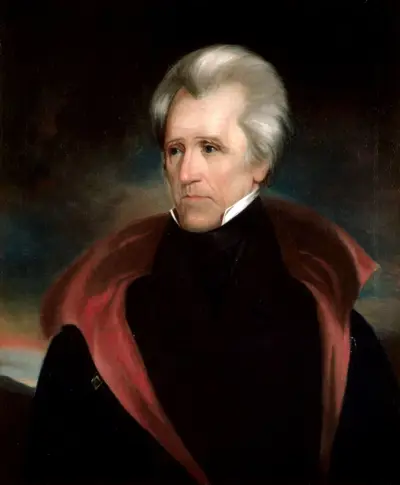
Andrew Jackson was an American lawyer, soldier, and statesman who served as the seventh president of the United States from 1829 to 1837. Before being elected to the presidency, Jackson gained fame as a general in the United States Army and served in both houses of the U.S. Congress. An expansionist president, Jackson sought to advance the rights of the "common man" against a "corrupt aristocracy" and to preserve the Union.
