Warren G. Harding Quotes
It has been proved again and again that we cannot, while throwing our markets open to the world, maintain American standards of living and opportunity, and hold our industrial eminence in such unequal competition. There is a luring fallacy in the theory of banished barriers of trade, but preserved American standards require our higher production costs to be reflected in our tariffs on imports.
At the time, Republicans were the protectionists and Democrats were free traders—the reverse of the party roles at the end of the 20th century and the beginning of the 21st.
Warren G. Harding, 1865-1923, 29th President of the United States (Republican, OH), Inaugural Address, March 4, 1921
Sourced by: Eigen's Political and Historical Quotations


It is interesting that the first national women’s political party was a strong advocate of protectionism and saw free trade as an unfair hurdle for mostly male workers. At the time, the Republicans were staunch protectionists, and the Democrats, the free traders thus illustrating that the major parties continuously flip-flop on major issues.


Democratic politicians of that era mostly opposed free trade because the experience ever since NAFTA showed that many manufacturing jobs were lost in the United States although many new jobs were created but few of these were good paying jobs that Americans with limited educations could perform as they were able to with manufacturing jobs. And during that period, the requirements for fair trade and foreign workers rights have been very poorly enforced. The Democrats split between those who thought that new trade treaties could be negotiated and enforced, correcting the problems of the past, and those who did not believe that such proper free trade was very likely.


Referring to NAFTA, CAFTA and other international trade agreements


The U. S. was very protectionist in its early history. Grant overestimated the time that it would take for us to change by about 100 years.


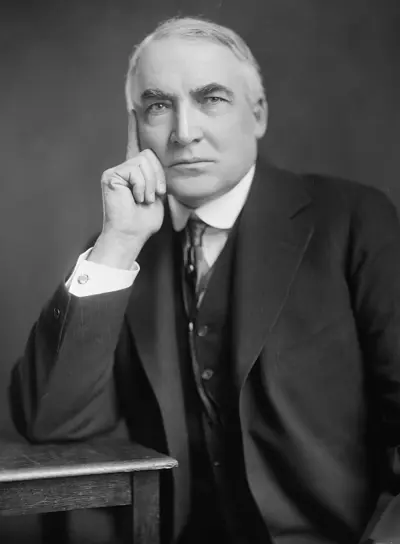
Warren Gamaliel Harding was the 29th president of the United States, serving from 1921 until his death in 1923. A member of the Republican Party, he was one of the most popular U.S. presidents to that point. After his death, a number of scandals, including Teapot Dome, came to light, as did his extramarital affair with Nan Britton; those eroded his popular regard.
