Boris Godunov Quotes
We have, immediately after our enthronement, caused a new privilege to be given to your merchants to trade directly into all our kingdoms and dominions without paying any manner of toll or custom [tax].
The right of English merchants had been attained earlier when Ivan IV, the Terrible, was Czar. However the Czar35266s were so autocratic that one might or might not live up to agreements made by their predecessors. So Queen Elisabeth's diplomats had to repeatedly negotiate free trade agreements with Russian Czars.
Boris Godunov, ~1551—1605, Regent and Czar of Russia, Letter to England's Queen Elisabeth I, March 23, 1598
Sourced by: Eigen's Political and Historical Quotations

Ivan the Terrible

This quotation illustrates two important points. First, that foreign and domestic trade and merchants were very much appreciated at the time and an important component of society that there were special protections for traders and merchants. Second, was the national preemption of jurisdiction and control over business and commerce that would enter and leave the city. On most matters the local authorities would handle things, but intercity and international commerce was historically continuously impaired by individual nobles and other authorities making rules affecting merchants who might come to their town or city. The Crown preempted this authority in the 13th century and the “Commerce Clause” of our Constitution was not an unusual concept and had an extensive legal and economic history.

This was typical of a free trade agreement of the time. It also provided that Englishmen residing for trade in the Ottoman Empire be free of Ottoman poll and head taxes. The Ottomans had such arrangements with France and Venice—then an independent city. In addition to the trade advantages, the Ottomans were militarily concerned with Spain and the English-Spanish hostility was supported and welcomed by the Ottomans. See Murad’s 1590 letter to Queen Elizabeth.

He was one of the strongest English advocates of colonization of the New World

With all the rights of Englishmen from Magna Carta on down, the right of emigration did not appear until modern times.


There has always been pressure from different interests to exempt certain products from duty and place higher duties on others. Calhoun urged a policy that would be based on general economic prinicples and conditions and not on pressure from special vested interests. He was a senator at the time.
The Russian autocrat found it hard to believe that peasants and merchants could have any rights at all as they did in England. He faulted the female ruler, the great Queen Elizabeth I. By modern standards Elizabeth had awesome power and the English People very little, but Elizabeth was relatively restrained in her use of power and paid attention to the effect of affairs of state had on the people." Ivan the Terrible
Sealed under duress and later repudiated by the King with Papal assistance. This was one of the most important freedoms that established free trade as a principle—one of the reasons that England became so prosperous." John Lackland


The U. S. was very protectionist in its early history. Grant overestimated the time that it would take for us to change by about 100 years.


Harris opened up trade with Japan for the United States. The problem at the time had nothing to do with the potential economic effects of trade on domestic industry or balance of payments, but for the Japanese was strictly a cultural problem. They were in great fear of what today some call “cultural imperialism”--the adoption of a foreign culture. The Japanese had been so fearful of cultural influence of foreigners that when some Japanese fishermen’s boat had been sunk and they had been rescued by foreign seamen and returned to Japan, they were executed as they had been “contaminated” and could “contaminate” the rest of the population.

The revenue laws he referred to were tariff duties on foreign imports that were instituted to protect fledgling American domestic manufacturers. The problem was that at the same time as it helped the manufacturers, it caused everyone to pay higher prices. Worse, it destroyed the business of the importers, and the retail merchants who specialized in fine European imports. It also hurt the shipping business so owners and sailors alike were damaged. Maritime and importing states were outraged and if enough people did not support the tariffs, smuggling would increase. Polarization and controversy were rife at the time. Unlike today conservatives tended to be for the protectionist tariffs and the left wing tended to be for free trade. Jackson insisted that the law be obeyed, but he wanted Congress to pay attention to the damaged forces.


The same problem has always existed with full scale trade wars always a possibility.


Republicans at that time were adamant protectionists and were violently opposed to free trade. They made a total flip flop on free trade after the Second Word War when the industrial capacity of all of the major industrial nations except America was completely emaciated. America still had production and there was huge money to be made from being the only nation that could deliver goods to the world. Meanwhile Germany, France, England, and Italy, our largest competitors could hardly manufacture for their own needs and could not compete in the American market. So the American corporations then wanted to become free traders.
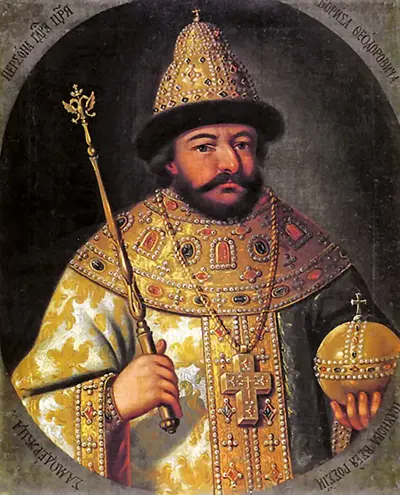
Boris Fyodorovich Godunov ruled the Tsardom of Russia as de facto regent from c. 1585 to 1598 and then as the first non-Rurikid tsar from 1598 to 1605. After the end of his reign, Russia descended into the Time of Troubles.
