Henry IV of France Quotes
We hereby prohibit the Passage of all Manner of People… except only the Lords and other great men of the Realm, and true and notable merchants and the Kings soldiers … out of the said Realm without the King’s special license.
With all the rights of Englishmen from Magna Carta on down, the right of emigration did not appear until modern times.
Henry IV, 1366-1413, King of England, Act of 1381
Sourced by: Eigen's Political and Historical Quotations

One thing that made this a very unusual declaration was that in 1381 an act (see {616281}) was passed in England which prohibited anyone from leaving the country without the express permission of the monarch. In this case she gave Gilbert the right to take any Englishman who wanted to go. With all the rights of Englishmen from Magna Carta on down, the right of emigration did not appear until modern times.

This quotation illustrates two important points. First, that foreign and domestic trade and merchants were very much appreciated at the time and an important component of society that there were special protections for traders and merchants. Second, was the national preemption of jurisdiction and control over business and commerce that would enter and leave the city. On most matters the local authorities would handle things, but intercity and international commerce was historically continuously impaired by individual nobles and other authorities making rules affecting merchants who might come to their town or city. The Crown preempted this authority in the 13th century and the “Commerce Clause” of our Constitution was not an unusual concept and had an extensive legal and economic history.

The right of English merchants had been attained earlier when Ivan IV, the Terrible, was Czar. However the Czar35266s were so autocratic that one might or might not live up to agreements made by their predecessors. So Queen Elisabeth's diplomats had to repeatedly negotiate free trade agreements with Russian Czars.

Sealed under duress and later repudiated by the King with Papal assistance. This was one of the most important freedoms that established free trade as a principle—one of the reasons that England became so prosperous." John Lackland

This is the clause that many Palestinians point to as supporting their position that even thought most Arab refugees left Israel voluntarily, they had a right of return.

“Service” referred to what was then the 7 year time of apprenticeship that a typical American apprentice was required to work for a master tradesman before he was given colonial citizenship and allowed to trade for himself. Under the bill that was passed anyone could come to the British American colonies (except Jews) by taking an oath of allegiance and paying a small fee. Holland and some thought that it discriminated against those apprentices who had come before and apprenticed themselves thus “playing by the rules.” Ever since, immigration and citizenship debates have faced the tension between the need for labor in America and the fairness to the people who had followed the earlier existing rules restricting immigration.


1st Viscount Bolingbroke. See {627799} for the origin of the bias against merchants and money men. It also represents a rigidity of class structure that characterized England until very recently. The landed gentry were the first class citizens. Usually titles went with the land. In America, someone who would be successful as a merchant or a banker could achieve the highest of social status and political influence. This was not true in England where a merchant that was far more wealthy than a landed lord was not accepted by the aristocracy.

Sealed under duress and later repudiated by the King with Papal assistance


As absurd as it seems to us today, traders were not very high in the English social order. Business itself was not well respected. English governing councils were devoid of anyone who had trade of business experience. Holland, in contrast, perhaps went to the other extreme in that traders and business men dominated to political structure. The Dutch were much more successful in foreign trade relatively than the English.
After King Henry VIII left the Roman Catholic Church and adopted Protestantism, English Protestants were in great danger in Catholic Europe. Queen Elisabeth I, with its traditional trading partners in Catholic Europe too dangerous for English merchants, negotiated successfully with the Ottoman Empire Sultan Murad III, for mutual trading. An Englishman was much safer in the Islamic world than he was in Europe. Not only did England open up new markets but its merchants developed the skills of trading with the East which was one of the main factors allowing them to be so successful in establishing the British Empire which was always fundamentally a trading empire. Elizabeth’s successful foreign policy not only allowed prosperity despite the schism with Europe, but established the foundation for England to become the greatest world power.


Cheating consumers with fraudulent scales was common. Fox started his own consumer movement.
- Born:
- Nationality: French
- Profession: Royalty, King of France, Monarch
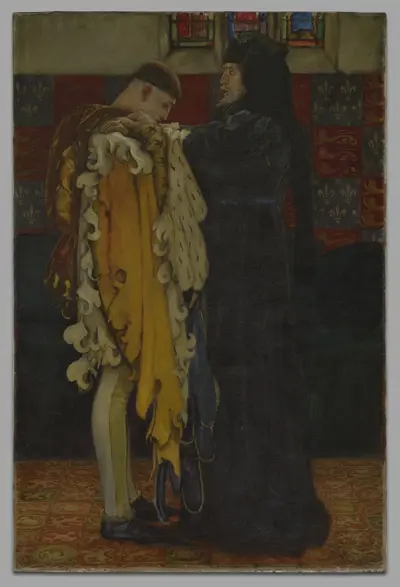
Henry IV (French: Henri IV; 13 December 1553 – 14 May 1610), also known by the epithets Good King Henry or Henry the Great, was King of Navarre (as Henry III) from 1572 and King of France from 1589 to 1610. He was the first monarch of France from the House of Bourbon, a cadet branch of the Capetian dynasty. He was assassinated in 1610 by François Ravaillac, a Catholic zealot, and was succeeded by his son Louis XIII.
