Henry St. John Quotes
The landed men are the true owners of our political vessel, the moneyed men are no more than passengers in it.
1st Viscount Bolingbroke. See {627799} for the origin of the bias against merchants and money men. It also represents a rigidity of class structure that characterized England until very recently. The landed gentry were the first class citizens. Usually titles went with the land. In America, someone who would be successful as a merchant or a banker could achieve the highest of social status and political influence. This was not true in England where a merchant that was far more wealthy than a landed lord was not accepted by the aristocracy.
Henry St. John, 1678-1751, British Secretary for War and Foreign Secretary (Tory), Some Reflections on the Present State of the Nation. 1753)
Sourced by: Eigen's Political and Historical Quotations

This was an old belief amongst the monarchs of Europe. The logic always involved comparisons with the landowners of the kingdom and the peasants or serfs compared with the merchants. The former two groups were tied to the land. The peasant could not afford to go anywhere else and if the landowner did, he lost his wealth. So both groups would support the king and fight off invaders. In contrast, the merchant to some degree had three things, each of which made him able to pick up and go to another land. They often had capital in the form of gold, silver or gemstones, that they could take with them to another country. Then they had inventory of whatever their trade was. This was more difficult to move than gold, but still much more movable than land. Last and most important, they had skills—they could read and write and knew arithmetic, skills which many rich nobles did not have. Even many of the kings were illiterate. Merchants could move to another land and use their skills there. So they were always suspect because they were not tied to the land as much as the others. Also. many merchants traveled abroad and had dealings with foreigners who were always considered potential enemies. So the merchants were all the more suspicious as they communicated with the “foreign enemy”. Immigrants were also suspect as they had family and friends in potentially enemy countries. If the immigrant was a merchant, he was doubly suspect. Jews were in many counties legally barred from owning land or practicing a profession, so many became merchants. Then they did not have the same degree of loyalty to the land and the rulers. This was one of the reasons for the anti-Semitism of the time.


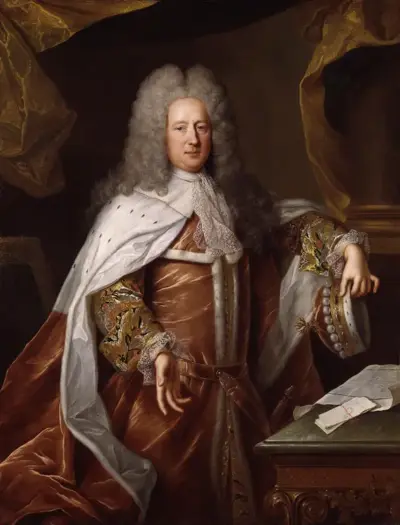
Henry St John, 1st Viscount Bolingbroke was an English politician, government official and political philosopher. He was a leader of the Tories, and supported the Church of England politically despite his antireligious views and opposition to theology. He supported the Jacobite rebellion of 1715 which sought to overthrow the new king George I. Escaping to France he became foreign minister for the Pretender. He was attainted for treason, but reversed course and was allowed to return to England in 1723. According to Ruth Mack, "Bolingbroke is best known for his party politics, including the ideological history he disseminated in The Craftsman (1726–1735) by adopting the formerly Whig theory of the Ancient Constitution and giving it new life as an anti-Walpole Tory principle."
