Adam Smith Quotes
A merchant, it has been said very properly, is not necessarily the citizen of any particular country.
This was an old belief amongst the monarchs of Europe. The logic always involved comparisons with the landowners of the kingdom and the peasants or serfs compared with the merchants. The former two groups were tied to the land. The peasant could not afford to go anywhere else and if the landowner did, he lost his wealth. So both groups would support the king and fight off invaders. In contrast, the merchant to some degree had three things, each of which made him able to pick up and go to another land. They often had capital in the form of gold, silver or gemstones, that they could take with them to another country. Then they had inventory of whatever their trade was. This was more difficult to move than gold, but still much more movable than land. Last and most important, they had skills—they could read and write and knew arithmetic, skills which many rich nobles did not have. Even many of the kings were illiterate. Merchants could move to another land and use their skills there. So they were always suspect because they were not tied to the land as much as the others. Also. many merchants traveled abroad and had dealings with foreigners who were always considered potential enemies. So the merchants were all the more suspicious as they communicated with the “foreign enemy”. Immigrants were also suspect as they had family and friends in potentially enemy countries. If the immigrant was a merchant, he was doubly suspect. Jews were in many counties legally barred from owning land or practicing a profession, so many became merchants. Then they did not have the same degree of loyalty to the land and the rulers. This was one of the reasons for the anti-Semitism of the time.
Adam Smith, 1723-1790, Scottish Political Economist, The Wealth of Nations, 1776
Sourced by: Eigen's Political and Historical Quotations

1st Viscount Bolingbroke. See {627799} for the origin of the bias against merchants and money men. It also represents a rigidity of class structure that characterized England until very recently. The landed gentry were the first class citizens. Usually titles went with the land. In America, someone who would be successful as a merchant or a banker could achieve the highest of social status and political influence. This was not true in England where a merchant that was far more wealthy than a landed lord was not accepted by the aristocracy.

Muir had spoken at the Convention of Scottish Friends of the People at Edinburgh in 1792. He had advocated election reform allowing all men to vote, not just property owners and was sentenced by Braxfield to the Australian penal colony at Botany Bay. Braxfield expressed the deep distrust the establishment felt even for merchants, traders and others with fungible assets.


Despite the fact that she had been born in Russia and had been deported from the United States, she was one of the first left wing radicals to realize that America was more liberal than Russia after the revolution.

“Amor patriae” is Latin for “love of country”. Jefferson had a strong prejudice against cities, merchants, factories and economic entities other than farms or plantations. Despite his brilliance and amazing predictive ability, Jefferson’s prejudice caused him to challenge Alexander Hamilton’s view of the economic future of America. Fortunately, Jefferson and his views did not prevail.

In a House debate in 1923 on the Nordic or Latin discovery of America, Congressman Summers of Washington asked Italian-American Congressman La Guardia to yield to ask whether or not Christopher Columbus had come from "your country."


Exxon Mobil is one of America’s largest corporations. It is headquartered in Texas, uses American Government funded research, functions under the protection of the U. S. abroad, benefits from the U. S. Navy keeping the oil sea lanes open and safe, and yet claims no obligation to the condition and future of the United States. It is one of the largest polluters in America and was responsible for the Exxon Valdez destruction of much of Alaska’s shores. And it benefits from special American tax breaks for oil companies, American pipelines and sells much of its products to the U. S. Government. It harasses environmental scientists who document their environmental impact. The company spends more money for lobbying American politicians and gives large donations to politicians and American political parties. Exxon Mobil violates the American Corrupt Practices Act and other American laws. No other large American corporation has taken such an unpatriotic position in modern times. Critics argue that if Foreign Governments are not allowed to donate money to influence American politics, why should this company which by its own admission does not function with American interests in mind.


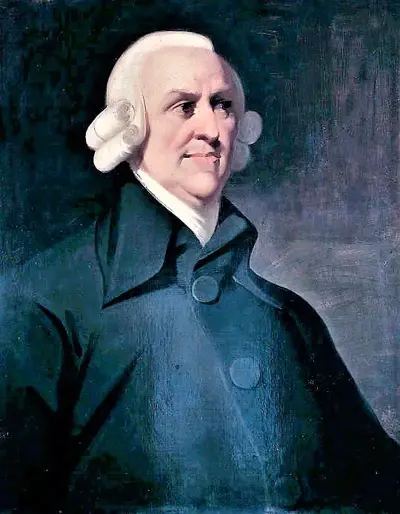
- Born: June 16, 1723
- Died: July 17, 1790
- Nationality: Scottish
- Profession: Economist
Adam Smith FRSA was a Scottish economist, philosopher as well as a moral philosopher, a pioneer of political economy, and a key figure during the Scottish Enlightenment, also known as ''The Father of Economics'' or ''The Father of Capitalism''. Smith wrote two classic works, The Theory of Moral Sentiments (1759) and An Inquiry into the Nature and Causes of the Wealth of Nations (1776). The latter, often abbreviated as The Wealth of Nations, is considered his magnum opus and the first modern work of economics. In his work, Adam Smith introduced his theory of absolute advantage.
