Adam Smith Quotes
Mercantile jealousy is excited, and both inflames, and is itself inflamed, by the violence of national animosity:..
Adam Smith, 1723-1790, Scottish Political Economist, The Wealth of Nations, 1776
Sourced by: Eigen's Political and Historical Quotations


The Concorde was a French supersonic passenger plane that required a passenger fare of twice the normal fare in order to pay for the increased costs. The plane served an elite niche market but never captured enough of a market to sustain the program. Complicating the situation further, the sonic boom that could be heard on the ground when the Concorde flew over, made American communities reluctant to allow the plane to overfly their area. The result was that the U. S. would only grant permission for Concorde flights to land / take off from New York / Washington and Los Angeles / San Francisco where the approach would be over the ocean. Chicago, Dallas, Denver, Kansas City and other natural American markets were closed to the Concorde. As was the lucrative New York to Los Angeles market where the Concorde could have made the trip in under 3 hours. The French have attributed the Concorde failure to American policy which they claim was protection for Boeing and the domestic aircraft industry. When the Airbus program began in Europe, the United States objected to a variety of “illegal” subsidies that France, Germany and other EU governments were giving to Airbus contrary to the international trade rules. The Europeans countered by observing that the U. S. in effect subsidized Boeing via large military purchases without which the cost of the Boeing civilian plans would have been much greater. There has been a low level trade war over aircraft manufacturing from the beginning. See {634597} for some of the other reasons.


This historical quotation shows us that the nation under Republican control at the end of the 19th century was highly protectionist. In addition. It shows us how a party can flip flop on its most cherished principles. A century later, free trade was the cornerstone of Republican philosophy and opponents who held to the Republican 19th century principles were accused of being detriments to the American growth and economic system.


This was an old belief amongst the monarchs of Europe. The logic always involved comparisons with the landowners of the kingdom and the peasants or serfs compared with the merchants. The former two groups were tied to the land. The peasant could not afford to go anywhere else and if the landowner did, he lost his wealth. So both groups would support the king and fight off invaders. In contrast, the merchant to some degree had three things, each of which made him able to pick up and go to another land. They often had capital in the form of gold, silver or gemstones, that they could take with them to another country. Then they had inventory of whatever their trade was. This was more difficult to move than gold, but still much more movable than land. Last and most important, they had skills—they could read and write and knew arithmetic, skills which many rich nobles did not have. Even many of the kings were illiterate. Merchants could move to another land and use their skills there. So they were always suspect because they were not tied to the land as much as the others. Also. many merchants traveled abroad and had dealings with foreigners who were always considered potential enemies. So the merchants were all the more suspicious as they communicated with the “foreign enemy”. Immigrants were also suspect as they had family and friends in potentially enemy countries. If the immigrant was a merchant, he was doubly suspect. Jews were in many counties legally barred from owning land or practicing a profession, so many became merchants. Then they did not have the same degree of loyalty to the land and the rulers. This was one of the reasons for the anti-Semitism of the time.
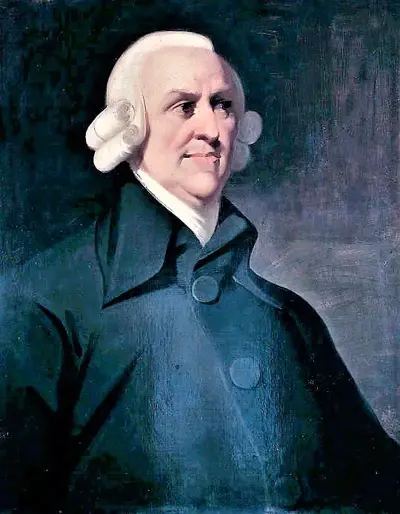
Adam Smith FRSA was a Scottish economist, philosopher as well as a moral philosopher, a pioneer of political economy, and a key figure during the Scottish Enlightenment, also known as ''The Father of Economics'' or ''The Father of Capitalism''. Smith wrote two classic works, The Theory of Moral Sentiments (1759) and An Inquiry into the Nature and Causes of the Wealth of Nations (1776). The latter, often abbreviated as The Wealth of Nations, is considered his magnum opus and the first modern work of economics. In his work, Adam Smith introduced his theory of absolute advantage.
