John Quincy Adams Quotes
Treaties of commerce have been found by experience to be among the most effective instruments for promoting peace and harmony between nations whose interests, exclusively considered on either side, are brought into frequent collisions by competition. In framing such treaties it is the duty of each party not simply to urge with unyielding pertinacity that which suits its own interest, but to concede liberally to that which is adapted to the interest of the other. To accomplish this, little more is generally required than a simple observance of the rule of reciprocity, and were it possible for the states- men of 1 nation by stratagem and management to obtain from the weakness or ignorance of another an over-reaching treaty, such a compact would prove an incentive to war rather than a bond of peace.
John Quincy Adams1767-1848, 6th President of the United States (Independent, MA), State of the Union Address, Washington, DC, December 4, 1827
Sourced by: Eigen's Political and Historical Quotations

The Republican controlled Senate had turned down the ratification of the League of Nations presented by Democratic President Wilson, and looked like they would turn down any international treaty even if presented by a Republican President. This statement allowed the treaty ratification by only a few votes. However, after that the Senate turned down our participation in the Permanent Court of Arbitration at the Hague. See {640099}.


In the history of diplomacy and peace treaty negotiations, the various national representative would meet in secret, negotiate treaties and add secret clauses. Then the treaty was finally made public for approbal or ratification in the different countries no one would be told of the secret clauses. Each side would have a written secret copy of these clauses, but the publics of the country would never know. For example, the agreements about various WWII issues that were secret have not yet been made public in the United States or England. Wilson wanted to put an end to that diplomatic ploy and wanted all the peace treaty clauses to be public with nothing secret. He also wanted the deliberations to made in public woth press access. He had little support for the idea in most European nations.


The basic treaty sold some of Ethiopia’s colonial territory (Eritrea and Tigray) to Italy in exchange for arms. Italy had tried to conquer the area but lost 500 men in the Battle of Dogali. However, after this peace treaty, Italy maintained that Article 17 of the treaty gave them the right to declare Ethiopia an Italian Protectorate which they did. However, there were two different versions of the treaty that the Italians had drawn up—one in Italian, the other in Aramaic. Britain, Belgium and Germany supported Italy; France, Turkey and Russia supported Ethiopia. Menelik then, to make matters clear, repudiated the treaty in 1893. Italy send an invasion force that was soundly thrashed by the Ethiopians setting the stage for the Italian attack on Ethiopia in World War II years later. Parties to International treaties thereafter have paid close attention to the different language versions.


In a NATO military operation, there is one NATO Supreme Commander but each nation has a minister for NATO. All significant decisions must be consented to be this group. But each of those is a representative of a different political government. Clark was masterful at this diplomatic side of the war just as Dwight Eisenhower was in WWII. Eisenhower had bigger egos to content with—Churchill, Roosevelt, Stalin, De Gaulle, but Clark had many more counties who could each veto actions.


In 2002, when Prodi made this offer on behalf of the EU, teh Russian economy was close to complete collapse, there was incufficient medicne available, the military was in disarray, and the EU thought that it could take advantage of Russia's weakness to offer them some economic benefits without the complications of even giving Russia the same degree of power and influence as Poland--Russia's former satellite. Russia's pride and dignity were offended. They rejected the arrangement and when Putin became President he began a very aggressive policy of pushback against NATO and EU expansion Eastward. Many political scientists feel that it would have been better had the EU not offered anything at all rather than the highly one-sided proposal that they made.

See {640831} for more on this subject.

The President was spending all day and most of the evening with Japanese and Russian negotiators. He was trying to mediate an end to the Russo-Japanese War. Despite all the difficulties, Roosevelt found a new skill of personal international diplomacy. The war seemed intractable, but Roosevelt was able to get a peace treaty signed for which he was awarded the Nobel Peace Prize. It is doubtful that any modern president could spend so much concentrated time on an issue that was really not in the national interest of the United States. However, Roosevelt’s time and effort investment paid off in that by settling that dispute and getting nothing out of it for America or American business, the United States was in world opinion, elevated to a new status of fair, impartial and non-selfish international activity—a model that despite some lapses in later years, the United States has been unique.

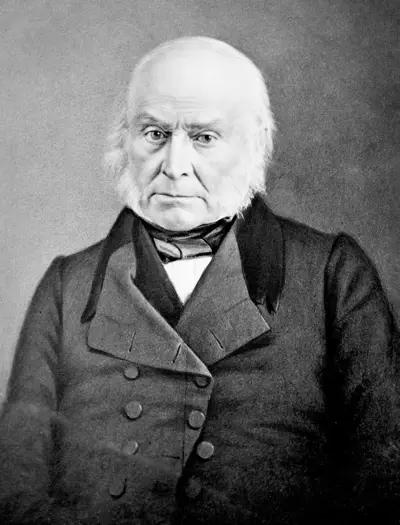
John Quincy Adams was an American statesman, diplomat, lawyer, and diarist who served as the sixth president of the United States, from 1825 to 1829. He previously served as the eighth United States Secretary of State from 1817 to 1825. During his long diplomatic and political career, Adams also served as an ambassador, and as a member of the United States Senate and House of Representatives representing Massachusetts. He was the eldest son of John Adams, who served as the second U.S. president from 1797 to 1801, and First Lady Abigail Adams. Initially a Federalist like his father, he won election to the presidency as a member of the Democratic-Republican Party, and in the mid-1830s became affiliated with the Whig Party.
