Jimmy Carter Quotes
If any agreement between two nations is to last, it must serve the best interests of both nations.
Jimmy Carter, 39th President of the United States (Democrat, GA), Speech, September 7, 1977
Sourced by: Eigen's Political and Historical Quotations


Inscribed in the John Adams Building of the Library of Congress. On this subject Jefferson was in agreement with George Washington {37176} and his political opponent, John Adams {592705}.

This was part of the negotiation of a peace treaty with the Barbary States. The Barbary Pirates had an incredible extortion racket going in the Mediterranean. If nations would pay them an annual sum each year, they would not attack and seize merchant ships of that country and sell the ships and goods while holding the sailors for ransom. Military action on land and sea by American marines and naval ships had caused much damage and intimidated the Barbary States somewhat. See {640870}


He was shot as a traitor when de Gaulle returned. See {587231} and {587230}.

There is one condition for us to have healthy relations with the United States. It's called respect.
This is an old and critical concept in American relations with the rest of the hemisphere which Simon Bolivar used to refer to as “respecto.” Americans tend to be relatively unconcerned by what other nations think of America, and since the US has been so successful, it has developed a strong national ego. Other nations, not so successful in modern times, tend to place a great deal of importance on the notion of respect. It is a major factor in most of the world.

Referring to the Peace between Japan and Russia which he had brokered and for which he had won the Nobel Peace Prize.


The Republican controlled Senate had turned down the ratification of the League of Nations presented by Democratic President Wilson, and looked like they would turn down any international treaty even if presented by a Republican President. This statement allowed the treaty ratification by only a few votes. However, after that the Senate turned down our participation in the Permanent Court of Arbitration at the Hague. See {640099}.
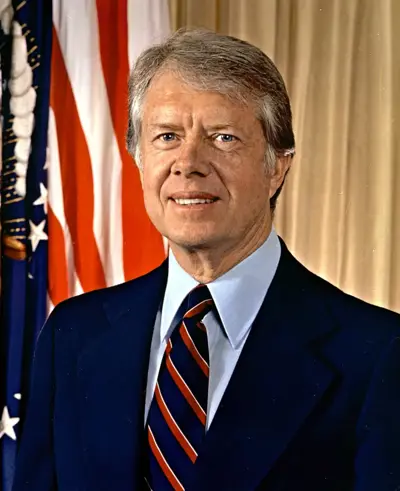
James Earl Carter Jr. is an American politician, businessman, and philanthropist who served as the 39th president of the United States from 1977 to 1981. A member of the Democratic Party, he previously served as a Georgia State Senator from 1963 to 1967 and as the 76th governor of Georgia from 1971 to 1975. Since leaving the presidency, Carter has remained engaged in political and social projects as a private citizen. In 2002, he was awarded the Nobel Peace Prize for his work in co-founding the Carter Center.
