Theodore Roosevelt Quotes
It was good for the Japanese. It was good for the Russians, and it was good for me.
Referring to the Peace between Japan and Russia which he had brokered and for which he had won the Nobel Peace Prize.
Theodore Roosevelt, 1858-1919, 26th President of the United States (Republican, NY), Quoted on PBS, Theodore Roosevelt, October 17, 1999
Sourced by: Eigen's Political and Historical Quotations

The Conclusion of the Russo-Japanese War. The treaty was negotiated and signed in Portsmouth New Hampshire. President Theodore Roosevelt was awarded the Nobel Peace Prize for his mediating efforts. The language was typical of a peace treaty where just before its signature the two nations and their emperors were vilifying and dehumanizing the other.


In his younger days Jinnah was considered one of the greatest of the Indian Politicians in the Congress Party and all of India. Even though he was a Muslim, his leadership and political philosophy was appreciated by educated and politically active Indians of all faiths and casts. He was also so considered by the English Viceroy and his staff and noted by the politicians in England as a man who could bring Indians together without regard for religious or socio-economic status. He underwent a number of personal tragedies and changed radically until he was not only a sectarian Muslim leader but threatened and facilitated Islamic terrorism against all the other religions. Jinnah's flip flop on this point led to one of the great massacres and tragedies in human history" The Nightingale of India


The Russians were breaking diplomatic relations with Israel.


Henry of Navarre. The Great Council was the first proposed International governing body—a precursor to the EEC, the UN and the League of Nations. Henry's plan included an international army and navy to enforce the decisions. There were 15 nations proposed in the Great Design. Each one had a veto presaging the United Nations Security Council.


The Republican controlled Senate had turned down the ratification of the League of Nations presented by Democratic President Wilson, and looked like they would turn down any international treaty even if presented by a Republican President. This statement allowed the treaty ratification by only a few votes. However, after that the Senate turned down our participation in the Permanent Court of Arbitration at the Hague. See {640099}.

The President was spending all day and most of the evening with Japanese and Russian negotiators. He was trying to mediate an end to the Russo-Japanese War. Despite all the difficulties, Roosevelt found a new skill of personal international diplomacy. The war seemed intractable, but Roosevelt was able to get a peace treaty signed for which he was awarded the Nobel Peace Prize. It is doubtful that any modern president could spend so much concentrated time on an issue that was really not in the national interest of the United States. However, Roosevelt’s time and effort investment paid off in that by settling that dispute and getting nothing out of it for America or American business, the United States was in world opinion, elevated to a new status of fair, impartial and non-selfish international activity—a model that despite some lapses in later years, the United States has been unique.


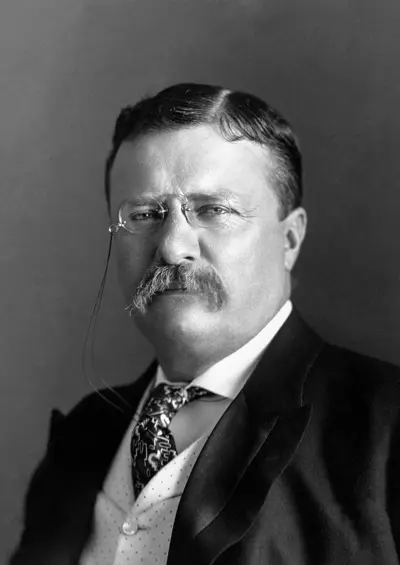
Theodore Roosevelt Jr., often referred to as Teddy or his initials T. R., was an American statesman, conservationist, naturalist, historian, and writer, who served as the 26th president of the United States from 1901 to 1909. He previously served as 33rd governor of New York from 1899 to 1900 and the 25th vice president of the United States from March to September 1901. Roosevelt emerged as a leader of the Republican Party and became a driving force for anti-trust and Progressive policies.
